Dr. Abhoy Kumar Sinha
Mahatma Gandhi Institute of Medical Sciences
Dr. Abhoy Kumar Sinha
The Paddy-Field Surgeon of Santhal Pargana
On the first of August, 1974, a humid morning draped in the quietude of the Gandhi Ashram, I stood among seventy-odd nervous young men and women assembled in Sevagram to begin a journey that none of us would ever forget. I was a young man with borrowed clothes, an empty wallet, and eyes gleaming with a fierce, quiet dream. At that time, I was simply Abhoy Kumar. It would not be until December 1982, after I had completed my postgraduation, that I formally adopted ‘Sinha’ as my surname. To my old acquaintances from the wards and the hostels of Sevagram, I remain Abhoy—the boy from Bihar who arrived with nothing but a tin trunk and left with the hands of a surgeon.
My story began in a village so small that maps barely noticed it: Dighi Simanpur in the Santhal Pargana of Bihar (now Jharkhand). It was a land of red earth and tribal Santhal heritage, where families like mine were known as ‘Dikus’—outsiders living in a rugged, beautiful landscape. Our village was geographically unique; the line splitting Bihar and Jharkhand passed directly through it, dividing farms and loyalties along state boundaries. Born on 27 January 1955—a date shared with my cousin in the school records because the headmaster simply copied the same day for both of us—I was the youngest son of Bishnu Prasad Rama and Mukteshwari Devi. My father was the village Mukhia and an honorary postmaster, operating the post office from a small room in our home. Though he had no formal schooling, he held deep convictions about the power of learning. My mother, like most women of her generation, was illiterate but possessed a resolve that could move mountains.
The Teacher Who Built My Mind
Schooling in Dighi Simanpur was an exercise in resilience. There was no electricity, no paved roads, and certainly no healthcare. I attended Azad Hind Middle School and Dighishwarnath Higher Secondary School, both built on land donated by my family. But the true architect of my academic success was my cousin’s teacher, Mr. Ramcharan Mahto. He was a history teacher with a polymathic command over every subject imaginable. He stayed in our home, and under his rigorous, disciplined guidance, I managed to stand on the merit list for the Bihar Higher Secondary Board.
That achievement earned me a National Talent Scholarship—a financial lifeline that would follow me all the way to Sevagram. I remember a meticulous man at MGIMS named Mr. Gawli who ensured that my scholarship paperwork was always processed on time; without that money, I simply wouldn’t have survived. My family was fractured by internal conflicts, and my father’s income from our small fields was meager. However, my elder brother, a metallurgical engineer who later earned a PhD in the US, had promised to fund my education. He kept that promise, even when the transition to a new education system in Bihar threatened to derail my path.
Just as I completed Class XII, Bihar shifted to a new education system (11+2+2), and good colleges suddenly became inaccessible. I received a letter from Banaras Hindu University (BHU), which was still following the old system, offering admission to BSc. I moved to Banaras, fell in love with the city, and stayed in the Broacha Hostel. English became the medium of instruction for the first time. I struggled, armed with a dictionary and memories of Mr. Mahto’s grammar drills. Banaras was intoxicating—not just with the scent of bhang and temples, but with its academic air and cultural heritage. A year passed. I felt ready to try medicine.
The Choice at R.K. Puram and Rank Number One
In 1974, the medical entrance exams for AIIMS, BHU, and MGIMS had separated. I was in Delhi for a coaching program, living in a small room in Patel Nagar. One afternoon, I received a telegram forwarded by my father: an interview call from Sevagram. I had never heard of the place. I found it in the prospectus: near Nagpur. I mapped my route—Mughal Sarai to Itarsi, then Nagpur, and finally Sevagram. With just a few hundred rupees, I withdrew what little money I had, bought an unreserved ticket to Wardha, and packed a tin trunk. I traveled alone, sitting on my trunk in crowded train compartments, guarding my certificates and money tucked in a pouch beneath my vest.
When I arrived at the Principal’s office in Sevagram, I was a solitary figure among candidates accompanied by protective parents and city-bred confidence. A list was posted on the wall. My heart raced as I read the name at the very top: Abhoy Kumar, Rank Number One. I was the first to be called into the interview hall. Five or six people sat across the table. They smiled, offered greetings, and asked only one question: how is paddy cultivated? Having grown up in the paddy fields of Santhal Pargana, I knew every step from ploughing to harvesting. I answered confidently. They nodded and said, “That’s all.”
Bricks, Khadi, and the Kindness of Strangers
While my heart was full of joy, my pockets were empty. The clerk at the office read out the list of dues—admission fee, deposit, hostel rent, six months’ tuition. I counted the coins in my pocket; they would not even pay for a bus ride back home. On top of that, I was expected to dress like a medical student—two pairs of khadi shirts and trousers. I went to the Khadi Bhandar, explained my plight, and the man in charge looked at me with pity. He pulled out a sheet of paper and wrote a note. “Here, keep this,” he said, handing it over. “Come back after Diwali vacation, bring money from home, and clear the bill.”
Back at the college office, I tried my luck again. The clerk twirled his pen, looked at my anxious face, and said, “Pay after three months. Until then, attend classes.” I could have fallen at his feet. And so, for the first three months, I ate breakfast, lunch, and dinner in the hostel without paying a paisa to the mess. Where else, I thought, could one find such kind men who understood what poverty meant? The first day of class was surreal. Dressed in fresh khadi, carrying my trunk, I stepped into the Ashram with cautious hope. Sevagram was austere, idealistic, and unlike any place I had known. But it welcomed me, as it did many others like me—sons and daughters of farmers, clerks, and schoolteachers.
The Sting of Shame at Warud Village
In our first year, we were assigned to Warud village, barely a kilometre from Sevagram. The rule was simple: stay there for fifteen days, live with the villagers, and learn what their life meant. So one hot afternoon, with a battered tin trunk and a rolled-up bedding on my shoulder, I set out with my classmates. The houses in Warud leaned against each other like tired old men, their mud walls flaking, their thatched roofs shedding straw. My roommate B.B. Gupta soon struck up a deep friendship with Mr. Namdevrao Chaudhary. The two would sit for hours under a neem tree, talking of crops, monsoon, and cattle as if they had known each other for years.
At the end of the camp, a valedictory function was held in the school courtyard. Gupta stood up and launched into a glowing speech about how the camp had opened our eyes. Then my turn came. I thought it was a debate, and that I was expected to take the opposite side. Without a second thought, I stood up and spoke my heart. “These fifteen days were a waste of time,” I declared. “We were deprived of our classes. Instead of sharpening our minds, we were left to sit idly in the village!”
There was a stunned silence. Then a sharp voice cut across the crowd: “Stop!” It was Dr. Sushila Nayar. She had been sitting quietly in the audience. Her face had turned red. “Do you even know what you are saying? This camp is the very soul of Sevagram!” I froze. My words hung in the air like a torn kite. Walking back from Warud to Sevagram that evening, I felt the sting of shame. The neem trees looked taller than usual, and every dog that barked seemed to laugh at me. That incident pushed me into a period of depression; my performance fell, and I lost my top rank. It was a harsh, necessary lesson in humility.
From the Hostel Blocks to the Surgical Wards
I still remember the days in Boys’ Hostel Block A. Ragging in those days was mild, but the 1973 batch ran into serious trouble when a few seniors forced freshers to shave their heads. A scuffle broke out in India Coffee House, and management came down hard. Football was my passion. I played alongside Pradeep Gupta, Waqar Hassan, Dhananjay Pingua, Deepak Fuljhale, and Ravi Sood. We won matches against local colleges and once travelled to Nagpur to play on the Law College ground.
In academics, I eventually pulled through, standing third in the second MBBS after Hari Om and Ashok Birbal. In the final MBBS, I did well in most subjects but fumbled badly in Medicine. During my long case, despite repeated hints from Dr A.P. Jain, I went blank. Dr Mitra and Mrs Mitra were the examiners—both strict—and I scraped through. Surgery, however, was my true love. The internship was my training ground. I worked at Talegaon Talatule and Seldoh PHC. I took internship very seriously—whether it was delivering babies, treating snakebites, incising abscesses, dressing wounds, or starting IV lines.
I applied for an Orthopaedics seat for my postgraduation under Dr S.C. Ahuja, who liked my sincerity. But fate was unkind; my classmate Purshottam Lal, ahead of me by four marks, claimed the Ortho seat. Perhaps that Medicine long case had cost me dearly. I had to settle for Surgery. I wasn’t disappointed for long. As a boy, I had always admired the Civil Surgeon in my district—a figure of absolute authority—and Surgery promised me that same stature. I completed my MS, writing a thesis on the genitourinary manifestations of leprosy under Dr. Belokar.
Bricks Under the Bed: Practice in Bihar
After earning my MS and working at Nanavati Hospital in Mumbai, I returned to my small Bihar village to practice. There was no anesthetist in sight. I performed surgeries in my bedroom on a wooden table. A compounder, trained in the civil hospital, administered ether. “Keep the patient still,” I would instruct. If blood pressure dropped, I had no fancy equipment. I simply placed common bricks under the foot-end of the bed to tilt the patient and keep the blood flowing to the brain. I operated on hernias, hydroceles, even did major laparotomies. It was risky, but I was young, determined, and Sevagram had taught me that a doctor does not wait for perfect conditions; he creates them.
The Legacy of Pratibha and a Life in Nagpur
In 1983, I married Pratibha Mishrikotkar, from the 1978 MGIMS batch. We were married in a quiet ceremony in Nagpur, attended by several friends from Sevagram who filled the gap left by my family from Bihar who couldn’t afford the journey. Pratibha was my anchor. While she pursued her MD in Obstetrics and Gynaecology under Dr. Chhabra, I worked for Western Coalfields at Khaperkheda. Every weekend, I rode my motorcycle to Sevagram to see her.
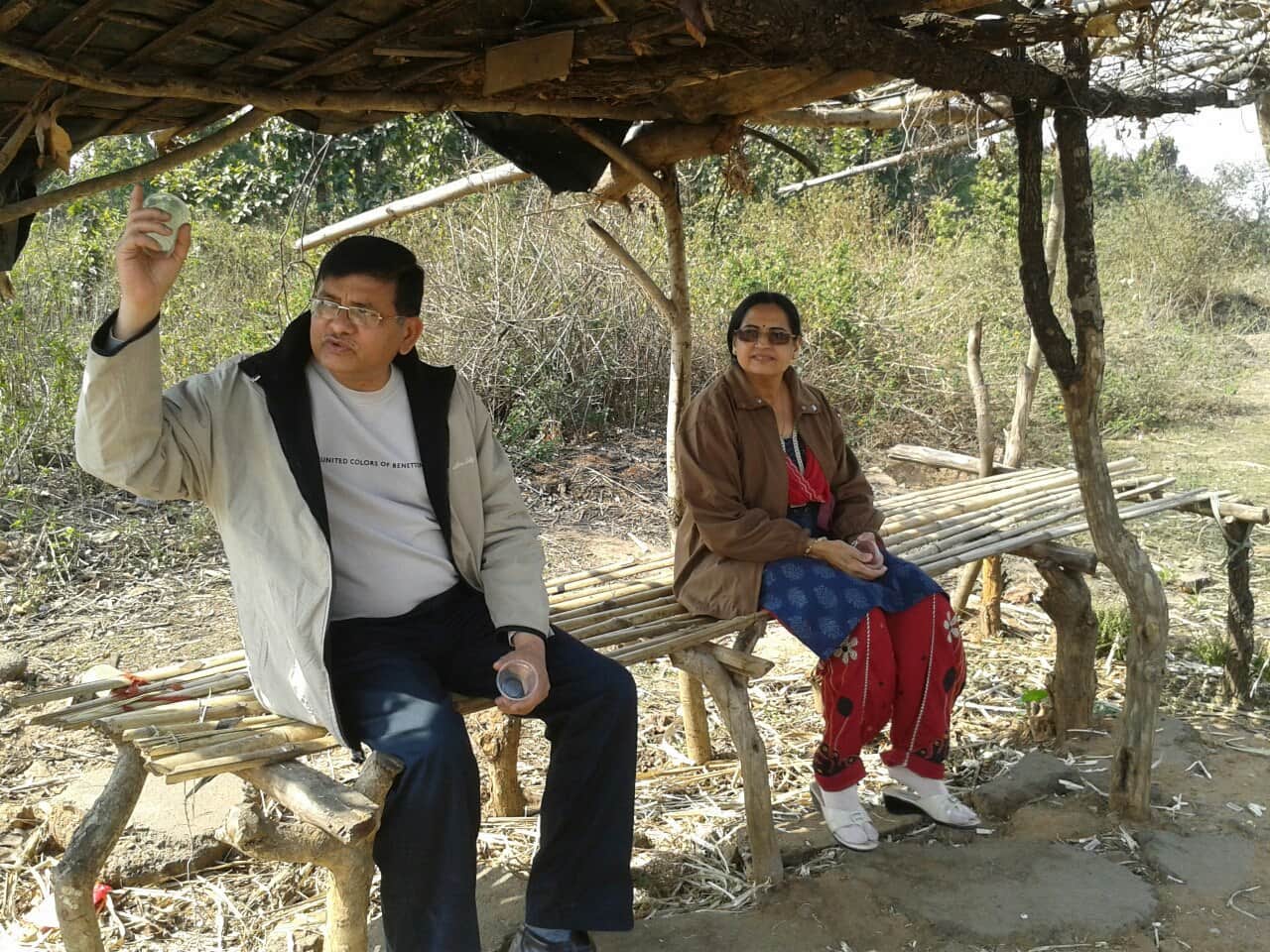
We eventually started our own practice in Nagpur, opening a 2,000 sq. ft. hospital in Sadar. I ran it well, balancing general, laparoscopic, and orthopedic surgery. In 2014, I became President of the Association of Surgeons of Nagpur—the only Sevagram alumnus to hold that post. But life brought me its hardest blow four years ago, when I lost Pratibha. She fought bronchial asthma with quiet courage throughout her life, but on 22 February 2022, she breathed her last.
Final Reflections
Since then, I have reduced my practice. My days are now gentler—spent with my granddaughter Anika. Looking back, two dreams remain unfulfilled. First, I wanted to be a full-fledged orthopaedic surgeon, not just a diploma holder. Second, I always wished to teach in a medical college. I tried—at Sevagram and later at Lata Mangeshkar Medical College—but never succeeded. Still, for a boy from a small village in Bihar, raised in poverty and educated in Hindi medium, destiny has been remarkably generous. Sevagram gave me my surgical hands, my lifelong friends, and the wife who walked beside me for forty years. For a boy who once sat on a tin trunk in an unreserved train compartment, the stars in the sky finally seem within reach.