Dr. Krishan Kumar Aggarwal
Mahatma Gandhi Institute of Medical Sciences
Dr. Krishan Kumar Aggerwal
The Prodigy of Tradition and Technology
The Encounter: A Pleural Tap and a Littmann Stethoscope
On May 5,1982, on a hot afternoon, I entered the MGIMS medicine ward in Sevagram. Unlike the noisy government medical college, Nagpur where I was trained, this hospital sounded remarkably calm and tranquil. I ran into an unkempt resident in the medical ward doing a pleural tap at the patient’s bedside. With a stethoscope hanging around his neck—he was to wear a Littmann stetho around his neck all his life —he looked at me, barely able to conceal the puzzled expression on his face. He asked who I was and why I was there. I felt so self-conscious under his intense gaze.
When he looked up, his gaze was intense, momentarily puzzled by my presence. I told him that I was appointed a senior resident in the department of medicine and I wanted to see Dr. OP Gupta, the department head. In an instant, the intensity vanished, replaced by a beaming, sheepish grin that radiated a rare, childlike innocence. He peeled off his gloves, shook my hand, and said, “I am Krishan, you can also call me Kissu.” That handshake began a chord of empathy that would vibrate through our lives for the next four decades.
The Enfant Terrible of the Wards
It took me less than a week to understand why Krishan was already a legend among his peers. To some, he was the enfant terrible—a restless spirit who refused to move at the slow pace of institutional bureaucracy. To others, he was a prodigy. His energy was breathtaking, almost supernatural. By 7:30 AM, while most were just beginning their day, Krishan had already completed his ward rounds, ordered a battery of tests, finalized discharge summaries, and was standing ready for the 8:00 AM case presentations.
Working in the old Kasturba Hospital in the early 1980s was an exercise in pure clinical instinct. We had no high-speed imaging, no advanced biochemistry, and no digital safety nets. Krishan flourished in this scarcity. He possessed an uncanny ability to unwrap the mysteries of complex maladies using nothing but his senses—poking, prodding, looking, and listening. He later remarked that MGIMS taught him how a skilled doctor could make amazingly accurate inferences by establishing a connection between tradition and technology. Even after he reached the summit of cardiology, he insisted that the “ritual” of the physical examination was the most sacred part of medicine.
A Giant with a Temper: The Price of Brilliance
Admittedly, Krishan was a difficult man to work with. He was a quintessential workaholic who strove for a perfection that few could match. He was a man who lived to challenge the status quo, often sailing against the tide and incurring the wrath of colleagues who preferred the safety of the shore. His residents often struggled to keep pace with his ideas, which sometimes bordered on the idiosyncratic.
Yet, even his harshest critics could not deny the impact he had on the world. He was a giant in the making long before the awards and the accolades began to pour in. His tempers were the byproduct of an insatiable curiosity and a frustration with anything that stood in the way of patient care. He was a king in his discipline, but a king who never lost the “thirst for knowledge” that he had first displayed under the neem trees of Sevagram.
The Legend of the COVID Educator
When the COVID-19 pandemic struck, Krishan found his final, and perhaps greatest, calling. He recognized early on that in a time of crisis, facts were the only antidote to fear. He mastered social media and YouTube, turning himself into a national educator. He became a calming voice in the storm, often citing the importance of scientific evidence to bring clarity to a terrified public.
He worked with the same incessant energy that I had witnessed in the medicine wards forty years prior. He spent hundreds of hours counseling, training, and dispelling myths. As destiny would have it, the education of his fellow citizens filled the last year of his life. He fought a protracted battle with the very virus he sought to demystify, eventually passing away on May 17, 2021, at the All India Institute of Medical Sciences.
A Legacy of Spiritual Equanimity
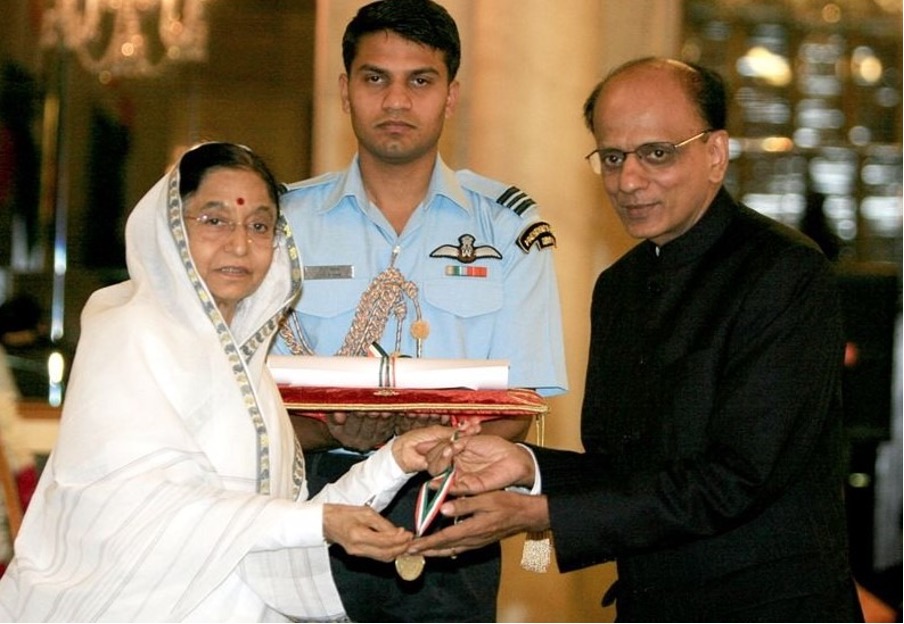
Krishan once famously said, “I do not want my death to be mourned; I would like you to celebrate it.” He viewed death as a natural feature of the overall landscape of one’s life, balancing medical science with a profound spiritual equanimity. He left behind an expansive legacy—articles, books, and scholarships—but his greatest contribution was the fire he ignited in the hearts of his colleagues and the hope he provided to his patients.
He succeeded in carving a very special place in the landscape of Sevagram and in the history of Indian medicine. He was a man of science, a man of facts, but above all, he was “Kissu”—a boy with a stethoscope and an innocent grin who believed that to serve a patient was to serve the truth. Rest in peace, Krishan. We shall miss your energy and your brilliance forever.
Shared Journeys & Connections
- Dr. Anita Mehta Kant (Roll No. 3)
His lifelong academic peer and desk-mate; he famously sketched the “doodles of wisdom” that guided her through her pathology exams.
- Dr. Madhu Kant (Roll No. 19)
A fellow resident of the 1975 batch who witnessed Krishan’s ascent from the medicine wards to national prominence.
- Dr. S.P. Kalantri (Professor of Medicine)
The author of this tribute and his senior resident in 1982, who shared a four-decade-long chord of clinical empathy.
- Dr. Aruna Mutha Jain (Batch of 1976)
A colleague from the 1982 Academy of Medical Sciences who shared the stage during his formative years of public speaking.