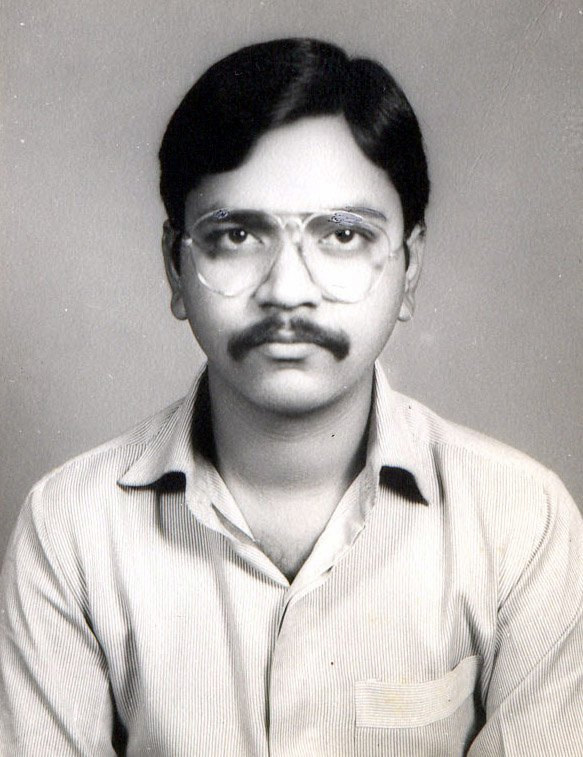
Dr. Vijay Gupta
Mahatma Gandhi Institute of Medical Sciences
Dr. Vijay Gupta
The Truth-Seeker of the '76 Batch
My Experiments with Admission
I was born on 15 January 1958 in Pattinarendrapur, a small village in Jaunpur district, eastern Uttar Pradesh. On that wintry morning, rain poured down in sheets, flooding the muddy paths. There were no roads, no electricity, and no doctor. A village midwife, a Dai, delivered me while my father, then working with the Indian Railways, was away. I was the youngest, with sisters ahead of me. My father would later rise to become Secretary of the Railway Recruitment Board, and my uncle, a homeopath, ran a small clinic in our village.
I began my schooling in a convent in Allahabad up to the fourth grade, before we moved to Bharwari, a modest railway town in the Kaushambi district in eastern Uttar Pradesh, where my father was posted. I joined the government primary school there, the only boy in a winter coat. Others, in thin shirts, sat cross-legged on the cold floor—shivering, yet learning.
We returned to Allahabad after my eighth standard. I joined Agrasen College for classes nine and ten, and then Government Intermediate College for eleventh and twelfth—a place known for producing toppers across Uttar Pradesh. It was there I resolved to become a doctor.
While pursuing B.Sc. Part I at Ewing Christian College, I also attended evening coaching classes. The red-brick college, perched on the banks of the Yamuna, echoed with lectures on science, philosophy, and Gandhiji. Their library held shelves of books on him, including My Experiments with Truth, which I had already read cover to cover in the eighth grade—gifted to me by my father.
In 1976, as students across India prepared for various PMTs, I applied to MGIMS Sevagram—a medical college that asked for not just Physics, Chemistry, and Biology, but also a paper on Gandhian Thought. The prospectus was expensive and had to be obtained via money order. I even tried selling it to classmates but found no takers. So, I decided to take the exam myself.
The MGIMS exam, with its two essay-type papers, was unlike any other. The Gandhian paper didn’t test facts—it asked what you believed. When I cleared it and found my name on the interview list, I was elated—though I had no idea where Wardha was.
My father and I boarded a train from Allahabad, changed at Itarsi, and arrived at Wardha. As a railway officer, he arranged for us to stay in the guest house. The interview panel included none other than Dr. Sushila Nayar—Badi Behenji.
I walked in with a mix of nerves and honesty, not knowing that my truth would be both my strength and my undoing.
She asked what I did during summer vacations, perhaps expecting me to say I volunteered in villages or taught children. But I simply told the truth: I spent my summers watching my uncle treat patients at his small homeopathy clinic. I didn’t know how to sugarcoat things. Gandhiji had taught me to never lie.
I could see that she was hoping for something nobler. But at that moment, I couldn’t bring myself to say what I didn’t believe. I remembered Gandhi’s Experiments with Truth, and decided I would follow his path—even if it cost me admission.
And it nearly did.
That evening, the results were announced. My name appeared—not in the main list, but on the waiting list for non-Maharashtra candidates. I was disheartened, but prepared to move on.
When the results were announced, I found my name—not in the main list—but on the waiting list for non-Maharashtra candidates. I was disheartened. Others on the waiting list included Nitin Gupte, Santosh Prabhu, Tarvinder Singh Oberoi, and Mridul Panditrao. As other medical colleges released their results, vacancies opened—and we got our chance.
A few days later, a telegram from the Principal of MGIMS arrived. It instructed me to report within two days, bringing a steel thali, katori, glass, spoon, and khadi clothes. I had only a cotton kurta-pajama; the rest I would find at Sevagram.
I packed my metal trunk and holdall—remnants of a pre-rucksack era—and boarded the Kashi Express to Itarsi, then the GT Express to Wardha East. I still remember the poha and hot milk during the layover.
My mother packed besan laddus and a kilogram of homemade ghee. It was my first long journey alone. My family’s hopes, pride, and quiet fears travelled with me.
By the time I reached Sevagram, the orientation camp had already begun. We loaded our luggage onto a cycle rickshaw and reached Gandhiji’s Ashram. Boys stayed in Rustam Bhavan, girls in Gauri Bhavan. There, we met L.R. Pandit ji—a gentle soul. He walked the dormitory at dawn, softly singing bhajans, waking us for morning prayers. He never scolded—his silence taught more than lectures.
Our first anatomy lecture took place seated cross-legged on the floor, with charts instead of cadavers. We learned not just medicine but how to clean latrines, spin the amber charkha, and work in the kitchen. At the end of our spinning, we were gifted a handkerchief—our first reward for physical labour.
But what lingers most in memory is the evening prayer. Sitting on gravel, facing the setting sun, listening to bhajans carried by the wind—it was grounding, spiritual, quietly profound.
We were 64 in the batch, including 20 girls—who, naturally, became the focus of attention for many seniors. I was the only student from Allahabad, but soon formed close friendships with Anup Saraiya and Anup Lohia.
Sevagram had its own vibrant student politics—Maharashtra, Punjab, and Jhansi panels jostled for influence. The Jhansi panel, vocal and fearless, often called the shots in student elections.
Sevagram taught me medicine, yes. But more than that, it taught me simplicity, service, and the courage to speak the truth—even when the truth isn’t what others want to hear.
And for that, I will always be grateful.
V. K. Gupta arrived in Sevagram in 1976, just as a young lecturer named Dr. Ulhas Jajoo had joined MGIMS.
Young, handsome, and impossible to ignore, Dr. Jajoo wore khadi, carried a permanent twinkle in his eye, and spoke of village healthcare not as an ideal but as something that had to be done. He taught medicine with energy and conviction, and students were drawn to him almost immediately.
Those from the 1973 to 1977 batches walked with him, cycled with him, and followed him down muddy village roads during the monsoon. They sat inside huts, listened to families, and saw for the first time how poverty, customs, beliefs, and social conditions shaped illness. Under Jajoo’s guidance, medicine became more than diagnosis and treatment. It became a way of understanding how people lived, why they delayed seeking care, and what kind of solutions might actually work in their world.
For V. K. Gupta, those years left a deep impression. His bond with the Jajoo family ran deep — not only with Ulhas, but also with his younger brother, Dr. Suhas Jajoo, a plastic surgeon from Government Medical College, with whom he spent many days during his MD years in Nagpur. Even now, nearly fifty years later, those four years with Ulhas Jajoo remain among the brightest parts of his memory.
V. K. Gupta went on to obtain his MD in Pathology from Government Medical College, where his thesis was supervised by Dr. Shobha Grover, then head of the Department of Pathology. He spent nearly four decades in the Indian Railways health services and the Central Government Health Scheme before retiring a few years ago.
Later in his career, he travelled to hospitals and laboratories across the country, helping them improve the quality of their laboratory services. He assessed how laboratories functioned, guided doctors and technicians, and showed them how to maintain standards so that test results remained accurate, reliable, and trustworthy.
His wife, Manisha, is a gynaecologist. They were married in Lucknow on the very day Javed Miandad hit Chetan Sharma for that unforgettable last-ball six in Sharjah. Their daughter, Aditi, completed her MS in Ophthalmology and now practises in Ghaziabad.
After spending most of his professional life in Allahabad, he has now returned to Lucknow. A lifelong reader, he moves easily between Hindi and English literature, equally at home with mythology, Hindi classics, novels, and the gentle humour of P. G. Wodehouse. He is happiest when pressing a well-loved book into a friend’s hands.
To family and friends, he has always been simply “VK.” The initials have stayed with him so long that they feel less like an abbreviation and more like a familiar blood group — simple, unmistakable, and instantly recognised by everyone who knows him.