In Sevagram, some medical students chose roads no one expected. They arrived at MGIMS in 1969 and the early 1970s with one aim. To become doctors. Yet life, with its quiet nudges and sudden jolts, steered them elsewhere. What unfolded were stories richer than fiction, each marked by the sacred soil of Sevagram.
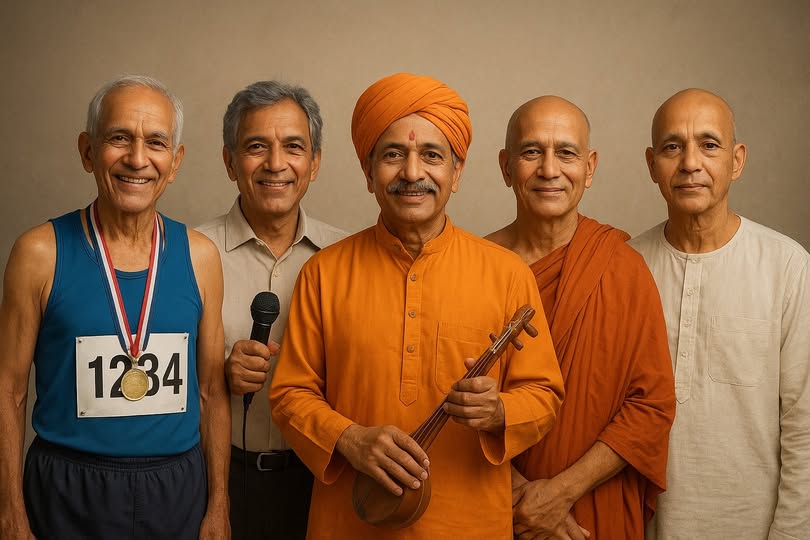
Take 𝗝𝗶𝘁𝗲𝗻𝗱𝗿𝗮 𝗔𝗱𝗵𝗶𝗮, a Gujrati boy from a small village in Rajlot who joined the first MGIMS batch in 1969. After his MBBS in Sevagram and MD in Community Medicine from Bombay, he practised dutifully for years. Then, in the mid-1990s, came a spark. At a workshop, watching applause rain down on a motivational speaker, Jitendra thought: If he can, so can I—better.
That night he opened 𝑇ℎ𝑒 𝑃𝑜𝑤𝑒𝑟 𝑜𝑓 𝑌𝑜𝑢𝑟 𝑆𝑢𝑏𝑐𝑜𝑛𝑠𝑐𝑖𝑜𝑢𝑠 𝑀𝑖𝑛𝑑, and his life tilted. His first lecture—just him, a blackboard, and an eager crowd—ended with a standing ovation. Soon, he was no longer only a doctor but a teacher of the mind. Today he has spoken to millions, written over a hundred books, and travelled the world. And yet, he always points back to Sevagram, where his foundations were laid.
From teaching the mind to healing the heart, we turn to 𝗔𝗸𝗶𝗹 𝗧𝗮𝗵𝗲𝗿, who entered Sevagram in 1970. A cricket lover who once shared the field with Sunil Gavaskar, he moved to America after his MBBS and built a conventional medical career. Then came the shock. A heart attack.
During his angioplasty, Akil’s heart stopped. “If they hadn’t shocked me, I wouldn’t be here,” he said later. That near-death moment turned the doctor into a patient, and then into something else altogether. Eight months later, he ran his first half marathon. Soon came full marathons in Chicago, Boston, Mumbai; mountain climbing, triathlons, even bungee-jumping and skydiving.
But the real transition was deeper. He discovered that medicine alone could not heal the heart. Yoga, pranayama, long walks, and good sleep became his prescription.
Today, he speaks across America, urging people to embrace lifestyle as the strongest medicine. His message is clear: the heart can heal twice—once in hospital, and again in how we live.
If Akil turned to fitness, 𝗦𝗵𝗮𝗿𝗮𝗱 𝗚𝗮𝗱𝗿𝗲 from the 1969 batch turned to faith. For years he practised in Miraj, until a classmate found him transformed. Gone was the stethoscope. He found his classmate, now a 𝑘𝑒𝑒𝑟𝑡𝑎𝑛𝑘𝑎𝑟, dressed in a simple white 𝘬𝘶𝘳𝘵𝘢 and 𝘥𝘩𝘰𝘵𝘪 with a pheta on his head and a shawl over his shoulder. Spiritual symbol of the humility of his new calling.
Sharad now led 𝘣𝘩𝘢𝘫𝘢𝘯𝘴 in packed halls, trading wards for devotion. For him, the music of the soul spoke louder than the hum of machines. Today, he spreads the names of Vitthal, Rukmini, Dnyaneshwar, and Tukaram through 𝘬𝘦𝘦𝘳𝘵𝘢𝘯𝘴—prescribing not pills, but prayer.
Where Sharad found solace in song, another Sharad from the 1972 batch found it in silence. Born in Gondia, 𝗦𝗵𝗮𝗿𝗮𝗱 𝗕𝗮𝗱𝗼𝗹𝗲 trained in anaesthesia and led a steady hospital life—until tragedy struck. His wife, also a doctor, died of ovarian cancer. Through her illness she walked the path of 𝘋𝘩𝘢𝘮𝘮𝘢 with courage. After her passing, grief drove Sharad to a Vipassana retreat.
What began as solace soon became his compass. He embraced 𝘝𝘪𝘱𝘢𝘴𝘴𝘢𝘯𝘢 fully and grew into one of its torchbearers, teaching across India and abroad. “Medicine treats the body,” he often says, “but peace comes only when the mind is stilled.” His wife’s death had opened a second door—one that shaped him as much as medicine had.
And then, 𝗔𝘀𝗵𝗼𝗸 𝗞𝗮𝗺𝗯𝗹𝗲, alumnus of the 1979 batch. Born in a small village in Wardha to parents who sold fruits and vegetables, he grew up counting every rupee. Against the odds, he entered MGIMS, completed his MBBS, then MD in Radiology. For years he taught in Sevagram before setting up a radiology centre in Yavatmal, bringing ultrasound and CT scans to a district that had none.
But success did not bind him. Drawn to Osho, 𝘝𝘪𝘱𝘢𝘴𝘴𝘢𝘯𝘢, and Buddhist teachings, he gave up his practice, donned the saffron robes of a 𝘉𝘩𝘪𝘬𝘴𝘩𝘶, and founded a meditation centre near Yavatmal. He gave away most of his earnings and now guides seekers through yoga, meditation, and self-discovery. His life is a rare arc—from survival to transcendence.
And so, journeys that began in crowded classrooms and wards have ended in lecture halls, marathon tracks, 𝘣𝘩𝘢𝘫𝘢𝘯 halls, meditation centres, and global stages. Five doctors. Five roads. Each less travelled, each unforgettable.