सजन रे, झूठ मत बोलो,
ख़ुदा के पास जाना है।
न गाड़ी है, न घोड़ा है,
वहाँ तो पैदल ही जाना है।
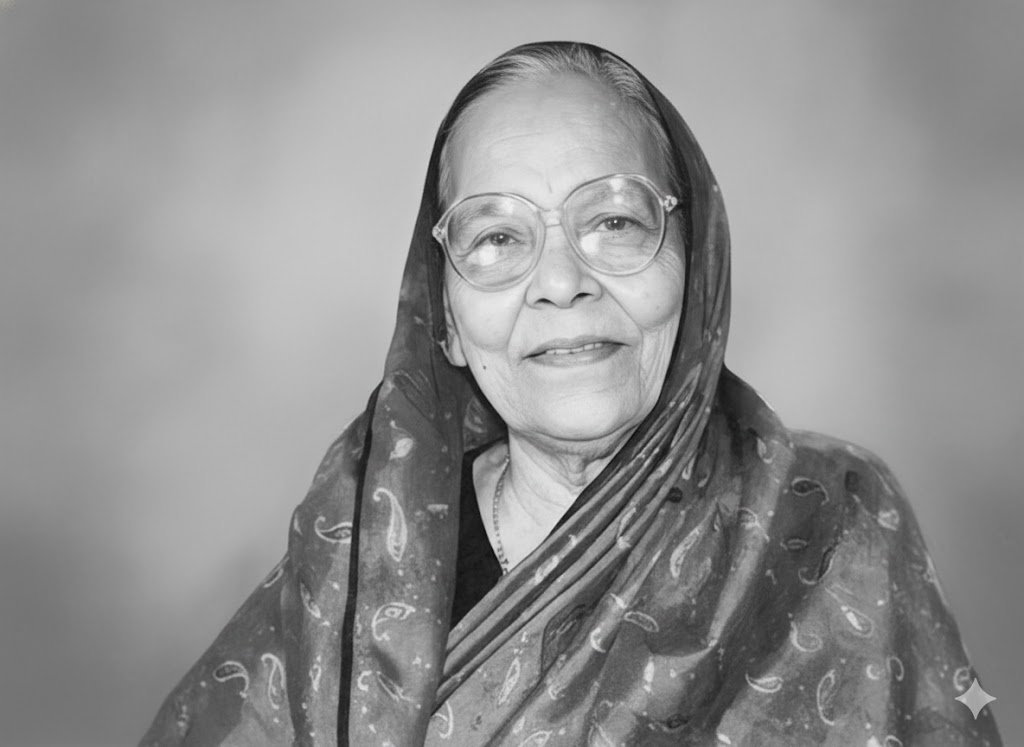
My mother (5 Jan 1926– 6 Dec 2005)
These lines return to me today, quietly and without warning, as if they had been waiting for this morning.
My mother loved this song from Teesri Kasam. In the evening of her life, long after my father had passed away, she would often hum it—sometimes while folding clothes, sometimes while sitting alone, lost in her thoughts. Once, a year before she died, she stood on a stage at her granddaughter’s wedding and sang the song from beginning to end. Her voice held no hesitation, no trace of nervousness—only calm assurance.
She was a religious woman. She read the Ramayana regularly and believed deeply in a supreme power that governed life and death. Yet I never quite understood what bound her so closely to this song, or why these particular words returned to her again and again, as if they held a meaning meant only for her.
She was not a highly educated woman. Her schooling ended with the fourth standard, in a Marathi medium school in Barsi, a small and quiet town in Solapur district. At fourteen—an age when most girls are still discovering themselves—she was married and brought to Wardha, a place she had never heard of, to live with people she had never met. A new home, unfamiliar faces, and a life that had already been decided for her awaited her there.
It could not have been easy for a young girl to step into such a world and make it her own.
When she visited her mother’s home, the journey itself was long and tiring. It took thirty-six hours and four train changes—Bhusaval, Manmad, Daund, Kurduwadi—though both homes were in Maharashtra. She never travelled alone; my father was always by her side, quietly ensuring she was not left to manage the journey on her own.
Life shifted, imperceptibly at first, then all at once. The family grew. Six children were born, with me being the youngest of them all. There was a large bungalow to run, cars to travel in, and comforts that had once seemed unimaginable. She watched her children marry in well-planned ceremonies and, every summer, welcomed her daughters and eight grandchildren into the house for two lively months. The kitchen stayed busy from morning to night, and she moved through the household chores with ease, rarely pausing to rest.
She was, in many ways, a typical Marwadi woman of her generation. A homemaker, rooted in family life, neither widely travelled nor well-read. Her world was small and familiar, made up of a few close friends, daily routines, and conversations that repeated themselves gently over the years.
So what, then, turned her inward?
What made her think so often about the fleeting nature of life, about leaving alone, without possessions or companions, when the time finally comes? She had no guru to guide her. She attended the Bhagwat discourses of Dongre Maharaj when they were held freely, but there was no one who deliberately nudged her toward philosophy or reflection.
These thoughts seemed to arrive quietly, on their own, settling into her mind without announcement.
And she left this world much as she had lived in it—without drama or display.
She had survived two heart attacks. When the third came, she did not die in a hospital, nor did she endure the noise and intrusion of machines. She breathed her last at home, resting on my lap, suddenly and peacefully, as if she had simply decided it was time. She was eighty.
Today, she would have turned a hundred, having been born on 5 January 1926.
As the day unfolded, many memories returned—of my childhood, my school and college years, my marriage, and her final days. They came gently, one after another, and then faded, leaving behind a quiet stillness.
But what stayed with me, long after the memories settled, was that line she loved so deeply:
Perhaps she understood something I am still trying to grasp : that in the end, we walk alone, and that a simple, softly spoken truth is all we finally carry with us.
सजन रे, झूठ मत बोलो…
This piece is about my naniji.
She lived a quiet, unassuming life—simple, rooted, and deeply faithful.
Without formal education or philosophical training, she seemed to understand an essential truth:
in the end, we walk alone, carrying nothing but honesty.
That song wasn’t nostalgia for her—it was clarity.
A life lived softly, and a departure just as peaceful.
Well written, Mamaji.
My thoughts are with you and your family, SP
I remember her affection whenever we met her. All I can say is that she was lucky to have a son like you and you were lucky to have a mother like her, I can’t imagine a better way to leave on one’s final journey.
ईश्वर उनको सद्गति प्रदान करें और तुम को स परिवार शक्ति दें ।
मेरा उनको श्रद्धापूर्ण प्रणाम ।
💐🕉️ शांति 🙏
So sorry for your loss SP. My heartfelt condolence to you and your family. May her soul rest in eternal peace. 🕉️🙏🏽
My Nani’s speed was a domestic marvel. If a guest arrived at our door, she could change into a crisp saree and be ready to welcome them before the echo of their knock had even faded.
The moment the visitor departed, she would vanish, returning to her everyday clothes in a wink to resume her chores. It was a lightning-fast ritual of grace that remains one of my most cherished memories of Nani’s home.
“The umbilical cord is finally cut from the mother when she passes away.”
Your loss is palpable, a mother nurtures us, takes care of us and loves us unconditionally.
May her memories bring solace to you and your family! May she attain Sadgadi. Om Shanti 🙏🏽