I have known Ulhas Jajoo for nearly five decades, and in all that time I have never seen him wear a shoe.
This creates a problem at retirement. The usual cliché — he hung up his boots — simply does not apply. For days I searched for the right phrase and found nothing that fit. Then, yesterday evening, I saw him at a dinner that Dr. Sachin Agrawal, an MGIMS 1999 alumnus, had hosted in Wardha to celebrate his parents’ golden wedding anniversary. There was Ulhas — pristine white khadi kurta and pyjama, chappals on his feet, that familiar luminous warmth on his face. He was in the middle of a conversation, and whoever he was talking to had his complete attention. He is always like that. He makes you feel, when he looks at you, that you are the only person in the room.
The phrase arrived, quietly and without effort.
He slipped into his kurta and pyjama.
This is not an affectation. It is not a performance of simplicity. It is simply how Ulhas moves through the world — chappals on the polished floor, khadi against his skin, arriving on his scooter with the unhurried confidence of a man who has never once felt the need to impress anyone. In a profession that routinely confuses designation with dignity and a good car with a good character, this is rarer than it sounds. Much rarer.
On 28 February 2026, after forty-eight years at MGIMS, he retired. Seventeen thousand, eight hundred and forty days — from 26 April 1977 to 28 February 2026. By any measure, a long innings. Not the innings of the flashy strokemakers, the ones who light up a ground for an afternoon and are gone. The innings of Sunil Gavaskar and Rahul Dravid — men who stayed at the crease long after others had come and gone, who accumulated quietly and without theatre, who were still there, unhurried and immovable, when the light finally faded.
The Department of Medicine will continue. The ward rounds will continue. The residents will arrive each morning with their lists and their anxieties, as they always have and always will. But the particular quality of attention that Ulhas brought to a bedside — that steadiness, that stillness, that absolute refusal to be anywhere other than precisely where he was — that will take some replacing.
How He Arrived Here
Ulhas was not supposed to be a doctor. He was headed to the Laxminarayan Institute of Technology in Nagpur to study engineering — mathematics was his passion, his marks were excellent, and his future seemed settled. Then Dr. Ramchandra Wardekar, a family friend and founder of the Gandhi Memorial Leprosy Foundation, came to visit.
In the way that a single conversation can sometimes redirect an entire life, Wardekar told Ulhas that his late grandfather had influenced Wardekar’s own path to medicine. He urged Ulhas to consider whether intelligence, in his hands, might best serve people rather than machines.
Ulhas had one objection: he was afraid of frogs and dissections.
Wardekar told him the fear would pass.
It did. Ulhas withdrew from LIT, spent a year at JB Science College in Wardha learning about earthworms and cockroaches, cleared the entrance examination, and arrived at Government Medical College Nagpur — from the same institution, incidentally, from which I graduated five years later. We did not know each other then. We would spend the next four decades as colleagues in the same department, which is a different kind of knowing.
The Khadi and the Ragging
Medical college in those years had its rituals, and one of them was ragging. For most students it was an inconvenience. For Ulhas, wearing khadi — a three-generation family tradition — it became a daily ordeal. He was mocked, jeered, and laughed at. At seventeen, humiliated by the daily ritual, he made the practical decision to buy a white cotton shirt and trousers. He went home and told his father.
His father — an economics professor, the son of a Gandhian — listened quietly.
“How long will you allow fear to guide your path in life?”
Ulhas returned the terrycot clothes. He put on his khadi again. The ragging eventually ended, as these things do. The khadi never came off.
I have thought about that moment many times over the years. Most of us, when tested at seventeen, make the reasonable compromise. Ulhas made a different kind of decision — not heroic, not dramatic, just quietly irreversible. That quality, I came to understand, was the foundation of everything else.
The Teacher
When I think of Ulhas in the ward, I do not think of diagnoses first. I think of the way he walked in.
Untucked khadi shirt, chappals on the polished floor, no stethoscope around his neck until he needed it. He would arrive at a bedside and become still — genuinely still, in the way that patients notice and remember. He listened to them the way I have rarely seen a physician listen: not waiting for the symptom that would confirm his working diagnosis, but actually attending to the person in front of him.
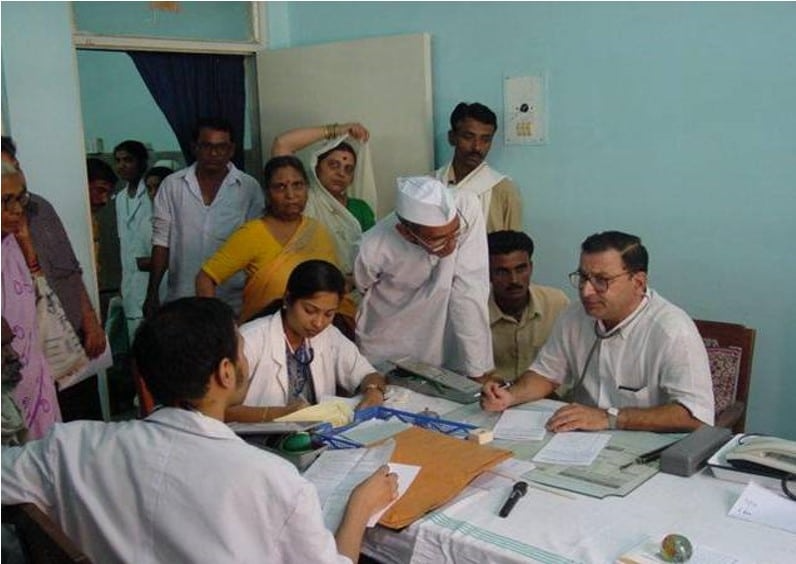
He called his residents sherus — lions. He taught them to stain their own slides, count their own cells, identify malaria parasites under the microscope. In an era of increasing subspecialisation and technological dependence, he insisted on self-sufficiency. Not because technology was unavailable, but because he believed a physician who cannot examine without a machine is only half a physician.
His teaching rounds became the stuff of MGIMS legend. He used the Socratic method — asking questions rather than delivering answers, pressing residents to press each other, visibly delighted when a student proved him wrong. That last quality — the genuine pleasure he took in being corrected by someone younger — I found remarkable in a senior colleague, and I find it remarkable still.
Every February 14th — his birthday — former students and residents post their memories of him on social media. What strikes me about these posts, year after year, is what they do not mention. They rarely describe a clever diagnosis or a treatment he got right. They describe moments — a question he asked, a phrase he used, the way he stood at a bedside, the way he made them feel that the patient’s story was the most important thing in the room. This is not the legacy of a clinician. It is the legacy of a teacher. The two are not the same thing, though Ulhas spent his career insisting they should be.
The Community and the Letters
Within a year of joining MGIMS, in September 1978, Ulhas wrote a four-page letter to Dr. Sushila Nayar outlining his vision for village healthcare. He was twenty-seven years old. The letter proposed a three-tier system — village health workers, a mobile health team, and the hospital — and argued for community involvement and self-contribution rather than charity and external funding.
I read that letter years later. It was not the letter of a young man performing idealism. It was the letter of someone who had already thought carefully about why good intentions so often fail — and had a practical alternative to offer.
He and his students rode hired cycles to villages in the rain, across slippery tracks and flooded paths, to understand why people were ill. What they found, repeatedly, was that health was not the villager’s first priority. The daughter’s marriage was. The bank loan was. The subsidised seeds were. Ulhas absorbed this without cynicism. He understood that medicine practised in isolation from its social context is a partial medicine — better than nothing, but not what the situation required.
Dr. Sushila Nayar, recognising what she saw in him, tried for years to persuade him to move from internal medicine to community medicine. She offered to mentor his postgraduate thesis. She offered to make him head of the department. Ulhas declined. He had concluded that a public health professional without a firm grounding in curative medicine would always be working at one remove from the patient. He stayed in medicine. He took the community with him into the ward.
The Final Years of His Parents
I watched Ulhas care for his parents in their late eighties, and I learned something from it that no textbook had taught me.
He did not hospitalise them. He did not reach for the ICU when it was not needed. He sat with them. He talked with them. He explained, gently and honestly, what was happening and what it meant. His brother Suhas — a plastic surgeon — was beside him throughout. Together they became sons, physicians, nurses, and companions, in whatever proportion each day required.
Ulhas had read Manu Kothari on death and Atul Gawande on mortality. He had thought carefully about what a good ending looks like, and he applied that thinking at home, without fanfare. His father died with dignity. His mother followed four years later. They died at home, surrounded by their family.
For a physician, this is the hardest kind of knowledge to carry — knowing enough to prevent an unnecessary intervention, and caring enough to resist the instinct to do something, anything, when the right thing is simply to be present. Ulhas carried it without apparent effort. I suspect it cost him more than he let on.
What Remains
On 28 February, Ulhas slipped his chappals on for the last time as a MGIMS faculty member and walked out of the Department of Medicine. He plans to spend a few hours a day at his younger brother’s clinic, seeing outpatients. I have no doubt he will be just as good at it as he was at everything else.
Manu Kothari, reviewing Ulhas’s 2012 book Towards Holistic Rural Health, called him a modern-day Schweitzer — embodying the spirit of Gandhi, the vision of Vivekananda, the clarity of Vinoba. It is the kind of sentence that can make a man sound impossibly distant, impossibly good. The truth is simpler and more useful: Ulhas was available. To his patients, to his students, to his colleagues, to his parents, to the villages around Sevagram. He showed up, consistently, for forty-eight years, in his chappals and his khadi, with nothing to prove and everything to give.
The ward will carry on. But for those of us who knew what it felt like when he walked in — that particular quality of stillness and attention — something will be missing. Not loudly. Not dramatically.
Just quietly, the way the best things leave.
S.P. Kalantri
1 March 2026
Great tribute! So beautifully penned.
Congratulation Dr UlhasJajoo. You will surely continue to serve the community one way or another.
I find it very nice to hear more about my guru, whom we eulogise. The portrayal of Dr Ulhas Jajoo is simple heartfelt, direct and honest, without any superlatives or exaggeration. He definitely has a magnetic personality and a teacher par excellence. He has touched many lives and left his mark. Generations of MGIMS alumni will always remember him with love.
Wonderful write-up describes Ulhas as he is.
I wish I could have worked in MGIMS and been close to all the doctors you write about
Dear SP sir, a truly moving account.
Though I preferred surgery over internal medicine, I was always fascinated by the logical ( mathematical) way Dr. Jajoo reached a diagnosis. You are very correct about his Socratic method of teaching. He really made us think, to the extent that at that moment we would willingly concede that well described and accepted precepts should be questioned or explored for loopholes. He has a disarming smile that could allow one to be led up a garden path before being dropped like a hot potato and one would realise the error committed.
The article bears your characteristic trade mark of simplicity of language and clarity of thought that has captivated readers over the years.
Beautiful sir.nishabd
Excellent write up sir..
Dr Jajoo Sir is epitome of simplicity with great knowledge
A beautiful description of Jajoo Sir.
He has many stories of villages and villagers which help in deciding the way health care should be delivered to them.
𝗪𝗔𝗛 𝗪𝗔𝗛 𝗪𝗔𝗛
𝗘𝗫𝗖𝗘𝗟𝗟𝗘𝗡𝗧. 𝗡𝗢 𝗪𝗢𝗥𝗗𝗦 𝗧𝗢 𝗔𝗣𝗣𝗥𝗘𝗖𝗜𝗔𝗧𝗘.
𝗜𝗧’𝗦 𝗔 𝗦𝗖𝗥𝗘𝗘𝗡 𝗣𝗟𝗔𝗬~~𝗔𝗦 𝗜𝗙 𝗜’𝗠 𝗪𝗔𝗧𝗖𝗛𝗜𝗡𝗚 𝗗𝗥 𝗨𝗟𝗛𝗔𝗦 𝗙𝗢𝗥 𝗧𝗛𝗘 𝗟𝗔𝗦𝗧 𝗙𝗢𝗥𝗧𝗬 𝗙𝗜𝗩𝗘 𝗬𝗘𝗔𝗥𝗦.
𝗔𝗧 𝗧𝗜𝗠𝗘𝗦 𝗜 𝗪𝗢𝗡𝗗𝗘𝗥 𝗛𝗢𝗪 𝗥𝗘𝗦𝗣𝗘𝗖𝗧𝗘𝗗 𝗗𝗔𝗗𝗔𝗝𝗜 𝗡𝗔𝗠𝗘𝗗 𝗛𝗜𝗦 𝗧𝗪𝗢 𝗦𝗢𝗡𝗦 𝗔𝗦 “𝗨𝗟𝗛𝗔𝗦”𝗔𝗡𝗗 “𝗦𝗨𝗛𝗔𝗦”;𝗔𝗡𝗗 𝗛𝗢𝗪 𝗕𝗢𝗧𝗛 𝗘𝗫𝗘𝗠𝗣𝗟𝗜𝗙𝗜𝗘𝗗 𝗧𝗛𝗘𝗜𝗥 𝗡𝗔𝗠𝗘𝗦???
𝗦𝗜𝗥, 𝗛𝗔𝗧𝗦 𝗢𝗙𝗙 𝗧𝗢 𝗬𝗢𝗨.
𝗪𝗜𝗧𝗛 𝗪𝗔𝗥𝗠 𝗥𝗘𝗚𝗔𝗥𝗗𝗦
Beautifully penned
A life lead by example.
Nurturing is healing
It’s so heartwarming to read all your experiences with people and place . Thanks sir
I am sure someone someday will write about you but it’s difficult to put into words the qualities you have, may Goddess Saraswati be with that person.
Wonderfully written sir. If there’s anyone in whom I have seen a halo it has been Jajoo sir, sparkling eyes, witty mind and a very soft comforting smile.
There have been 3 incidences in my life where he’s taught me something that I can never ever forget- once as an intern, once as a junior consultant in orthopaedics and once when I was leaving MGIMS…. Maybe I’ll narrate it some other time. A true Gandhian , a man who practiced simplicity and total detachment to material things. I can never tell when his influence over me will ever fade- maybe never
Wonderful insights. Hat’s off 🙏🙏
We met him, interacted closely and felt his greatness. His idea on rural health care services should be translated into action.
So beautifully written. Capturing the essence of Ulhas bhai. Much gratitude for this touching portrayal as well as for the person that Ulhas is.
What a beautiful tribute to an amazing person. I am so glad to have met Ulhas (several times) and can recognise him in this tribute from SP.
Michael (Mike) Galvin 1st March 2026
Dr. Ushas Jajoo sir, a great human being.
A deeply moving and beautifully written . Though I am nearly two decades junior and was never his student, I had the opportunity to know Dr. Ulhas Jajoo sir as a doctor, a neighbour, and a senior whose quiet presence always commanded respect. What stood out even in brief encounters was his simplicity, warmth, and the calm attention he gave to everyone around him. Some people influence us not through formal teaching but through the example they set in everyday life. Reading this piece brought back that feeling once again. Thank you, Dr. Kalantri sir, for portraying him so sensitively.
Dr. Kalantri, Hats off to you for a nice write-up!
Best wishes to Dr. Ulhas for the new journey ahead. May this new inning bring him even greater achievements and satisfaction.
Dr Jajoo ,Sir ,to many,Bhai to me,a person who was limitless in his patience and ability to listen and heal,a friend and philosopher to all,a wonderful smile on his face, that is how I will always remember him.As he starts his new journey I wish him well and seek his blessings.🙏
After almost 4 decade, Dr. Jajoo’s teaching still resonate in my mind. I have mentioned about him on my many morning rounds to my residents & fellows.
Above all, he is a very very nice human being & always treated everybody with grace & dignity.
Salute to such a legend.
God bless him & his family with happiness, togetherness & prosperity.
Dr Ulhas Jajoo is a great social reformer and a Legendary health specialist in community medicine. He has performed a great social activity on health sciences at MGIMS Sewagram, for almost 5 decades. He is a very well known Doctor in Wardha district premises. I wish him a success and a long & heslthy life for his second innings at Jajoo wadi, Wardha.
Dr Kalantriji congratulations for your excellent & factual write up.
Thank you
Prof Deepak Deshmukh
Retd Prof from JB Science college.
Wardha/ Amravati.
Dear Jajoo,
I happened to read the appreciative farewell messages on the occasion of your closure of service at the department of medicine at MGIMS. I remember our under graduate student days at Nagpur. I have fond memories of association with you and Abhay particularly when you both brought some of us to be associated with MFC. I remember your commitment to social medicine and distributive justice. As a resident in child health training when I needed your help to look after children with renal complications you reached out generously as a the registrar of renal unit to help. That was when I noticed your calling to serve. When we overlapped for a short while at MGIMS, we had many occasions to relate to you personally and formally at the work place. I recall how you fostered the general OP service by the community medicine department for all before patients before they were referred to specialists! You planted the seed of family medicine practice through that initiative! I remember a visit Anna and I made to your home where your parents touched us with their hospitality! I recall your visit to the Children Development Centre at Chennai when we were still finding our way into a new area of service. Your comment then was an inspiration and affirming when less was known about developmental paediatrics in India in 1984! Our paths did not cross since then, although you remained in our thoughts as one who meant a lot in my formative years! How refreshing it is to read citations about you and feel the joy of a life time of service you rendered as a physician, teacher and formator of young physicians! You lived a simple life and authenticated your vocation by example and becoming an inspiration! Anna and I remember you fondly! Good wishes for health and wellness! MCMathew
Never met or known him in person.From the narrative penned by Dr Kalantri,Dr Ulhas Jaju does appear to be an attractive colour that withers away and will be strongly missed by those who stay on.My best wishes for his happy days ahead🌹
Very well written about a simple, soft and gentle family physician Dr Ulhas Jajoo. The village health care scheme at MGIMS, Sevagram must have been his brain child. A true Gandhian not only in dress but in deeds, Dr Ulhas has been an immense inspiration for our family during our stay at Sevagram.
I congratulate Dr kalantri for penning the work life and amicable habits of Dr Jajoo, the senior in a very simple readable style.