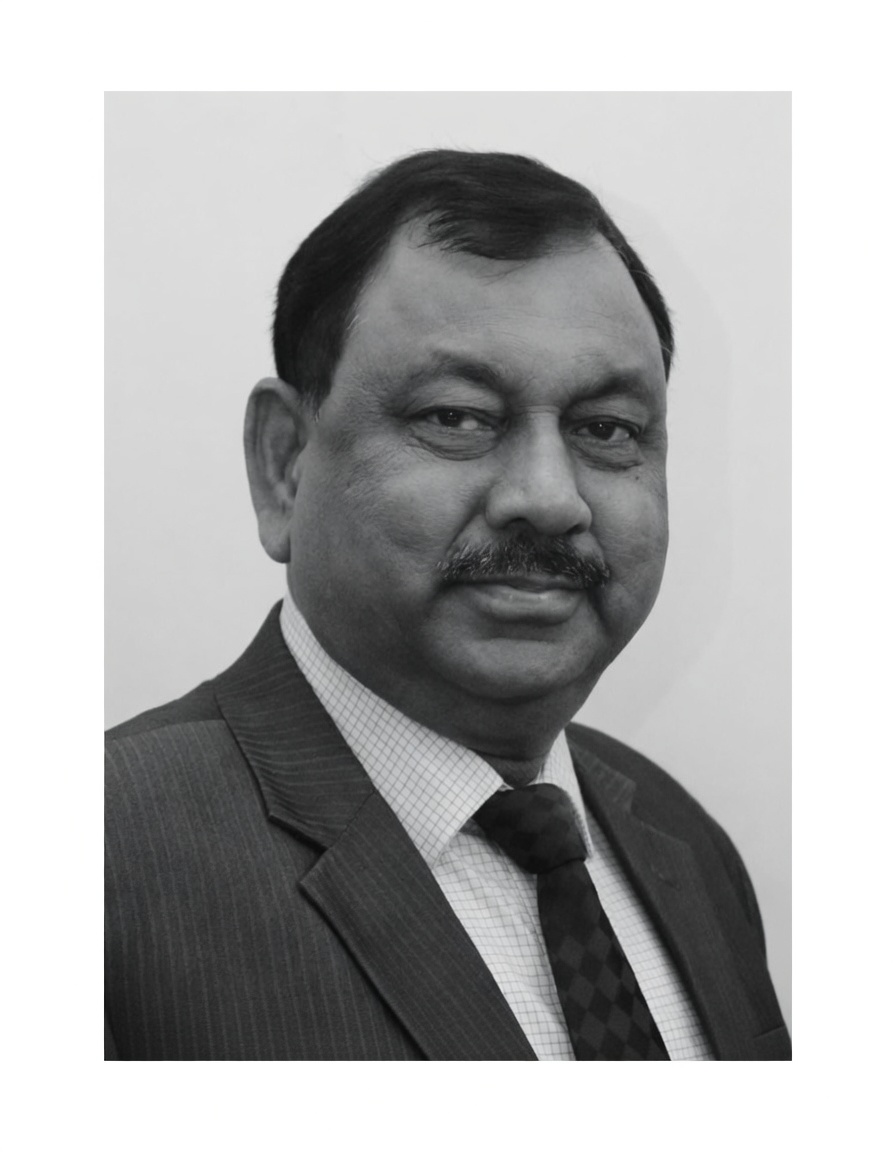
Dr. Baijnath Gupta
Mahatma Gandhi Institute of Medical Sciences
Dr. Baijnath Gupta
Persistence of a Bihar Topper
The Vision of the PHC Doctor
I was born on August 23, 1953, in Barsoi, a small town in the Katihar district of Bihar. My father, Sri Sarju Prasad Gupta, was a businessman, and my mother, Smt. Uma Devi, managed our home with a steady hand. Ours was not a medical lineage; beyond a distant cousin, the stethoscope was a foreign object in our household. I grew up alongside two younger brothers, Vishwanath and Dilip, and my sister, Veena, all of whom were still navigating their school years while I began to look toward the horizon.
My schooling at Barsoi High School was conventional, but my aspirations were shaped by a singular observation. In our local Primary Health Centre (PHC), there was only one doctor. He was a man who commanded an almost spiritual respect. In a town where many voices competed, people fell silent to listen to him. He was needed, and in that necessity, I found my calling. I wanted to be that person—the one who stood between a community and its suffering. Encouraged by a teacher who saw my potential, I moved to TNB College in Bhagalpur to pursue my B.Sc., focusing on the sciences that would eventually lead me to the gates of Wardha.
The Persistence of 1973
My path to MGIMS was not a single stride, but a two-year marathon. I first appeared for the entrance exam in 1972, accompanied by my school teacher. I cleared the written test, but the interview proved to be my undoing. I returned to Bihar disappointed but undeterred. In 1973, I doubled my efforts. I attended coaching in Patna and immersed myself in the books on Gandhian thought recommended by my mentors. That year, I sat for several exams—AIIMS, BHU, AFMC—and achieved a monumental milestone by topping the Bihar PMDT (Pre-Medical Dental Test).
Despite being the state topper in Bihar, the pull of Sevagram remained uniquely strong. There was an honesty in the newspaper advertisement for MGIMS that resonated with my rural roots. I traveled back to Wardha, this time alone, and checked into Annapurna Lodge across from the junction. The second interview was a starkly different experience. Dr. I.D. Singh and Badi Behenji questioned me on the natural calamities of Bihar, testing my awareness of the world I came from. Then came a question that broke the ice: “Who is your favorite playback singer?” I answered “Mukesh,” and for a few minutes, we weren’t discussing pathology or physics, but the soulful melodies that defined an era.
Room 36 and the Taste of Goras Paak
The orientation at the Gandhi Ashram remains an unforgettable sensory tapestry. Coming from Bihar, the Maharashtrian flavors were entirely new—the spicy poha, the comforting dalia, and the legendary Goras Paak (a local dairy sweet). We participated in shramdaan, clearing the land and learning that a doctor’s hands should not be afraid of the soil. It was here that I met Anand Kumar and Radha Mohan Arora. We were three nervous strangers who clicked instantly, forming a bond that has now weathered over five decades.
After the camp ended, I was allotted Room No. 36 in F Block. I remember walking in and realizing the room was brand new; I was its very first occupant. There is a specific kind of pride in being the first to inhabit a space intended for learning. The first day of class felt surreal. I sat in the lecture hall, looking at the blackboard and the faces of my professors, gripped by the disbelief that a boy from Barsoi had actually made it.
The Lessons of Mhasala and the Mentors
Our batch was assigned the village of Mhasala for our community-based programs. This wasn’t just a clinical posting; it was an immersion. We learned that healthcare in rural India is often a battle against environment and infrastructure as much as it is against pathogens. This experience grounded our medical knowledge in a way that city-based rotations never could.
We were fortunate to be shaped by teachers who were as invested in our character as they were in our grades. Prof. R.V. Agarwal in Pathology taught us precision; Dr. A.P. Jain in Medicine taught us empathy; and the Dhawans and Samals provided the parental guidance that students far from home desperately needed. They didn’t just teach us how to diagnose a heart murmur or a malarial parasite; they taught us the value of the person behind the patient.
Five Decades of Gratitude
Looking back from the vantage point of fifty years, the distance from Barsoi to Sevagram seems much shorter than it did in 1973. MGIMS gave me more than a degree; it gave me an identity. The friendships I formed—with Ajay Vyas, Arvind Saili, Ashok Sinha, and others—have been the steady background music of my life.
I am proud to be a product of an institution that valued the “Mukesh” fan as much as the state topper. We were taught that medicine is a meaningful life, not just a successful career. As I reflect on those days in Room 36, I realize that the “meaningful something” I went searching for in Bhagalpur was found in the red soil of Sevagram. For the mentorship, the values, and the brothers-in-arms I found there, I remain deeply and eternally grateful.
After graduating from MGIMS, Dr. Baijnath Gupta pursued an MS in Ophthalmology at Rajendra Institute of Medical Sciences, Ranchi. He later settled in Dhanbad, where he continues to practise. Outside medicine, he enjoys music and travel. Even after all these years, he fondly remembers Dr. Mrs. Samal and Dr. A.P. Jain, who taught him during his undergraduate days in Sevagram. Both are no longer alive, but their influence remains with him.