Dr. Jyotsana Bhambri-Walia
Mahatma Gandhi Institute of Medical Sciences
Dr. Jyotsana Bhambri-Walia
The "Lal Stetho" and Delhi Dreams
“Patil, yeh khana insaan ka hai?” I remember saying—half in exasperation, half in laughter—as he served us watery bhindi and shriveled rotis in the hostel mess. The food was, by any standard, terrible. Rajma paired with arhar dal in an unholy alliance, rice so overcooked it clumped into sad little lumps, and rotis that could easily pass for papads. I hated bhindi for years after that. I would march to Mrs. Pandit, our rector, and complain. “I’ll have another dish cooked for you, beta,” she would say. “No,” I would insist, “I don’t want special treatment—what about the other girls?” Little did I realize then that this was not some peculiar Sevagram curse. Messes across India ran exactly the same way. But in that dusty little village, we learnt to laugh at what we couldn’t change. My parents never let me go without—even if my mother had to skip buying a sari or my father new shoes, I always had enough pocket money.
Beginnings: From Delhi to Sevagram
I was born in New Delhi, delivered by a caesarean section under local anesthesia at Dr. Khera’s Nursing Home—a novelty in 1953. “Was I exchanged?” I would tease my parents in later years, for I was the only one in the family with darker skin. “No chance,” they would laugh. “You were the only baby born in that nursing home that day, at that exact hour.” It was all in jest, but the story became a family refrain.
My father, Mr. Satya Dev Bhambri, was an Indian Administrative Service officer of formidable reputation. Over the course of his career, he served as Chief Secretary of Haryana, working with three Chief Ministers. His position gave him extraordinary power, yet he never touched a dishonest paisa. Honesty for him was a personal creed. His integrity was so well known that even decades after his retirement, when he passed away at the age of 94 in 2019, the then Chief Minister of Haryana came in person to attend his cremation. He could have been a wealthy man, but chose instead to live simply, valuing probity over privilege.
My father’s younger brother was Jagdev Bhambri, the actor, producer, and director. Once, when visiting me in the Sevagram girls’ hostel, he casually asked for a glass to pour some alcohol he had brought in his bag. One of my roommates obligingly handed him one—and the entire room instantly turned into a conspiracy of silence. In Sevagram, especially under the watchful eye of Dr. Sushila Nayar, alcohol on the campus was unthinkable.
Growing Up: Schools and Cities
My father’s career meant frequent transfers—Barnala, Sonepat, Sangrur, Patiala, Chandigarh. In the late 1950s, he was transferred to Delhi as Deputy Secretary in the Ministry of Petroleum and Chemicals, where he was instrumental in founding Indian Oil Corporation. At the time, foreign giants like Burmah Shell dominated the Indian market. My father’s vision helped establish Indian Oil as a state-owned counterweight—a name he himself chose.
My schooling started in Delhi with the nuns at Carmel Convent. When he was posted to Bombay, I studied there between 1966 and 1969, before returning to Delhi. My final school years were at St Joseph’s Convent, and then I joined Dyal Singh College for pre-medical studies. My sister, Suneela, found her joy in the arts, but I was captivated by the precision of science. This was my first taste of hostel life and co-education. For a girl raised in traditional Punjabi surroundings, it was a cultural shift—exhilarating and unsettling.
The Crossroads and the Interview
From my early childhood, my father dreamed of having a doctor in the family. But a bureaucratic technicality intervened: I had no domicile for Punjab or Haryana, and could not apply to the medical colleges in those states. I sat for the AIIMS entrance and missed out on MAMC. I enrolled in English Honours in Delhi, carrying my father’s dream quietly. Then came an application for the Mahatma Gandhi Institute of Medical Sciences. I took the joint entrance test, and in the summer of 1971, a telegram arrived from Sevagram for an interview.
My mother, Savitri, had never heard of Sevagram and balked at the idea. “Beti ko itne door nahi bhejna,” she pleaded. But my father was resolute. “She’ll go,” he said simply. I set off by airplane to Nagpur—a rare luxury. The interview room held Dr. Sushila Nayar herself, alongside Dr. Manimala Chaudhari. My answers, delivered in confident English, seemed to take them aback—a soft, collective “Wow!” that I can still hear.
First Impressions and the Ashram Hum
The first month I lived in the ashram. For a city-bred girl, it was an awakening. I slept on the cool floor. Our mornings would start with a soft hum of voices gathering for the Sarv Dharma prayer. We sat cross-legged in the Gandhi Ashram chanting prayers. Among them was the Japji Sahib, composed by Guru Nanak Dev Ji. We chanted in unison—“Ad sach, jugad sach, hai bhi sach, Nanak hosi bhi sach”—True in the beginning, true through the ages, true now, forever true shall Nanak be. The words sank deep; I realized its significance a decade later when I married Harinder Walia, a Sikh.
Life in the 1970s Hostel
We wore khadi saris to clinics. Dr. O.P. Gupta was strict, but we’d sometimes “pretend” a sari was khadi. In our batch, Delhi girls wore bell-bottoms, shocking Wardha’s sensibilities. At the cinema, locals expected girls to sit in the “ladies section,” but we took balcony seats, laughing at the disapproving stares. Each term, I would lose nearly ten pounds during my stay in Sevagram due to the food, only to regain it when I went home to my mother’s cooking.
One day, Bhuvaneshwari, a senior, told me a friend had been stealing—shampoo, a watch, even trinkets. The whole hostel knew—except me. The watch was hidden in a Bourn Vita tin. Her father once came with a gun, furious. She was transferred out. It was my first taste of betrayal. Despite these hurdles, we Delhi girls often travelled together in the GT Express, turning the long journey into a festival of laughter. As the train’s whistle blew in Delhi, our mothers would cry, but I would tell them, “Don’t cry! Before we reach Nizamuddin station, we’ll be giggling.” And true enough, the tears would vanish, replaced by gossip and snack packets.
Teachers and the “Lal Stetho”
Dr. S.P. Nigam, head of medicine, nicknamed me “lal stetho wali” for my bright red Littmann from the USA. “History first, examination next,” he’d insist. He taught us to think like physicians. During internship we went to Warora where we learnt from patients at Dr. Amte’s leprosy colony—women with deformed hands cooking for us with dignity. Unlike many of my batch-mates found buried in books in the library, I rarely stepped inside except to borrow a book. My room was my sanctuary. I valued the balance between work and play, knowing that medicine needs a dose of joy.
I never learnt Marathi, yet somehow managed with batch-mates’ translations. English, however, was my stronghold. I prided myself on my command of the language and took care to write with precision. I was blessed with a calligraphic hand; when Dr. M. L. Sharma taught pharmacology, I would record his lectures almost verbatim. My neat, meticulously prepared and beautifully written notes travelled far and wide before exams.
Friendships, Proxies, and Gode’s Biryani
During our Sevagram days, friendship was pure. We accepted each other at face value. We—Delhi girls and those from the 1970 batch—were often called the “fast girls” for the English we spoke and the bell-bottoms we wore. I was Roll No. 11, and Surinder was Roll No. 10. I would often skip afternoon PSM theory classes, and Surinder would mime my presence and mark my proxy attendance. During final exams, Dr. B.K. Mahajan confronted me about my attendance. I replied in chaste Punjabi, knowing it would melt his demeanor—and it worked.
We played cricket in Kharangana Gode, plucking amrud straight from trees and relishing Gode Aunty’s unforgettable biryani. Holi was celebrated with buckets of water, and our teasing knew no mercy. Surinder Bajwa was a steadfast friend, and so was Dilip Gode. I still remember helping Dilip polish his English speeches at the Madras Hotel until midnight. Sevagram taught me to be independent—to cook, wash, and mend. No work was too small; I learned that no honest work was beneath me.
Sevagram: The Final Legacy
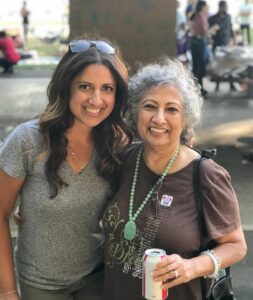
I married Harinder Walia, a dentist, in June 1980, and moved to the USA. My son and daughter followed in our footsteps, and joined the dental profession. Today, I am blessed with four granddaughters who light up my life. Sevagram—with its dusty lanes, the clang of the mess bell, the smell of khadi, the patient dignity of villagers—shaped me quietly, like water shapes stone. Those friendships, those teachers, those long summer afternoons… they remain with me, glowing softly in the corner of my heart.