I saw him in my Saturday OPD this morning.
No history of Sevagram, no history of MGIMS, can be written without a chapter on Babulalji.
Ask anyone from the first ten batches, 1969 to 1980, and the memories come flooding back: his steaming cups of tea, his aloo bondas, and, above all, his quiet generosity.
He was the man every medical student turned to when money ran short. He lent without hesitation. He never asked for repayment, and he never kept accounts. Trust was his ledger. Kindness was his currency.
He is eighty-eight now.
Every few weeks he comes to my OPD to have his blood pressure checked. Age has begun to slow him down. His memory sometimes fails him. A few times, he has forgotten the way home in Sevagram, a town he has walked for sixty years.
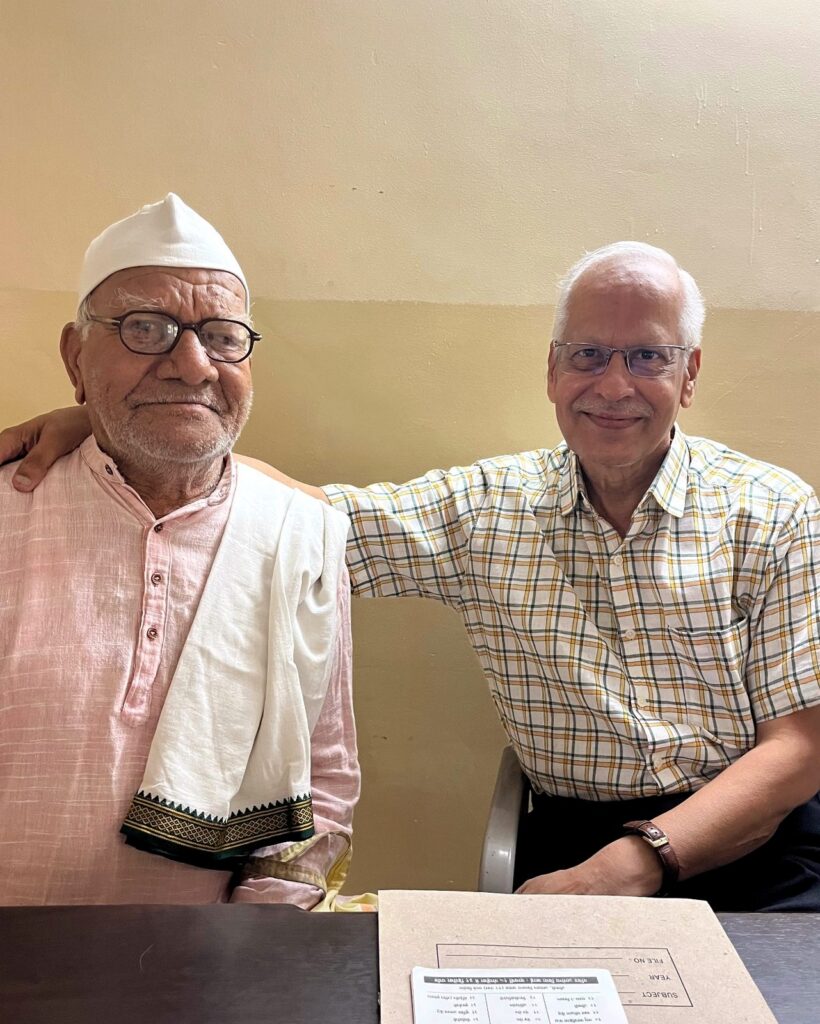
But say a name from those early years — Kishore Shah, class of 1974 — and Babulalji’s face changes before you finish the sentence. He remembers Moruchi Mavshi, the Marathi play Kishore directed and acted in. Mention any of the other MGIMS pioneers, and something remarkable happens: his face brightens, a smile spreads slowly across it, and his eyes fill with tears.
“Those were the days,” he says softly.
I tell him those days are remembered because of people like him. Thousands of doctors have passed through MGIMS. Many now hold distinguished positions across India and the world. Yet nearly all of them remember the man behind the tea stall — not for the tea, not even for the aloo bondas, but for the dignity and affection with which he treated a generation of young students far from home.
No institution can ever fully repay a debt like that.
He leaves my chamber with moist eyes. I watch him walk away, carrying memories that are fading for him but stay vivid for the rest of us. I am left with a heavy heart, and a full one.
I am sure Babulalji carries within him hundreds of untold stories from the early days of MGIMS. Over the decades, he quietly witnessed friendships, romances, heartbreaks, conflicts, acts of generosity, and countless human dramas involving students, nurses, faculty, and Ashram residents. He has shared a few astonishing anecdotes with me over the years. Many are deeply personal and, of course, not meant for public consumption. Yet they are remarkably demystifying and offer a rare glimpse into the human side of an institution we often remember only through its achievements.
Your mission, as I see it, is to write the history not only of the buildings and the people, but of the very soul of MGIMS. Babulalji remains one of the last authentic custodians of that living history. As his physician, and as someone documenting the institution’s past, you are uniquely placed to record his memories—ethically and with his consent—before they are lost forever. Individuals matter, but what matters even more are the patterns, the culture, and, as we say, *मिट्टी के रंग*.
One person whose story particularly intrigues me is our late batchmate and my roommate, Dr. Suleiman Khan. Babulalji knew him well and often spoke with him privately. Many of us remember Suleiman’s extraordinary life—his deep faith, his unconventional behaviour, his generosity towards the poor, and the tragic circumstances of his death. Whether his life reflected profound spirituality, inner turmoil, or something else entirely, I suspect Babulalji may hold pieces of that story that no one else does.
Some people are simply born; others seem to have been made especially for society.
Very true. He was a local guardian to all of us. My warm regards.
I have fond memories of the aloo bondas served with red gram curry at Babulalji’s canteen. They were delicious, wholesome, and filling. I was an occasional visitor there between 1974 and 1980.
Babulalji was a man of few words, but his warm smile never left his face.
I always paid in cash, and he seemed to appreciate that. Unlike many of my friends, I never had a running account with him!
My other favourite food joints on the MGIMS campus were the Indian Coffee House and the Madras Café.
Nice, Sir. I remember him fondly for attesting countless certificates for us. No matter how large the pile of documents, he never showed the slightest irritation. He was always kind, patient, and generous. 🙏
He is truly an icon of Sevagram. I still remember that during our first year, because of some youthful indiscretion, we were barred from eating at the Indian Coffee House. Our next favourite haunt became the Madras Café—and, of course, Babulalji’s canteen!
Babulalji’s aloo bonda with his delicious, spicy *tarry* was legendary in those days. For many of us, it wasn’t just a snack—it was an unforgettable taste of Sevagram.
Yes, Sir. Every word you wrote about Babulalji is true and brings back nostalgic memories of those golden days. Kind-hearted and generous souls like him are a rarity today. 🙏
Great write-up, Sir. We spent countless hours at Babulalji’s canteen. Those moments remain among my fondest memories, and Babulalji still holds a special place in my heart.
So beautifully written, Sir. I fondly remember our regular breakfasts of aloo bonda at his canteen down the hill. Babulalji was truly an icon of Sevagram. 🙏🎉