(4 February 1937 – 19 January 2026)
I have just learnt that Dr. Madhao Dattatraya Khapre passed away this evening in Nagpur.
He served MGIMS as Professor and Head of Pharmacology for many years—from February 1971 to August 1987. Outside the campus, he was a devoted senior member of the Shri Dnyaneshwar Madhuradvait Sampradaya.
In Sevagram, he lived with quiet discipline and a gentle faith—visible in the way he carried himself each day. He was a voice in the classroom, a familiar presence at college functions, and someone who could make a heavy day feel lighter with nothing more than a warm, unhurried smile.
I joined MGIMS as a Senior Registrar in the Department of Medicine in the summer of 1982, and I watched him teach pharmacology until 1987.
In most teaching hospitals, physicians rarely cross paths with pharmacology professors. Sevagram was different. As I walked down the corridor that ran from the Anatomy department to the MS office, I would often spot him—moving at his own unhurried pace, wearing that mischievous smile, a twinkle in his eyes, and a paan tucked firmly into his cheek.
If Dr. Keshav Ingley, our physiology professor, had a weakness for tea, Dr. Khapre had one for paan. Together, they made a perfect pair—two gentle, unforgettable presences in the everyday life of MGIMS. Even today, I do not picture him sitting behind a desk. I see him walking briskly across the campus, eyes bright, as if a tune was always playing inside him.

A line I never forget:
Hard work and rote-learning can make you an engineer or a doctor.
– Dr. M.D. Khapre
But music cannot be learnt that way.
I wanted to be a Hindustani classical vocalist—yet I became a doctor.
Dr. Khapre was born in Nagpur on 4 February 1937. He grew up in Khapre Wada, in a simple, rooted home. At his father’s insistence—his father was a lawyer—he joined Government Medical College, Nagpur, in 1955. He had wanted to take up music full time, but he set that dream aside and chose medicine.
Building MGIMS: a teacher from the first generation
He came to MGIMS in the early 1970s, when the institute itself was still young. Those were the years when the college was being built not only with bricks and files, but with people. He belonged to that first generation of teachers who gave MGIMS its character—Dr. Indurkar and Dr. Kane in Anatomy, Dr. K.N. Ingley in Physiology, Dr. R.V. Agrawal in Pathology, and in Pharmacology, the unforgettable pair of Dr. M.L. Sharma and Dr. Khapre.
Together, Dr. Sharma and Dr. Khapre built the department, each in his own way. Dr. Sharma was dramatic, full of jokes and energy. Dr. Khapre was quieter, but his clarity was something else. He could take a long, dry list of drugs and turn it into a story that students could actually follow. He made pharmacology feel simple. He also moved easily between English and Marathi so that no student felt lost. Between Dr. Sharma’s flair and Dr. Khapre’s clarity, the department shaped lessons—and memories—that students still carry today.
Even today, alumni speak of Dr. Khapre’s notes with affection. When standard textbooks became popular, students still said, “Dr. Khapre’s notes are enough.” It was not a shortcut. It was trust.
The cultural pulse of Sevagram
But if pharmacology was his profession, music was his first love. He became the cultural pulse of MGIMS. He started 𝗦𝗮𝗿𝗴𝗮𝗺, where students would gather most evenings to practise—often in the Pharmacology hall itself. On Friday evenings, he would even sit on the tabla while our Principal, Dr. I.D. Singh, played the harmonium. Looking back, those scenes feel almost unreal in a medical college setting—so simple, and yet so serene.
He brought the same energy to theatre. In February 1974, he put together a full three-act Marathi play, 𝗞𝗮𝗸𝗮 𝗞𝗶𝘀𝗵𝗮𝗰𝗵𝗮, and persuaded his relative, the respected director Mr. Sudhakar Deshpande, to come from Nagpur and guide the students. Dr. Khapre stayed in the background, quietly fixing what needed to be fixed, and making sure nothing fell apart. When the audience rose for a standing ovation that night, a part of it belonged to the Pharmacology professor who believed a medical college should also make space for the arts.
Mehfils, bhajans, and a voice that carried devotion
His home, too, became an extension of that spirit. During college gatherings and Ganpati days, he would organise small mehfils—his baritone leading the way, Sudam Ambulkar singing bhajans, Hari on the tanpura, and young students like Avinash Wagh on the tabla, with Shyam Babhulkar and others joining in. A trained classical singer and Sangeet Visharad, he enlivened every programme with humour and song—whether it was “झनक झनक पायल बाजे” or “केतकी गुलाब जूही चंपक बन फूले“.
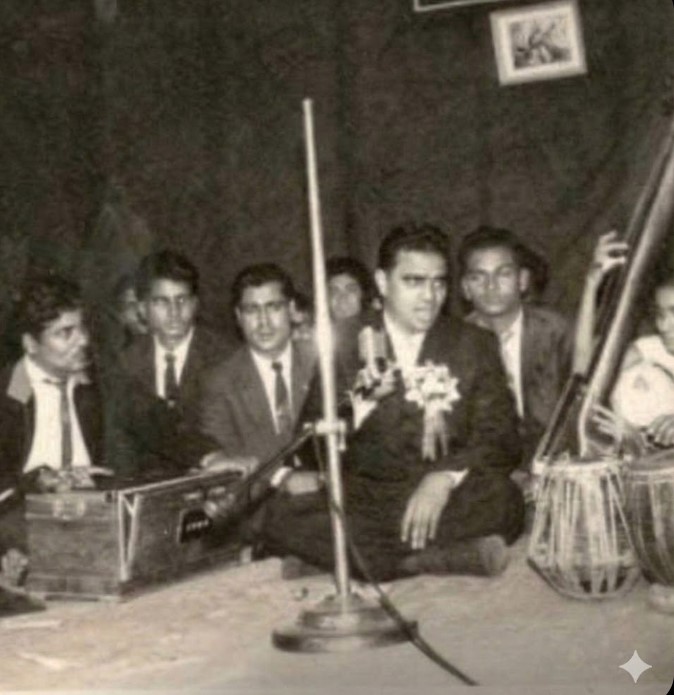
He also coached colleagues in acting, patiently building their confidence, and even accompanied young Sujata Bele to performances in Wardha and Nagpur, simply to steady her nerves. In the early 1980s, he himself took the stage in पंख लाभले आज सुरांना at Dhanwate Rang Mandir, alongside seasoned artists like Pandit Prabhakar Deshkar.
Kindness without an audience
The same warmth followed him outside the spotlight. I remember him speaking fondly of the old Sevagram music gatherings—hours of practice, chiwda, paan, and laughter. And his kindness never needed an audience. Decades back, when Gajanan Ambulkar’s father passed away during a torrential downpour, Dr. Khapre walked through ankle-deep mud to help carry the arthi.
In the summer of 2023, I spoke to him on the phone for almost an hour and a half. His voice was full of nostalgia. “The two decades I spent in Sevagram were the golden days of my life,” he told me. He sounded so pure—like someone speaking of home.
A farewell—and a legacy that remains
Dr. Khapre passed away at Viveka Hospital, Nagpur, on 19 January 2026, just days short of his 89th birthday.
He leaves behind a legacy closely linked to MGIMS. His nephew, Rajabhau Khapre, served in the Department of Pharmacology. His grand-nieces, Dr. Mukta Khapre-Umarji (Batch of 1974) and Dr. Mugdha Khapre (Batch of 1998), are both MGIMS alumni.
For those of us who learnt under him, worked with him, or heard him sing “Jhanak Jhanak Payal Baje,” Dr. Khapre remains a vivid memory—an exceptional teacher who made pharmacology less frightening, a musician who carried devotion in his voice, and a colleague who showed us what simple goodness looks like.
Tonight, MGIMS has lost one of its pillars. But somewhere in our minds, his voice still rises—warm, steady, and full of music.
Dr Khapre will be remembered for his “Jhanak Jhanak Payal Baje”
May the angels in heaven be singing with him. 🙏🏽
One of our finest teachers of golden era of MGIMS. Khapre Sir was very good teacher but more than that he was too good a human being.
RIP 🙏
I am a student of 77 batch. Still have fond memories of him during sargam practices and organizing art exhibition in Anatomy hall. Mukta di was fantastic in making picturesque rangolies on the scary floors of anatomy halls. I owe him, to revive my painting skill during internship period. We have lost not only an excellent teacher but an extraordinary person with a musical heart . May his soul rest in peace.
I think we were blessed to have teachers like Dr Khapre, Dr Ingle Dr Sharma and many more to shape us.
Deepest condolences 🙏🙏. He was an exceptional teacher, deeply invested in his students. I am grateful for having had the privilege of being his student. He shaped our careers by laying the bedrock of our understanding of Pharmacology. We were privileged to know him and even more fortunate to learn from him. His kindness, his wisdom, and that unforgettable twinkle in his eyes that matched his sharp, brilliant mind, will be missed by us all. May his soul rest in eternal peace. My Pranaams to a teacher par excellence 🙏🙏🙏
Khapre Sir was one of the kindest and friendliest teachers. We were his students and later his colleagues at Sawangi. He will be sorely missed. May the Almighty grant peace to his soul. Om Shanti.
Dr. Khapre was always active in Marathi dramas, and the background music for these plays was always his choice. The first one-act play, Kayapalat, was staged in 1972 and directed by his relative, Mr. Deshpande.
The team continued performing while I was there up to 1975, though I am not sure about the period after 1976. We staged several three-act plays, including Pala Pala Kon Pudhe Pale To and Kaka Kishacha, among others. In all these productions, the late Dr. Sudhir Deshmukh and I had major roles. Those were truly the golden days of our team.
Om Shanti 🙏 My heartfelt condolences to the family.
As a student of the 1980 Batch, I feel truly blessed to have studied during the golden era of teachers like Khapre Sir, MK Sharma Sir, and Patel Sir. Khapre Sir had a gift for making a complex subject like Pharmacology understandable and memorable.
I also hold fond memories of our cultural activities, specifically the ‘Sargam’ practice sessions for the Ganesh Festivals and annual functions held in the 2nd-floor Pharmacology hall. Dr. Khapre was a great soul and a wonderful human being. He will always live on in our memories.
Your tribute to Late Prof Khapre is heart touching. It describes both aspects of his life,a great teacher and a fondly remembered musician. His interest in drama encouraged many students to participate in Marathi plays during the Ganesh festival. He may have left this world but his memory will always be in our hearts.
Khapre sir was an extraordinary teacher, an excellent classical singer and so soft and polite with students. I distinctly remember his classical singing Jhanak Jhanak Payal Baaje sung in one of the Annual Functions during our times.
Legends will be remembered forever ……
Heartfelt condolences🙏
He was a distant relative—and my first guide in Sevagram after I got admission.
Soon after I arrived, I was sent back because my rural certificate was incomplete. My father’s electorate number hadn’t been mentioned. My admission was almost cancelled. He stepped in at once and helped me get three days to complete the formalities. That timely support saved my seat.
And then there was his teaching. He taught us Pharmacology with such clarity and warmth that it became—and still remains—my favourite subject.
Beyond academics, he was gifted in the arts. He loved music, and he was a wonderful painter too. During two or three short visits to his home, I remember watching him paint—quietly, patiently, completely absorbed.
भावपूर्ण श्रद्धांजली 💐💐💐🙏🙏🙏🙏🙏🙏🙏
An outstanding teacher. A fabulous human being.
He was always approachable—warm, calm, and genuinely kind. During practical exams, especially when externals were around, he had a reassuring presence. He guided students quietly, helped without making anyone feel small, and brought out the best in us. He was, without doubt, one of the friendliest teachers we ever had.
I hold him in the highest respect—not only as a par excellence artist, but as one of the kindest and most helpful human beings I have known. I cannot forget him. He will be deeply missed by all of us.
ॐ शांति। परमात्मा उनकी आत्मा को मोक्ष प्रदान करे।
Our heartfelt condolences to his family and his near and dear ones.
I had the privilege of learning bhajans from him during my stay in Sevagram, when I was studying in Classes 11 and 12. Those moments remain precious.
🙏🙏 My heartfelt condolences 💐
If possible, could you please share a photograph from his younger days? I’m finding it hard to relate to this recent image of him.
RIP 🙏
I cleared my Pharmacology exam because of his help. I will always remember that.
🙏 Khapre Sir… words fall short to describe him.
I was fortunate to be under his able guidance in music. We were fond of each other. Under his guidance, I continued in Sarvanna as an organiser for many years—right up to my final MBBS.
I was also lucky enough to sing the famous duet of Bhimsen ji and Manna da—“Ketaki Gulab Juhi, Champak Ban Phoole”—at the 1975 annual gathering.
His wit was truly rare.
I still remember one Friday prayer when I sang “Keshava Madhava, tuzya navat re godava”. He winked at me and quipped:
“अजून किती मस्का लावशील? केशवराव इंगळयांचे Physio क्लिअर झाले आहे. Pharmac देखील पास झाला आहेस!”
Later, in Nagpur too, I would often meet him while he was on his way to his residence.
We can never forget his immense contribution to the cultural life of MGIMS.
— Mukund Oke
Thanks for sharing this, Sir. My deepest condolences on his sad demise.
We were neighbours in Vivekanand Block 2. His late daughter, Indrayani, when she was very small, used to come to our house every day after school. One day, my mother saw her sitting on their porch with the maid, and she gently requested Mrs. Khapre to send Indrayani to our house to wait—because she would often come late, as she had senior classes at Kasturba Vidya Mandir.
I was also a beneficiary of his wonderful singing. 🙏
Good morning Sir
A very heartwarming tribute to one of the finest teachers that we ever had at MGIMS.
Sir, many thanks for sharing 🙏
I’m sorry to hear this news. He was truly a devoted professional—and also a friend to his students—while always maintaining the right distance. I still remember his warm smile.
Thank you, Dr. Kalantri, for informing us and for sharing this beautiful article. If you hadn’t posted it, I might not have known for a month. 🙏
आदरणीय खापरे सर एक बहुत ही उम्दा व्यक्तित्व के धनी थे। अपने चारों ओर एक विशिष्ट आकर्षण बनाए रखने के कारण वे हर विद्यार्थी के प्रिय थे।
गाना शुरू करने से पहले सर बहुत बढ़िया बना हुआ पान मुँह में चबाकर, गाल में रखकर गाते थे। यह करना आसान नहीं था, लेकिन पान के बाद उनकी आवाज़ जिस तरह खुलती थी और श्रोताओं को जो आनंद मिलता था—उसे शब्दों में बयान करना कठिन है।
“तीन चूक तेरा” और “वेटिंग रूम” जैसे ड्रामों में भी सर ने हमसे अभिनय करवाया था।
सर को भावपूर्ण श्रद्धांजलि। 🙏💐
My heartfelt condolences. May his soul rest in eternal peace. भावपूर्ण श्रद्धांजलि।ॐ शान्ति।।
We have fond memories of him—and deep respect.
I walked miles with him on many mornings. We talked as we walked, and those conversations stayed with me. I would sit spellbound during his bhajans and songs. He was a great teacher, organiser, and director.
I often sought his advice—along with inspiration and consolation—and he never disappointed. Truly, he was a friend, philosopher, and guide.
May his tribe increase.
My sincere tributes and solemn prayers. 🙏💐
Such fond memories, Sir—and such a vivid description. I have had the privilege of knowing him through your words. Truly, a father figure.
My father, Dr. Vinod Kumar Pande, was also an alumnus of Nagpur Medical College—perhaps one of its earliest batches, as he completed his MBBS in 1956. Maybe their paths crossed at some point.
Respect 🙏
I was personally very close to him. After I joined MGIMS, Sevagram, in 1982, we came in contact even more during those first six months. We met many times. In fact, he wanted me to join his department—but by then it was too late, as I had already joined Physiology. The HOD of Physiology was his friend, so he said nothing and quietly respected my decision.
Then came a long gap. When I saw his recent photograph, I didn’t even recognise him.
His daughter later became our student at GMC. I was her internal examiner, and even then I didn’t know she was his daughter. I remembered seeing her only as a little child when I first joined Sevagram.
Once, on his invitation, I visited his quarter at Ajini. We sat together, and he sang Mehdi Hassan’s ghazal—“Patta patta buta buta.” Whenever I heard that ghazal later in life, I always thought of him.
|| ॐ शांति || 🙏💐
Khapre Sir was our teacher with shining, smiling, speaking eyes. Those eyes—I still remember. He was so friendly, in sharp contrast to Sharma Sir, who could smile at will and then, unpredictably, turn harsh within minutes.
Dr. Sharma took most of our theory classes, so Dr. Khapre was with us mainly for practicals and tutorials. He always seemed at peace with himself. Much later, I discovered the secret of his calm—during a college function near the fish pond. His “signature” song was: “पान खाए सैंया हमारो…”
I, too, joined Pharmacology in the city of paan, and over time I realised something interesting: I made Pharmacology—the most cumbersome subject in undergraduate study—engaging, stimulating, and yet simple… perhaps with a little help from Banarasi paan!
Sir lived a full life, teaching a difficult subject with grace and devotion. A truly pious life.
May God redeem his soul.
Om Shanti. 🙏
He was truly a remarkable human being—kind, considerate, and deeply humane. Later, he became one of the early Deans at JNMC, Sawangi (1994–95) and played an important role in building the institution and helping it gain recognition from the MCI.
The untimely loss of his daughter shattered him, yet he continued to remain a guiding spirit to so many.
May his soul rest in peace. 🙏
We have fond memories of our long association with Dr. Khapre, especially through the Students’ Association and its many activities. We particularly cherish the bhajans and classical ragas he would sing at the Staff Club—often at the request of Badi Bahen ji.
He was our neighbour in Vivekanand Block, and we would often see him riding his special, much-loved scooter—the only one of its kind on the campus. He also had a wonderful sense of humour that kept everyone in good spirits.
A very popular teacher, he remained close to students even after retirement. Just a few years ago, he made it a point to attend the students’ reunion and met all of us with the same warmth.
Our heartfelt condolences to his family. May God grant peace to his pious soul. Om Shanti.
— Dr. & Mrs. Narang
He looks so different in this photograph. I last saw him in 1978—or perhaps 1979—when he still had dark hair.
He once shared with me what he felt was the secret of tranquility:
Know yourself.
Know your limitations.
Love yourself.
Even then, I found it profoundly practical—and I still do.