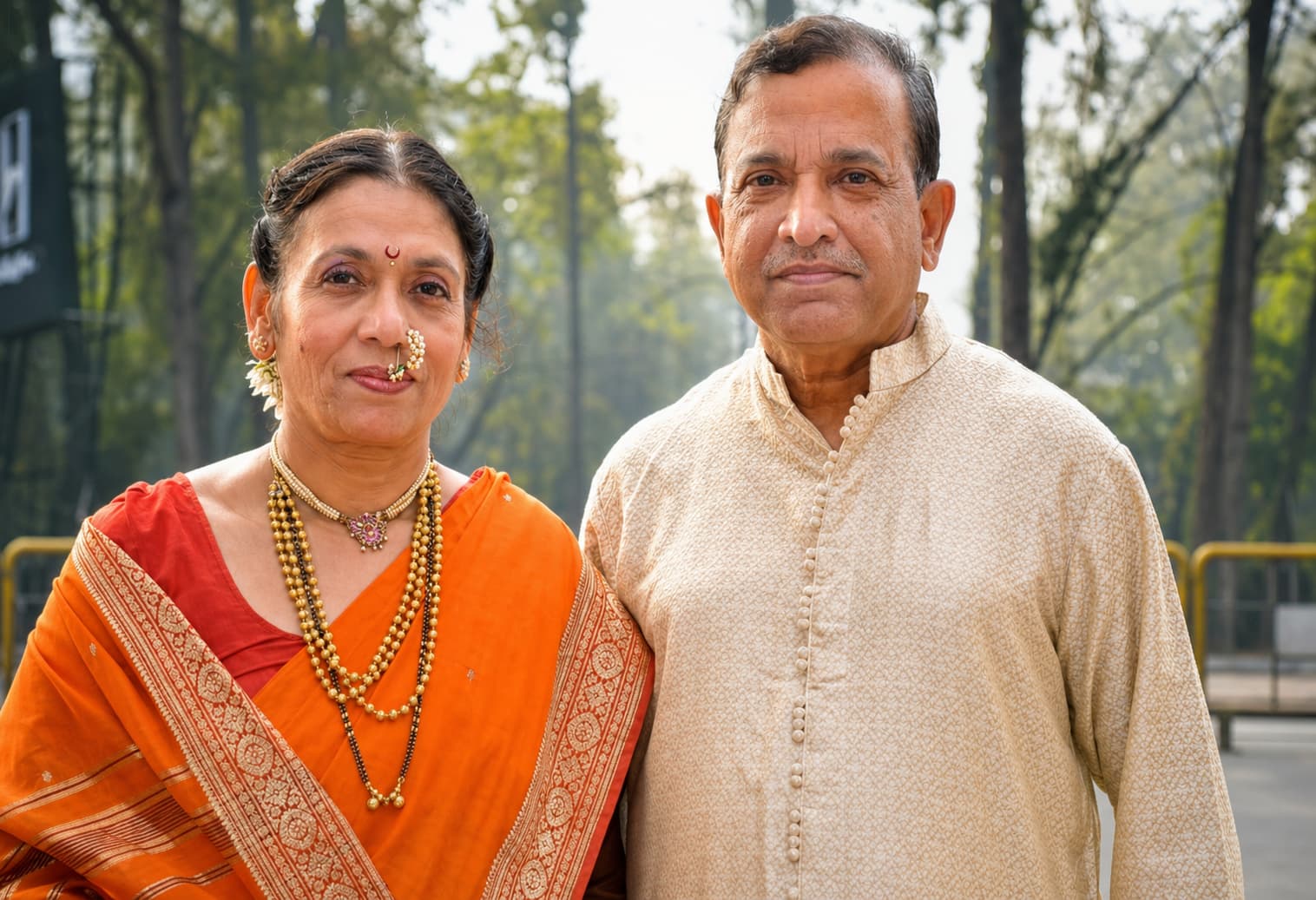
In the late 1970s, a young man from Nagpur’s Institute of Science walked into the Department of Obstetrics and Gynaecology at Government Medical College and announced, in effect, that he intended to make it his life’s work. His colleagues raised eyebrows. Obstetrics and Gynaecology was considered, by unspoken consensus, a woman’s specialty — a domain entered by men only when they couldn’t get into something else. Pradip Sambarey had ranked fifth in the state in his tenth-board examination. He had held a national merit scholarship through five years of MBBS. He could have gone anywhere. He chose the labour ward.
The Male Obstetrician
Pradip was one of seven men from the GMC Nagpur 1973 batch to enter Obstetrics and Gynaecology — alongside Rajiv Laul, Vivek Deshpande, Hari Paranjape, Sudhir Sathe, CL Sonkusare, and Raymond Maughan. In a batch of 205, this was not coincidence. It was, in its quiet way, a minor social fact: a generation of doctors from small towns and government colleges who chose their specialties on merit and inclination rather than fashion.
Pradip was born in Nagpur, the son of a Central Government officer and a homemaker. He attended Jamdar Primary School and CP and Berar High School before moving to the Institute of Science, Nagpur, for his pre-medical year. He entered GMC Nagpur in 1973 and graduated in 1977, national merit scholarship intact throughout.
His internship took him to the primary health centre at Kuhi, where he worked alongside Ajit Pradhan, the late Dilip Magarkar, and Mohan Gupte. The rural posting did what rural postings are designed to do: it showed him the distance between what medicine promises and what it delivers in a village — and it did not discourage him from the specialty he had already chosen.
Forty-Two Years, Five Colleges
Pradip’s MD thesis examined medical termination of pregnancy in the second trimester using intraamniotic mannitol, guided by Dr. Asha Deshmukh. He earned his MD from GMC Nagpur in 1982. Over the years, he also acquired a PhD in male infertility from Mahatma Gandhi Institute of Medical Sciences, Sevagram — becoming, at the time, the first obstetrician in the region to hold a doctorate.
The career that followed was peripatetic by government service standards. Forty-two years, five institutions, one consistent focus. He taught at GMC Nagpur, then at MGIMS Sevagram, then moved to BJ Government Medical College, Pune in 1990. A transfer took him to Bhausaheb Hire Government Medical College, Dhule in 2002, where he was promoted to Professor in 2004. He returned to Pune in 2005, spent time at Swami Ramanand Teerth Rural Government Medical College, Ambajogai, and finally came back to BJ Medical College in 2015 to head the department of Obstetrics and Gynaecology until his retirement on 31 December 2019.
Five colleges in Maharashtra. Each transfer decided not by Pradip but by the machinery of government posting orders. He followed them without complaint and built a body of teaching wherever he landed.
The generation of Indian doctors who built their careers entirely within government medical colleges — moving from institution to institution at the state’s direction, teaching each new cohort from scratch, earning salaries that bore no relation to the complexity of their work — represents something that Indian medicine has largely moved past. Pradip’s career belongs to that generation. He trained hundreds of residents. He brought a PhD to a specialty that rarely demanded one. He did it within the government system, on government time, on a government salary.
The Consultant Who Stayed a Teacher
What his residents remember is not the academic record. They remember how he handled the room. Obstetrics is a specialty that regularly confronts the worst moments of a woman’s life — a dead baby, a failed pregnancy, a diagnosis that changes everything. The clinical facts can be communicated in a sentence. The sentence itself takes years to learn to deliver.
Pradip’s colleagues describe him as a counsellor as much as a clinician. He listened. He explained. He came back the following day to check whether the explanation had been understood. His residents watched him do this and absorbed the method, even when nobody named it.
He was unassuming to a degree his colleagues found remarkable. In forty-two years, he never acquired the performance of eminence that institutional seniority so readily supplies. He downplayed his achievements in conversation. He treated patients with the same manner in his last year of practice that his junior colleagues remembered from his first.
In retirement, Pradip and Dr. Prajakta Divekar — his wife, an ophthalmologist and Professor & Head at MIMER Medical College, Talegaon — live at Viman Nagar, Pune. Their daughter Shiwani works with Microsoft in Seattle. Their daughter Avanti completed her PhD at the Indian Institute of Science, Bengaluru, and is doing post-doctoral work in Michigan.
Pradip retired on the last day of 2019 — a date that has the feeling of a chosen ending. He had ranked fifth in the state at 16. He had held his scholarship all the way through. He had chosen the specialty nobody expected him to choose. He had taught it, at five institutions, for four decades. The day the government finally let him stop, he stopped.