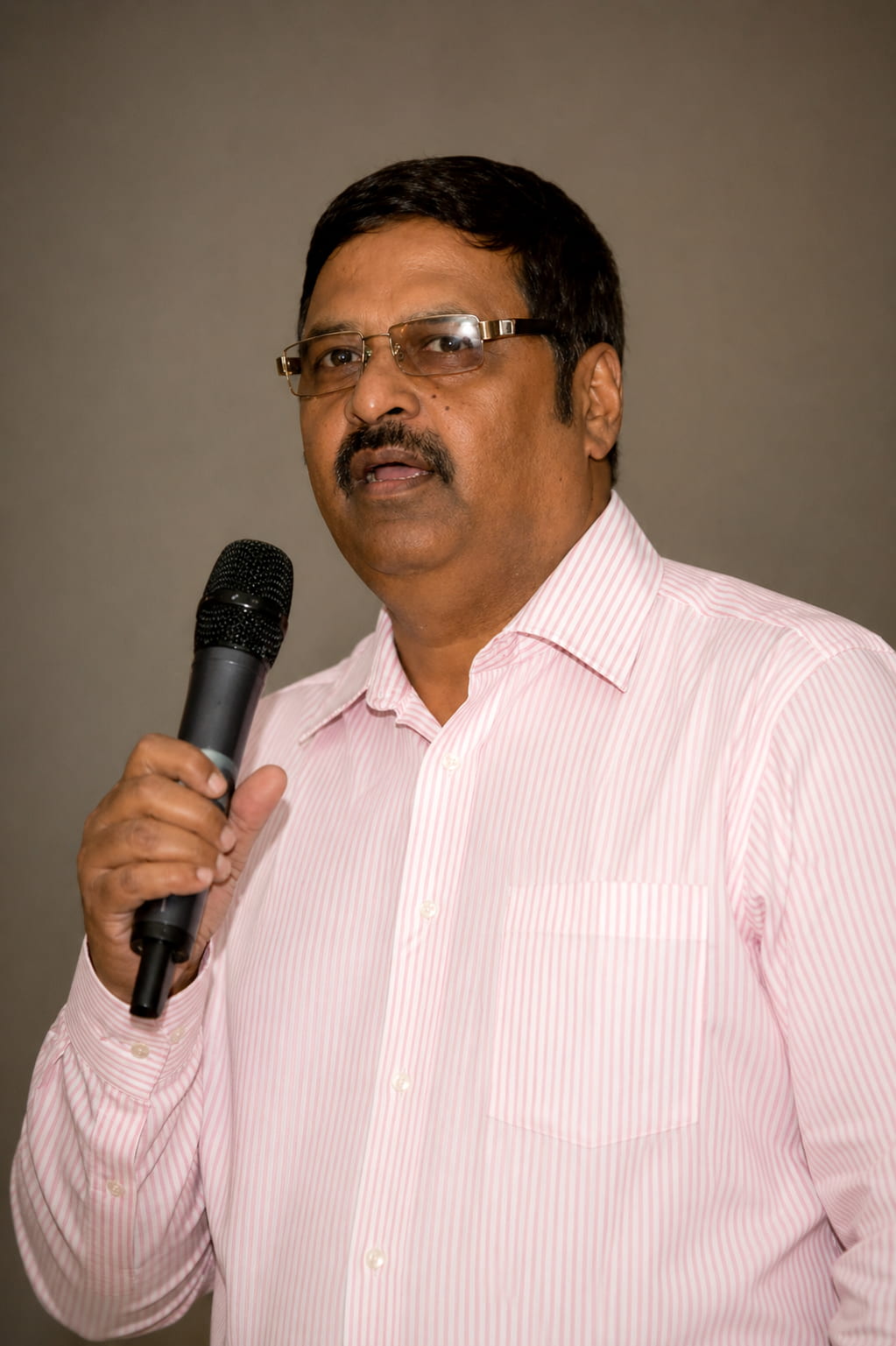
On 2 January 2014, Sharad Adoni walked into a hospital in Nagpur as a patient and came out, a few days later, as a man with three new grafts in his coronary arteries. Within weeks, he was back in Paratwada — back in theatre, back at the operating table, scalpel in hand. His colleagues in the GMC 1973 batch have a name for this informal fellowship: the coronary club. Sharad joined it without ceremony and returned to work without fuss. It is, in a small way, a portrait of the man.
The Son of Paratwada
Sharad was born in Paratwada, a town 30 kilometres northeast of Amravati, and he has never really left. His father practised Ayurvedic medicine, trained at Banaras Hindu University — a detail that matters, because it means Sharad grew up in a household where healing was the family business long before modern medicine arrived. He studied at Sundarabai Gopalswamy High School and IES Boys School in Paratwada, then moved to Vidarbha Mahavidyalaya in Amravati for his pre-medical education, and entered Government Medical College, Nagpur in 1973.
His first MBBS years were shared with Bahekar, Bhaskarwar, Bawage, and PD Deshmukh — first at Smriti Bhavan, then in a rented flat in Chandan Nagar, and finally in the boys’ hostel at GMC. The hostel was a republic unto itself: competitive, companionable, occasionally chaotic, and formative in ways that no lecture hall could replicate.
A Survey in the Dark
The rural internship that followed graduation was, for many GMC students, a bureaucratic obligation to be endured. For Sharad and two batchmates — Satish Bhaskarwar and PD Deshmukh — it became something else entirely. Posted to a primary health centre in Adyal, 86 kilometres southeast of Nagpur in Bhandara district, they found the clinical workload thin. So they went looking for work.
Six kilometres from the centre, they identified a village and decided to survey it for filariasis. What followed was a serious piece of fieldwork. Armed with three vehicles and four microscopes, they conducted door-to-door examinations, collected night blood from 4,000 people, and found that one in six tested positive for microfilariae. The findings were published — in a WHO bulletin and in the International Journal of Preventive and Social Medicine. They did not stop there. The three of them secured over 400,000 tablets of diethylcarbamazine and distributed them across the village.
“We found a streak of public activists in the three of us,” Prabhakar Deshmukh recalled later. Their supervisor, Professor Ketkar, head of Preventive and Social Medicine at GMC Nagpur, encouraged them throughout. It was, for young men still some months from their first clinical jobs, an impressive piece of work.
The Surgeon in the Small Town
After internship, Sharad did house jobs in Surgery and ENT at Government Medical College, Aurangabad. He briefly enrolled in a DMRD programme before securing a seat in the MS (General Surgery) programme — he left the radiology diploma without hesitation. His MS thesis, supervised by Dr. SG Agrawal, examined carotid angiography in head injury. He completed his MS in April 1983.
A year in the cardiac surgery department in Mumbai followed — a year of watching the chest being opened and closed, of learning what the heart looks like when it is threatened. Then, in May 1987, he returned to Paratwada and opened his practice.
He brought laparoscopic surgery to the district in 1991 — early, for a small-town surgeon in Maharashtra. He built a 17-bed hospital and ran it steadily for the decades that followed. Running a busy surgical hospital in a district town is not glamorous work. It demands that the surgeon be available for everything: the hernia that needs fixing, the appendix that perforates at midnight, the road accident that arrives in a car with no warning. Sharad was available. His patients knew this. His reputation spread accordingly.
In 1993, he began working in the Melghat tribal belt alongside members of the Lions Club — adopting villages, planting trees, providing healthcare to people who might otherwise travel long distances or go without. He is closely associated with Sundarabai Gopalswami Boys High School and Mahila Junior College in Paratwada, run by Vidya Vikas Samiti, Achalpur. The community that shaped him became, over four decades, the community he shaped in return.
The Art of Living, and the Coronary Club
Somewhere in the middle of a long surgical career, Sharad found himself drawn to the teachings of Sri Sri Ravi Shankar and the Art of Living. He speaks of knowledge, sadhana, seva, and satsang — not in the manner of a convert making claims, but in the manner of a man who has found something that works.
“Breathing techniques, meditation, and yoga are part of my life now,” he said. “The stress-elimination programmes have given me love, peace, and compassion.” For a surgeon who has spent four decades operating in a small-town hospital with limited backup and no margin for error, the cultivation of equanimity is not a luxury. It is a professional requirement.
Then came the cardiac surgery — elective, triple-vessel, on 2 January 2014. He joined what his batchmates call the coronary club with the same composure he brings to everything else. He recovered, returned to Paratwada, and picked up the scalpel he had put down before the operation. There was no drama in the resumption. It was simply what a surgeon does.
His wife, Dr. Megha, an MBBS and DGO from GMC Nagpur’s 1978 batch, practises gynaecology alongside him. Their son Raghav completed his MBBS at NKP Salve Institute of Medical Sciences in Nagpur. Their daughter Abha works in events management at MIT Pune. The hospital in Paratwada, once a modest beginning, is four decades old now — the same age as the practice of the surgeon who built it.