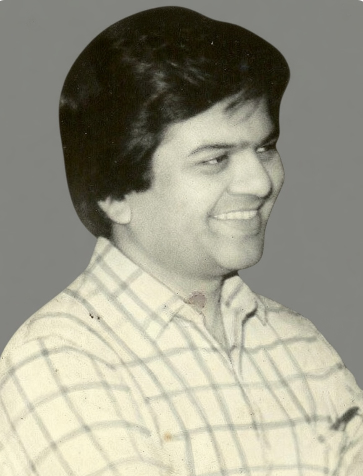
The boys’ common room during lunch recess was the loudest room in GMC Nagpur. Vivek Kulkarni ran it. He would plant himself at the centre of the noise, tease everyone within reach, produce the loudest two-fingered whistle anyone had heard, and then look genuinely surprised when the room erupted. The targets of his teasing found it nearly impossible not to laugh. A day without him was, as his classmates put it plainly, a day of dullness.
He died at 31. Esophageal carcinoma, then perforation, then mediastinitis, in the ICU of St. George’s Hospital, Mumbai. The class of 1973 had not expected to write an obituary so soon.
Tillya
He was called Tillya. The name was his in the way certain nicknames become permanent — chosen by the group, stuck for life, and carrying more affection than any formal address. Our paths first crossed in the queue at the GMC administrative office in July 1973, collecting documents for registration. From that day until March 1987, we were inseparable.
Vivek was born in Nagpur, the son of Appasaheb, a teacher whom his students held in deep regard. The gift of language came naturally — Vivek had topped his 10th standard board examination in 1971 and gone on to accumulate more than a hundred prizes and awards in debate and elocution at the university level. His command of English and Marathi was complete. On a stage, with a complex argument to unpick, he was something to watch: he could dissolve a difficult question into its simplest parts and make the audience wonder why they hadn’t seen it that way themselves.
He seemed shaped by nature for presence—a tall frame, an easy charisma, a luxuriant sweep of hair, a quick mind, and a repartee that landed clean and bright. Above all, there was that smile—winsome, disarming—that lit up even the dullest hour. He became, almost at once, the pulse of our unruly circle, leading our mischief with a kind of joyful authority.
At lunch, the boys’ common room erupted into a familiar theatre of noise and laughter, with Vivek at its centre. He would rope in Ved Prakash Mishra (1972 batch) for their ritual contest—two fingers to the mouth, a shrill whistle, each trying to outdo the other as the room roared. The same spirit spilled into the Coffee House, where Vivek set the tone and carried the crowd with him. He teased freely, sometimes mercilessly, yet so deftly that even his targets dissolved into laughter. On the rare day he was absent, the campus felt oddly muted, as if someone had turned the volume of life down a notch.
He was also a cricketer. A social activist — anti-dowry campaigns, Andhashraddha Nirmulan, causes that mattered. He read newspaper editorials when most of us were reading the cinema listings. He tuned in to AIR broadcasts. He paid attention to the world.
And yet none of this was ever heavy. Tillya made everything light. He could be quite particular about small decisions — full cup of tea or a ‘cut’, two samosas or one, which fabric for his shirt — and he made these deliberations funny. He made everything funny.
The Doctor
He was also a very good doctor. He became the first lecturer from our batch — a distinction earned early and deserved. He progressed to associate professor, qualified as a postgraduate teacher, and married Kishori. Even after marriage, whenever they planned an evening out, Vivek’s scooter would reliably end up at my door, or at Uday Gupte’s. Some habits resist domestication.
Their son Dhawal arrived in 1985. Vivek was 30. He had, by then, a full life — a career ascending, a family begun, friendships that had deepened over twelve years of shared mess food and shared wards and shared coffee at the Coffee House where he always led the laughter.
February 1987
In February 1987, he began to bleed. He went to Shriram Kane, who had recently set up his haematology practice in Nagpur. Large thrombi formed in the calf veins — cancer-associated venous thrombosis, a cruel combination of clotting and bleeding that placed Kane in a position no doctor wants to occupy: managing a catastrophic illness in a classmate. Barium studies revealed the rat-tail narrowing of esophageal carcinoma. The endoscopy was done in Mumbai, where Vivek had been taken for treatment. His condition fell rapidly after the procedure.
He died in the ICU of St. George’s Hospital on 4 March 1987. He was 31.
Three days later, Sunil Gavaskar became the first batsman to score 10,000 runs in Test cricket. Tillya would have wanted to see that. He didn’t.
What He Left
None of us were with him at the end. That is the fact we have carried for thirty-seven years.
What remains is the noise of the common room, and the two-fingered whistle, and the way he made even his targets laugh. A life of 31 years that was, by any measure, a full one — and a loss that changed the texture of everything that followed.
Omar Khayyam wrote: “The moving finger writes, and having writ, moves on.” Vivek Kulkarni was one of the finest lives the moving finger ever briefly touched.
Here is a refined version with smoother flow, tighter phrasing, and a more resonant close:
Epilogue
After Vivek’s passing, we chose remembrance over silence. His name found a living voice in the intercollegiate elocution contests we began, and in a trophy instituted in his honour—traditions we sustained, year after year, for nearly a quarter of a century. In time, grief softened into continuity. Kishori Nisal, his wife, stepped away from her teaching position at GMC and now serves patients in private practice.
Dhawal took a different road, one that carried him far from home. He graduated from Shri Ramdeobaba Kamla Nehru Engineering College in 2007 and went on to pursue a master’s degree in Robotics in the United States. Today, he lives in Dallas, Texas. On 12 March 2012, he married Sneha, a software developer specialising in cloud technologies with American Airlines. Beyond her work in technology, Sneha moves with equal ease in the creative world—on stage and screen—and is remembered for her lead role in the 2012 Marathi film Yedyanchi Jatra.
In these diverging journeys—one rooted in service, the other reaching across continents—Vivek’s memory endures, not as a shadow of loss, but as a quiet, abiding presence.
By Dr Vivek Deshpande | GMC Nagpur Class of 1973