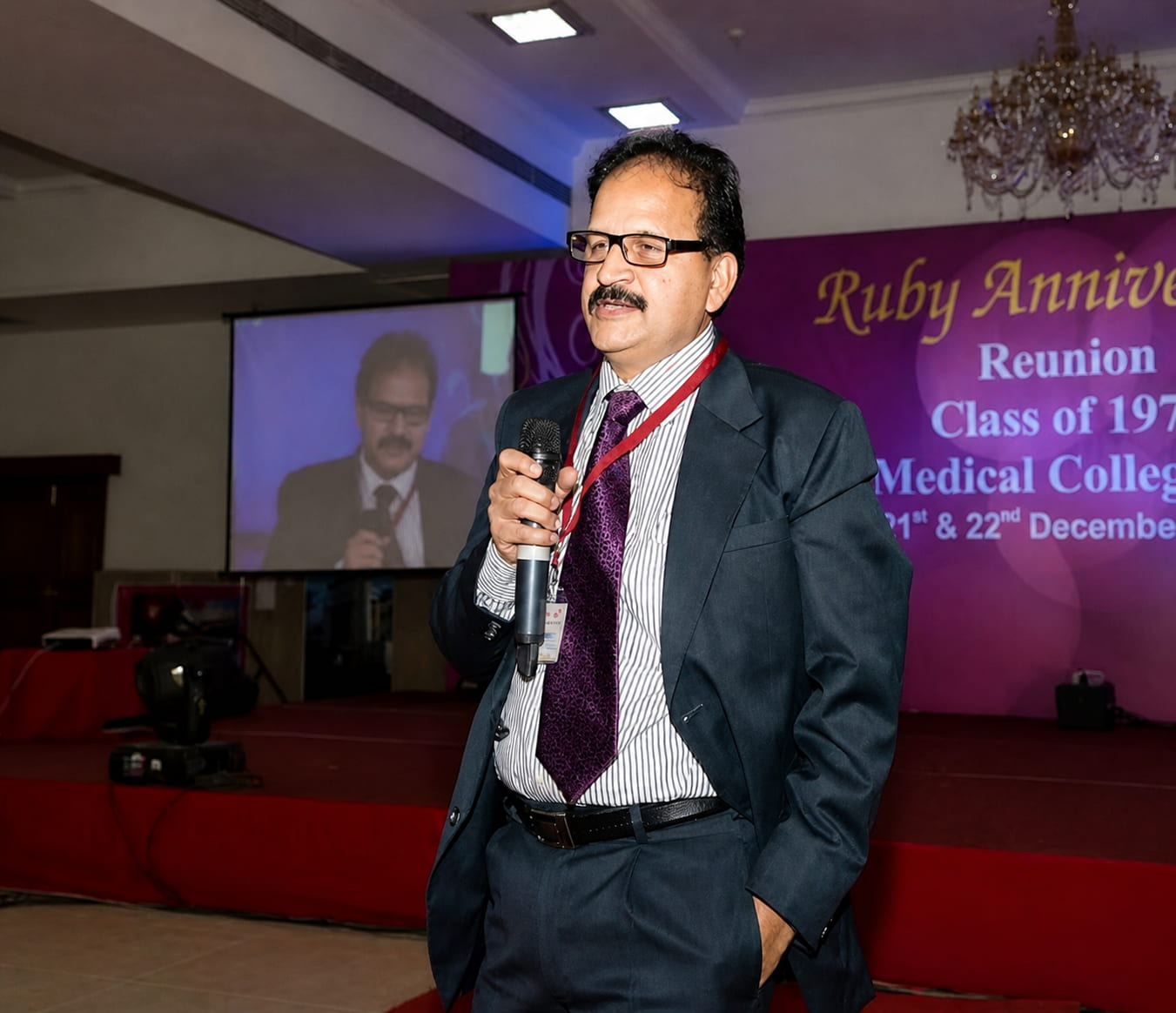
The sentence Kishore Kedar uses to describe forty years of cardiology is short enough to fit on a prescription slip: “My job is to make breathless patients breathe well.” Eleven words. No elaboration. He has been doing this work since 1984, in Akola, in a practice he built from scratch when the town had no Cath lab, no echocardiography worth mentioning, and no cardiologist within reasonable reach.
The Boy from Patansavangi
Kishore was born in Patansavangi, a farming village in Saoner taluka, 27 kilometres north of Nagpur, on 2 October — the birthday he shares with Mahatma Gandhi. His father farmed the land. Kishore did his primary and secondary schooling in the village, then made the move to Nagpur, where he attended CP and Berar High School, Ravi Nagar, before joining the Institute of Science for his pre-medical year. Government Medical College, Nagpur admitted him in 1973.
At GMC he was part of a cohort that came largely from small towns and farming families — students for whom medicine was not a family inheritance but a door that opened, unexpectedly, through merit. Kishore walked through it and kept walking.
After graduation, he interned at Government Medical College, Nagpur, and chose Rohana primary health centre for his rural posting — working alongside Prakash Wakode, Aziz Khan, and Dhirendra Wagh, three classmates who would each, in their own way, go on to build institutions. He then enrolled in the MD (Medicine) programme at GMC Nagpur, where he studied systolic time intervals for his thesis under Dr. S.M. Patil. Medicine suited him. The discipline of it, the requirement of careful attention before any intervention. He completed his MD and set his sights on cardiology.
The Long Road to the Cath Lab
In Mumbai, at Grant Medical College, Kishore trained in DM Cardiology alongside Aziz Khan — two Akola-bound doctors taking the same advanced course, bound in different directions afterward. Kishore returned to Akola in 1984. Aziz would follow, separately, to build his practice in Nagpur.
Kishore began in an era before the machines arrived. Echocardiography offered only M-mode. There were no Cath labs in Akola, or anywhere close. Diagnoses rested on a history carefully taken, a chest examined with patience, an ECG read by a physician who trusted his clinical instincts as much as the tracing. Kishore had trained precisely for this. He set up his nursing home and began admitting seriously ill patients — failed hearts, water-logged lungs, dangerous arrhythmias.
The work was relentless and the patients were often in extremis when they arrived. He stayed. For seven years he ran inpatient cardiac care out of his own facility, treating the kinds of cases that, in larger cities, would have been managed in well-staffed ICUs with round-the-clock backup. In Akola, the backup was Kishore himself.
Then, with characteristic practicality, he made a decision that others might have found difficult. He closed the nursing home and began admitting his patients to the corporate multi-specialty ICUs that had started appearing in the town. His reasoning was direct: “I felt that if I don’t do this, one day I will be occupying my own ICU bed.” Not self-deprecation — an honest assessment of sustainable practice, from a man who had spent years understanding the physiology of the heart’s limits.
What Forty Years Teaches
The town around Kishore changed considerably between 1984 and 2024. Akola now has two Cath labs and five cardiologists. The interventional landscape that was entirely absent when he arrived has become, in his later years, reliably populated by colleagues equipped to do what the specialty now demands. He watched this happen and, in watching it, adjusted his own role with the same precision he once applied to reading an ECG.
By December 2023, Kishore had stopped inpatient work entirely. He refers all admissions to colleagues. His day runs from 11 in the morning to 7 in the evening, outpatient only. The decision carries none of the bitterness of retreat — it reads instead as the conclusion of a long, considered reckoning with what medicine should ask of a physician at any given stage of life.
His wife Madhuri is a physiotherapist. Their daughter Aditi, and their younger daughter Aishwarya — an MBBS from Government Medical College Akola, then a resident in Respiratory Medicine at Jawaharlal Nehru Medical College, Sawangi — carry the family’s investment in medicine forward into the next generation.
Kishore Kedar came from a village, trained in a city, and spent his career making Akola’s most breathless patients breathe. He did it in an era when the tools were few and the physician was the primary instrument. That the tools multiplied around him, and that he used them wisely and then stepped aside when others could use them better — this, too, is a kind of clinical judgement.