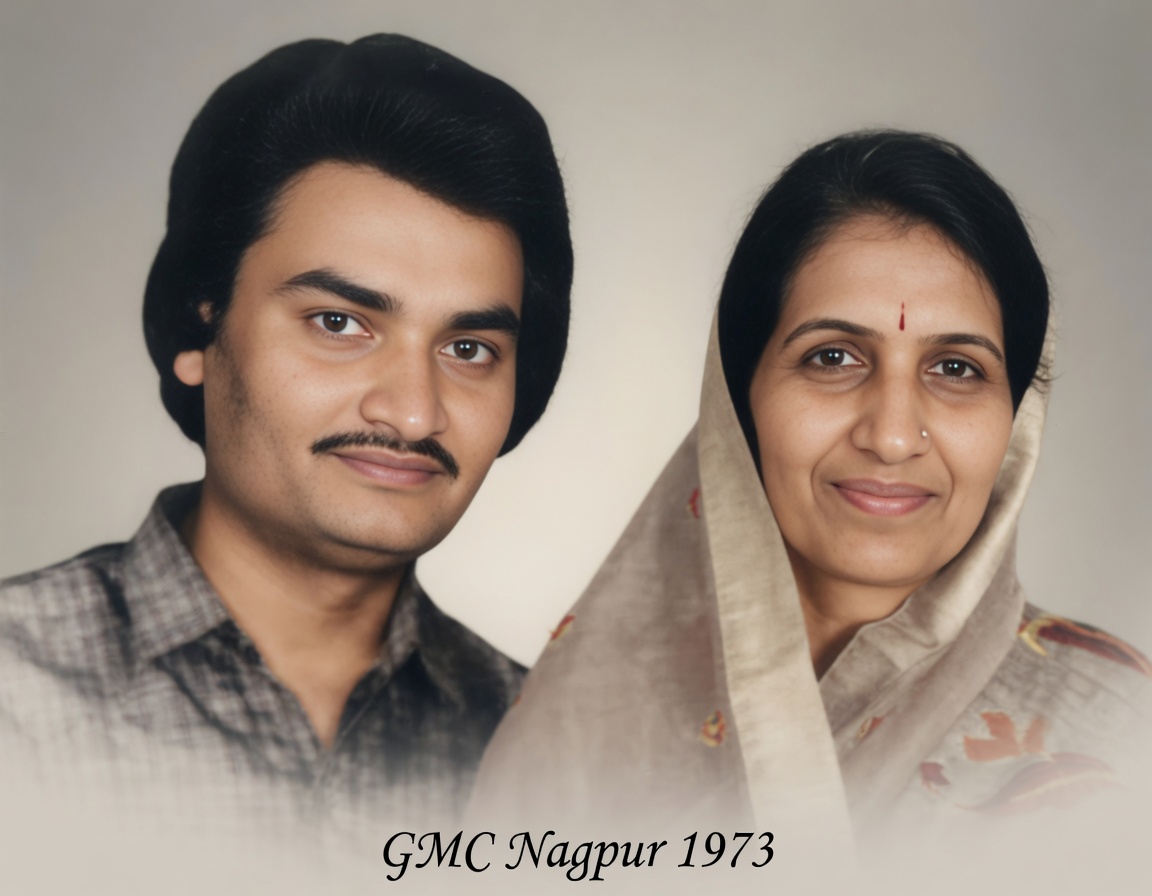
The laughing triumvirate of the GMC 1973 batch — Satyanarayan Rathi, Laxmikant Rathi, and Ravi Kasat — was not a formal arrangement. No one elected them, no one gave them a name. But anyone who spent time in the corridors and hostel rooms of Government Medical College, Nagpur, in the mid-1970s knew the sound of their combined laughter: enormous, unrestrained, and impossible to ignore. The corridors resonated. Satyanarayan, or Satya as he was known, could produce that laugh at the drop of a hat. He could also make everyone around him produce it.
He died in Ujjain in the summer of 1994, aged 39. He had not yet found the peace that his friends believed he deserved.
The Boy from Daryapur
Satyanarayan, son of Shri Damodar and Smt. Kamala Rathi, was born in Shegaon and grew up in Daryapur, a city 52 kilometres west of Amravati. He studied at Adarsh High School, Daryapur, and completed his Higher Secondary Certificate from Khamgaon before entering GMC Nagpur in 1973.
He was, by all accounts, a natural — warm, funny, impossibly stylish in the way that young men from small Vidarbha towns sometimes were when they arrived at the city college and discovered bell-bottoms. The flared hems and wide leg openings were not affectation; they were conviction. Satya wore them with the confidence of someone who knew he looked well and did not care who disagreed.
But beneath the stylish sartorial tastes and the bell-bottom swagger was a mind that paid attention. He read newspapers for the editorials, not the cinema listings. He had opinions. He argued them.
After GMC
Satyanarayan graduated from GMC in 1977. His rural internship at the primary health center at Parseoni was shared with Prakash Katariya, Suresh Batra, and Rajendra Sarda. After internship, he returned to Daryapur and opened his practice. He worked as a medical officer at Loni and at Bombay Hospital before settling back in Daryapur as a general practitioner.
General practice in a small Vidarbha town in the 1980s was honest work: irregular patients, irregular income, no institutional support, and the expectation that the doctor could manage almost anything that walked through the door. Satyanarayan managed.
Then the losses began.
Grief, and Then More
In the mid-1980s, his younger brother Shyam — an alumnus of MGIMS Sevagram from the 1976 batch, a gold medallist in DLO from Nagpur University — fell ill with interstitial lung disease while completing his post-graduation in ENT at Sevagram. He had been married barely a year. He died within months. SP Kalantri, who had housed Shyam during those difficult final months, described the loss as one he found hard to bear. For Satyanarayan, it was a rupture.
He continued to practice. The Daryapur clinic was his anchor, and he held it.
In the summer of 1994, Satyanarayan Rathi died, presumably of cystic bronchiectasis — a ruptured cyst caused fatal pneumothorax. He was in Ujjain. He was 39 years old.
His wife Meena survived him. She died on 25 May 2017.
What Was Left
His son Govind was five years old when his father died. He grew up knowing his father through his mother’s stories, his uncle’s accounts, and the occasional mention in his father’s batch. SP Kalantri spoke to Govind on 15 February 2021. “I told him that his father was always a character,” Kalantri wrote, “and possessed one of the unique senses of humour one could ever encounter.” Govind, who holds an engineering degree and an MBA and lives in Mumbai, felt proud that his father’s classmates still remembered him.
His daughters, both married, live in Mumbai and Bengaluru.
The class of 1973 remembered the bell-bottoms. They remembered the belly laughs. They remembered the warmth that animated both. Satyanarayan Rathi had not found settled ground in his brief professional life — the moves between Loni and Bombay Hospital and Daryapur suggest a restlessness that never quite resolved. But the laugh did not require resolution. It was its own complete thing, and it filled every corridor it entered.