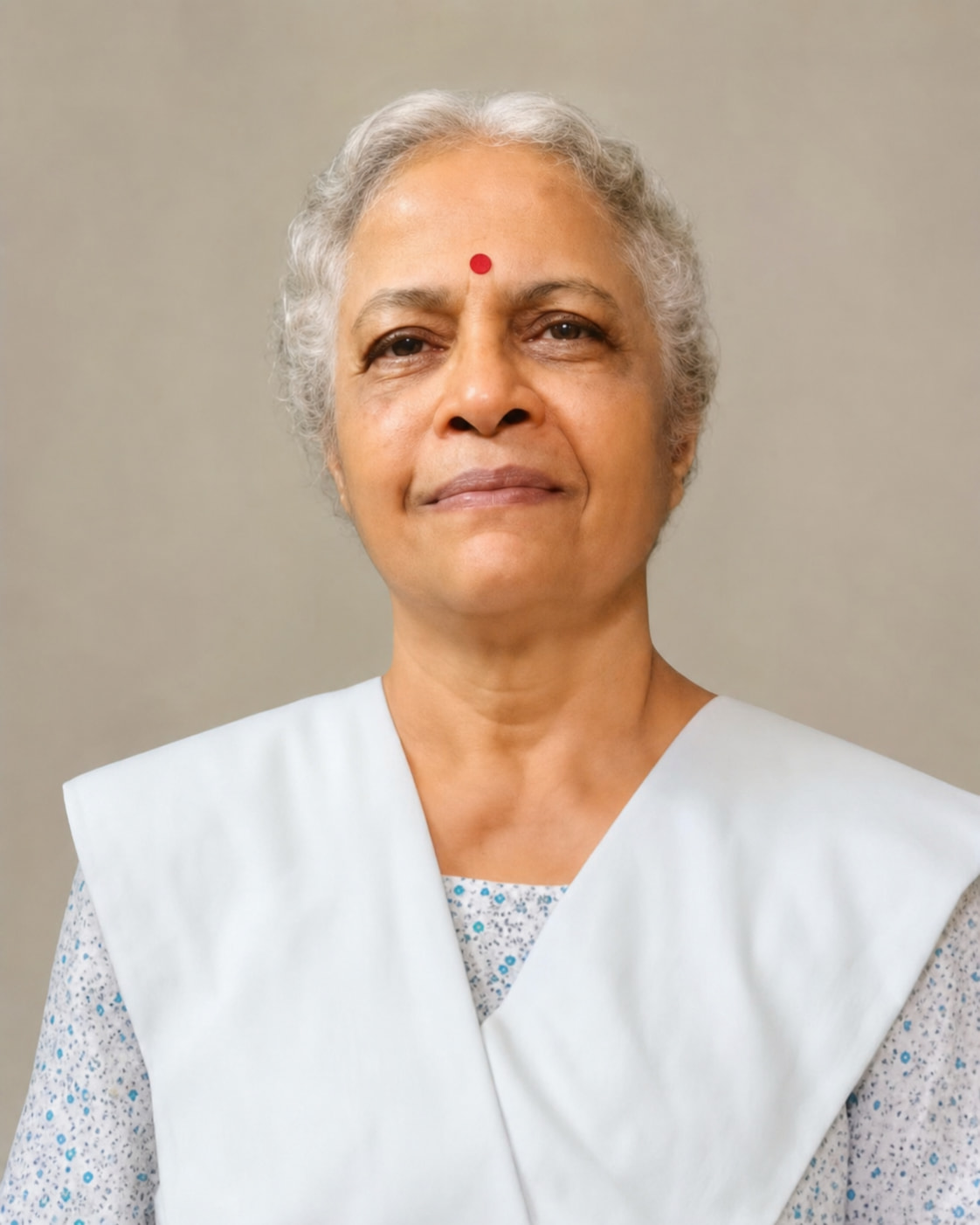
At fifteen, Vimala Iyer read Swami Vivekananda. The books did not produce an immediate transformation — she was still a schoolgirl in Nagpur, still years from medicine, still years from the ordnance factories and the ashrams and the slow relinquishing of one life for another. But something settled then that would not fully dislodge. “Saints’ guidance,” she says, “whether in books or in presence, profoundly influenced my positive path.”
She chose not to marry. She chose not to pursue postgraduation despite marks that could have taken her anywhere. She chose, in 2001, to take voluntary retirement from government service and walk into Anandashram in Kanhangad, Kerala — the abode of bliss, founded by Swami Ramdas in 1931 — where she has lived ever since. She describes none of these choices as sacrifices. She describes them as destiny.
The Daughter of a Clerk
Vimala was born in 1956 in Khandwa, Madhya Pradesh, the youngest of three children. Her father, Shri KV Subramanian, was a clerk with Indian Railways who rose to office superintendent; her mother, Annapurni, was a homemaker of exceptional capability. Her two brothers became engineers. She grew up in railway quarters, moving as postings moved, until the family came to Nagpur in 1965 when she was 9.
She did her schooling at St Joseph’s Convent, Nagpur — five to eleven standard — and speaks Hindi and Marathi with the fluency of someone who absorbed both from the streets and classrooms of Vidarbha. She enrolled at the Institute of Science for her pre-university year and entered Government Medical College, Nagpur in 1973.
During those years she was, by her own account, studious and reticent — perceived as hardworking, a girl who wore thick glasses and rarely smiled. She commuted five kilometres by bicycle from the Motibagh Railway Quarters every day; in the third year, her brother took pity on her and convinced their father to buy her a moped. Sujata Pandya, who lived in Mohan Nagar, rode with her.
The Long Way Round
She graduated, did house jobs in Unit 1 Medicine and in TB and Chest at GMC Nagpur. Her marks could have secured postgraduation in any clinical subject. Instead, financial hardship intervened: her father had retired without a pension, and the family needed income. She abandoned the TB posting halfway, wrote the UPSC examination, and joined the ordnance factory hospitals under the Ministry of Defence.
Her first posting was Bhusawal. She had to look at a map to find it. She joined on 11 October 1979, bringing her parents with her.
Within a week, a colleague invited her to satsang. The seeds that Vivekananda had planted fifteen years earlier found soil. She spent five years at Bhusawal, then resigned in 1985 and went to Ganeshpuri Ashram in Thane district for a year. Her father said she was “a different daughter.” The Ashram was beautiful, tranquil — she felt, she says, the world slipping away on entry.
She came back to Bhusawal after a year to care for her parents. Dabbled, briefly and successfully, with private practice — earning genuine respect, working until midnight, building trust quickly. Her mother wanted her in the safer ordnance factory. The General Manager and local community urged her back. The government, unusually, waived her five-and-a-half-year absence and restored her service. She returned.
The next fifteen years moved through ordnance factories: Bhusawal, Heavy Vehicle Factory at Avadi in Chennai, Medak in Andhra Pradesh, Khadki in Pune, Dum Dum in Kolkata, back to Bhusawal. She was 45 when her father died. She had already known, for some years, where she was going.
Kanhangad
In 2002, she took voluntary retirement, qualifying for a modest pension. Her father’s death in 2001 at age 82 had made her realize she no longer needed to earn a living—her mother was a simple, contented soul, and the savings she had accumulated would suffice. She thus applied for voluntary retirement with the minimum pension that year.
She came to Anandashram in Kanhangad, District Kasaragod, Kerala — 84 km southeast of Mangalore — bringing her mother with her. Her mother lived there for nine years and died in 2012. “I am whatever I am because of my mother,” Vimala says. “She slogged very hard, often enduring hunger.”
Her days at the ashram begin with the Vishnu Sahasranaam, move through chanting and meditation, and include the medical work she still does — patient care alongside the spiritual practice, the clinic and the contemplative life woven together without apparent contradiction.
She has no regrets about postgraduation foregone or marriage declined. “For the first few years, I did feel a tad disappointed,” she concedes about the postgraduate degree. “But with the passage of time, I took this in my stride.”
The arc of her life is unusual in this archive of 205 doctors — not the medicine abandoned, but the completeness with which she replaced it with something else and the absence of any apparent nostalgia for what she left. She chose, she says. Destiny confirmed.
I am profoundly grateful to the Divine for shaping my life this way, with spiritual pursuit as my central calling. All else—medical work, my passions for gardening, cooking, sewing, and more—serves as mere supporting acts in the divine drama. I observe them as a detached witness, embracing everything as God’s will without rejection, for it is all His divine play. We take birth solely for the clearance of our karma.