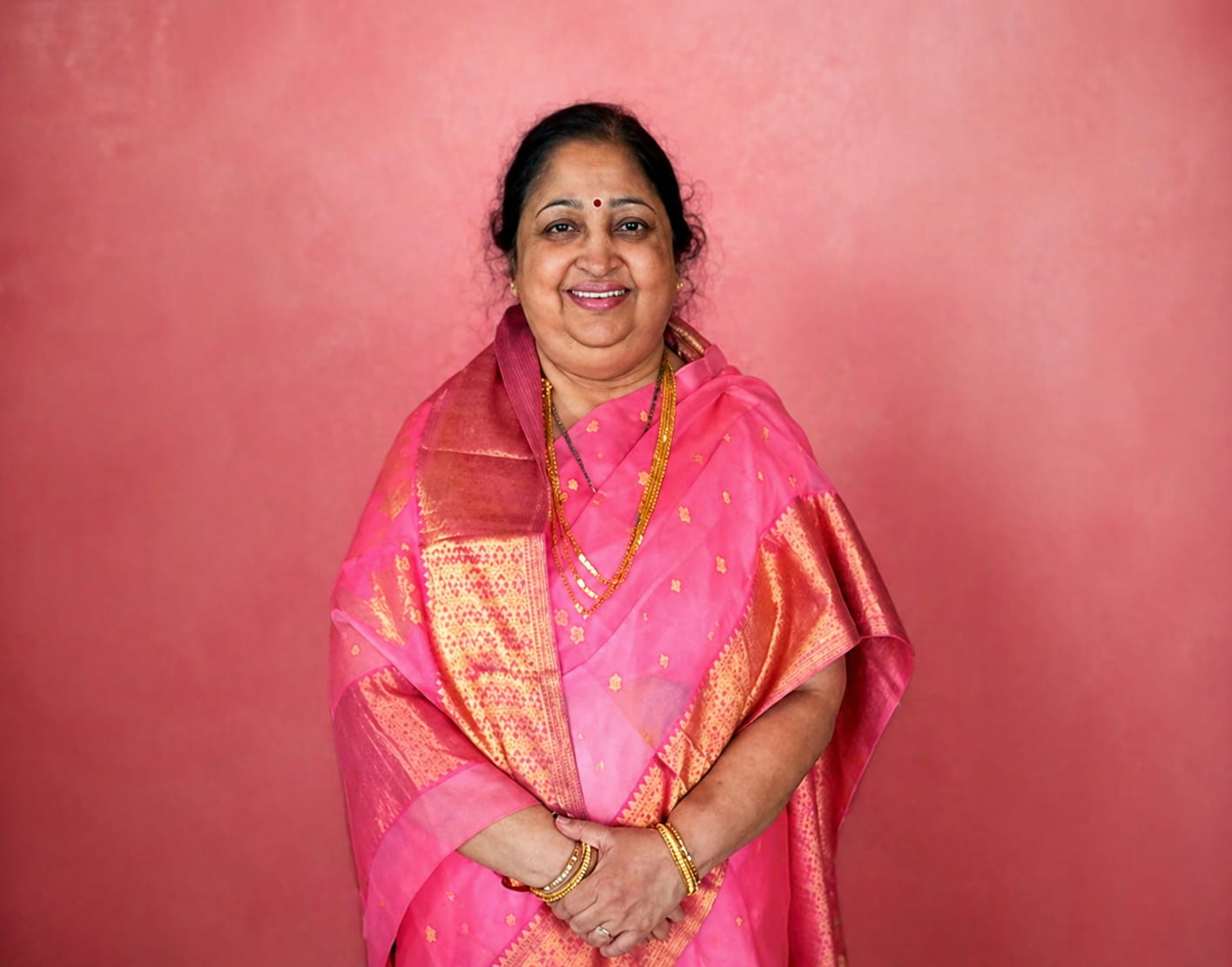
The Athare Patil Hospital at Savedi, on the Nagar-Manmad road outside Ahmednagar, is the kind of institution that takes decades to build and a certain kind of person to sustain. Sixty beds. An ICU. A trauma unit. Surgical and gynaecological care for a district and beyond. Beside it, on 25 acres, a school with 500 boarders and 1,500 day scholars. Across from both, an orphanage housing 80 children — 30 of them girls — arranged in ten homes, each with a living room, a kitchen, and a housekeeper, and managed with the quiet care of people who understand that a child’s safety is not a project but a commitment.
Anjali Sapkal built this with her husband, Dr. Anil Athare-Patil, over forty years in Ahmednagar. She began as a gynaecologist. She became something harder to name.
A Father Who Believed in Education
Anjali was born in Gwalior, at her maternal grandmother’s home. Her father, Advocate Nilkanth Shridhar Sapkal, was president of Zilla Parishad, Akola, in 1962, founder chairman of Akola District Central Cooperative Bank, and Co-operation Minister in the Maharashtra Government from 1973 to 1975. He was a man of public life, and he believed — without reservation — in education as the foundation of everything else.
Anjali went to Government Girls’ School, Akola, through eighth standard, then to New English High School for the tenth. Her premed year was at Shri Radhakisan Laxminarayan Toshniwal College of Science, Akola. In 1973, she entered Government Medical College, Nagpur.
At GMC, she found her people quickly: deep friendships with Archana Srivastava, Anjali Sapkal, Ramesh Mundle, Nandakishor Chandak, and others. After graduation in 1978, she enrolled in the MD programme in Obstetrics and Gynaecology. Her thesis, supervised by Dr. Shastrakar, examined the floating foetal head in primipara — a clinical problem with real consequences in a country where antenatal care was then uneven at best. She obtained her MD in 1982.
On 9 February 1981, she married Dr. Anil Athare-Patil, a surgeon from Grant Medical College, Mumbai. After her MD, she followed him to Ahmednagar.
Ahmednagar, and What Grew There
The hospital came first, as it had to. Then the school. The Athare-Patil Public School — 25 acres, 500 boarders, 1,500 day scholars, an institution with a physical scale unusual in a district town of Maharashtra. The impulse behind it was not complicated: Anjali’s father had believed in education, and Anjali and Anil had the resources and the conviction to act on that belief.
The orphanage arrived in 2007. Eighty children, approved by Bal Kalyan Kendra — born out of wedlock, orphaned, or from families too poor to raise them. They live in groups of eight in ten homes, each managed by a housekeeper who functions as a surrogate parent. The children stay until they can stand on their own; the girls, until they marry. Anjali and Anil provide for them as they go.
The hospital, in the meantime, continued its work: free camps, surgical outreach, gynaecological care for patients who could not have afforded it elsewhere.
The Children
Her son Mansingh began playing professional lawn tennis before he started school. He competed in Asian Junior Tennis Championships. He studied Risk Management and Insurance at Troy University, Alabama. He returned to India after the Covid pandemic disrupted professional circuits in Portugal and now coaches tennis in India. Her daughters, Gauri and Aditi, are both dentists — Gauri in Nagpur, Aditi in a different direction entirely: she married Jeffrey Curtis, a mechanical and business graduate, and together they run Bigstage Productions, an event management company.
These are children raised by a woman who built a hospital, a school, and an orphanage in one district town, and still found time to practice gynaecology. The lesson was not explicit. It did not need to be.
Anjali Sapkal came to GMC Nagpur from a family where public service was assumed and education was non-negotiable. She left Ahmednagar — or rather, she never left — having built institutions that will outlast her by generations.
Her father, the minister who believed in education as an everlasting gift, would have recognised what she did. He would also have known, as she did, that the gift was never only for her children.