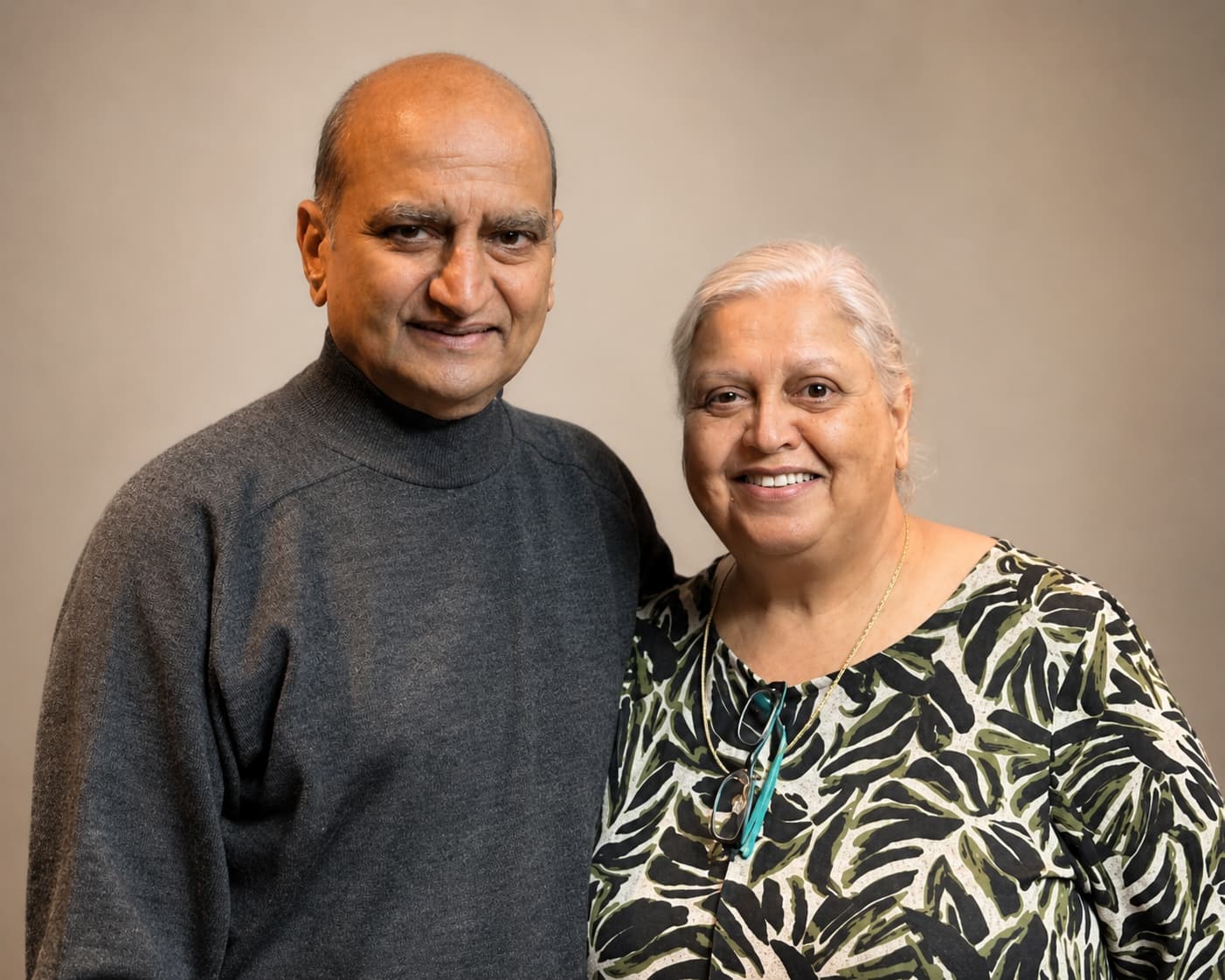
Alison Girling believes in the predictive power of a terrace on a holy night. During her years at GMC Nagpur, she once spent Shivratri at the home of her classmate, Ratna Shekhawat. Ratna’s father, a man who claimed a deep understanding of the science of foretelling, looked at Alison and traced the lines of a future she hadn’t yet imagined. Surprisingly, every detail he predicted—the moves, the marriage, the distant shores—eventually came to pass. For Alison, a career that spanned the wards of Mumbai, the heat of Riyadh, and the green dales of Derbyshire was not just a series of professional posts, but the unfolding of a script written long ago on a Nagpur rooftop.
The Nomadic Daughter
Alison was born in Mumbai into a family defined by the logistics of the Nehruvian era. Her father was a divisional engineer for Bharat Petroleum, a role that made the family a permanent fixture on the Indian railway map. Every two years, the bags were packed, and Alison was introduced to a new school, a new dialect, and a new set of classmates. From the convents of Belgaum and Goa to the military atmosphere of Mhow in Madhya Pradesh, she learned the art of the quick arrival and the graceful exit.
By the time she reached St. Francis De Sales (SFS) College in Nagpur for her pre-medical education, she was ready for stability. Entry into GMC Nagpur in 1973 provided it. In the hostel, the nomadic girl finally found an anchor. She and her room partner, Archana Srivastava, developed a ritual of spiritual insurance—visiting both the church and the temple before every exam. “Archie’s mum,” Alison recalls with a smile, “was the one who finally taught us how to tie a sari in the hostel.” It was a quintessential GMC moment: a group of girls from diverse backgrounds huddled in a small room, mastering the pleats of adulthood while laughing about the lectures they had just missed.
The Riyadh Pivot
The defining professional turn in Alison’s life happened in Mumbai, triggered by a family crisis. Her twenty-one-year-old brother suffered a ruptured cerebral aneurysm in Goa and was rushed to Bombay Hospital. While Alison was at his bedside, she began talking to the neurosurgeon, who introduced her to the head of Anaesthesia. The conversation resulted in an immediate job offer. It was in the high-stakes environment of the Bombay Hospital ICU that she met Sanjay Saxena, an anaesthetist from Bhopal.
They married in the summer of 1984 and, like many of their generation, looked toward the Middle East. In the 1980s, the “Gulf Dream” was the primary mechanism for young Indian doctors to bypass the slow financial crawl of the domestic public sector.
We wanted to earn enough money to buy a flat in Mumbai. We had originally planned for just a year—but eventually ended up spending 14 years in Riyadh. The financial goal was achieved, but the experience of working in a different cultural and clinical setting changed our perspective on what it meant to be a specialist.
In 1998, a second migration followed. To ensure their sons, Karan and Rishi, received a global education, the Saxenas moved to the UK. Alison joined the NHS at Royal Derby Hospital, navigating the shift from the private-heavy Gulf system to the structured, state-funded healthcare of Great Britain. She became a fixture in Derby, a city she describes as the gateway to the scenic Peak District.
The Echoes of Saoner
Retired a decade ago, with Sanjay following in 2019, Alison now lives in Derby. Her days carry a quiet sense of purpose—volunteering with the church, serving on the parish pastoral committee, and, five years ago, during the dark stretch of the pandemic, working as a COVID steward.
Yet Vidarbha has never quite left her. The memories remain bright and immediate: Vilas Tambe’s “cheery red scooter,” always ready to offer her a lift, and the spirited, unforgettable sessions at the Rural Health and Training Center in Saoner.
I cannot forget Saoner—we had so much fun there—long walks in the mornings, watching the blockbusters of the 70s in the afternoons, and dancing merrily in the nights. Although I am geographically away, emotionally I am very close to the batch of 1973. Please keep updating me with the gossips and anecdotes that the reunion is sure to generate.
Alison’s life represents the global diaspora of the GMC 1973 batch—a generation that exported Indian medical excellence to every corner of the map. She is the completion of the circle that began on that Nagpur terrace: the girl who learned to tie a sari in a hostel room and ended up navigating the complexities of the NHS, always carrying the warmth of the “old gang” with her.