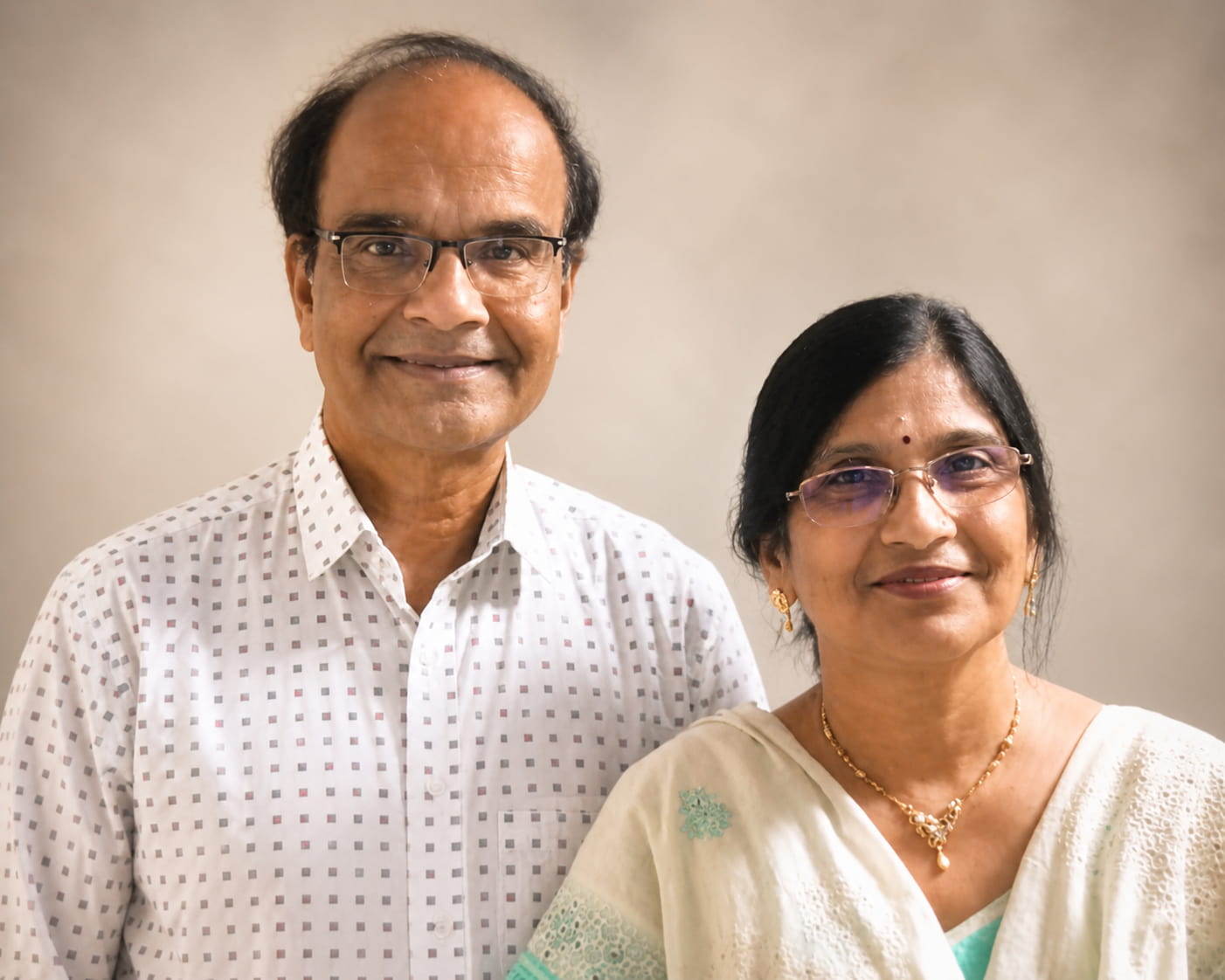
BH Bahetee remembers the fear. In his student days at GMC Nagpur, Anatomy was a “rite of passage” characterized by “awe rather than joy”. Students were expected to memorize the minutiae of muscles, nerves, and vessels with little understanding of how they connected to the breathing, suffering person in the hospital bed. But as his career progressed—from the high-volume wards of Ambajogai to the Vice Dean’s office at BJ Medical College, Pune—Bahetee dedicated himself to a single, transformative mission: “injecting bright hues” into the gray science of the dead.
The Engineer’s Detour
Bahetee was born in Washim, the son of a farmer and businessman. Like many in the Class of 1973, his entry into medicine was an act of filial piety. His heart was set on engineering and mathematics, but his chronically ailing mother, Anandibai, had a different wish. When she passed away while he was in the ninth standard, Bahetee “bowed to her wish” and opted for Biology.
He arrived at GMC Nagpur via RLT College in Akola, renting a room at Mehadia Square in Dhantoli. His academic journey was defined by a steady, quiet discipline. After an internship at Deolapar—alongside Rooplal Lanjewar and Pradeep Deshpande—he returned to the very subject that had once evoked such dread. In 1980, he joined SRTR Medical College in Ambajogai as a lecturer in Anatomy, eventually obtaining his MS in 1985.
His thesis was a testament to his engineering mind: he examined the termination of optic nerve fibers in the brains of albino rats. It was a topic so challenging and microscopic that Bahetee notes it was “never done before, nor likely to be attempted in the future”. Under the guidance of Dr. V. Gosavi, Bahetee was already moving away from the “gross” and toward the “molecular.”
From Mitochondria to Medical Administration
Bahetee spent three decades in Ambajogai, rising from lecturer to professor, before making the jump to Pune. At BJ Medical College, he became a “pillar of administration,” serving as Vice Dean and Head of Anatomy. He was one of only two anatomists produced by the Class of 1973, the other being Madhukar Parchand. Both had learned their craft from the legendary Dr. P.N. Dubey, but Bahetee was determined to evolve the Dubey legacy for the 21st century.
I enjoyed teaching and taught them how to apply basic anatomy to the bedside clinical medicine. Even after retirement, I do teach Anatomy online, but virtual teaching cannot compete with face-to-face teaching and learning.
Bahetee’s career reflects the “historical sweep” of Indian medical education: the shift from the rigid, authoritarian lecture halls of the 1970s to the curriculum design and digital resources of the 2000s. As a member of the Medical Council of India (MCI) committee, he inspected over 80 medical colleges across the country, witnessing “the entire spectrum… the best and the worst” of Indian medical schools. This bird’s-eye view convinced him that the “old-style anatomy teaching is dead”.
The New Avatar
Today, retired since 2019, Bahetee remains a vocal advocate for the “new avatar” of his specialty. He envisions a world where medical students use digital technology to “breathe new life” into the hundred-year-old process of dissection. He wants students to see the human body not as a collection of parts to be memorized, but as a “wonderful journey” toward patient care.
He lives in Pune with his wife, Padma, while his son, Parag, has ironically fulfilled the family’s engineering legacy as the founder of a tech firm. Bahetee’s life has completed a complex circle: the boy who wanted to be an engineer became an anatomist who now uses technology to re-engineer the way we understand the human body. He has proven that even the most “mundane” subject can be transformed into an “exciting educational journey” if the teacher has the courage to apply bright hues to the canvas of the past.
As I enter my seventy-first year, I continue to serve as Professor Emeritus at Smt. Sakhubai Narayanrao Katkade Medical College & Research Centre (SSNKMCRC), located in Kokamthan (Kopargaon), Ahmednagar district—remaining connected to students, teaching, and the academic life that has shaped me over decades. Beyond the institution, life has found a quieter rhythm. Time with family, unhurried days, and simple moments now hold a deeper meaning, bringing with them a sense of contentment that feels both earned and complete. And in this gentle pace, I find a quiet gratitude for the journey that has unfolded.