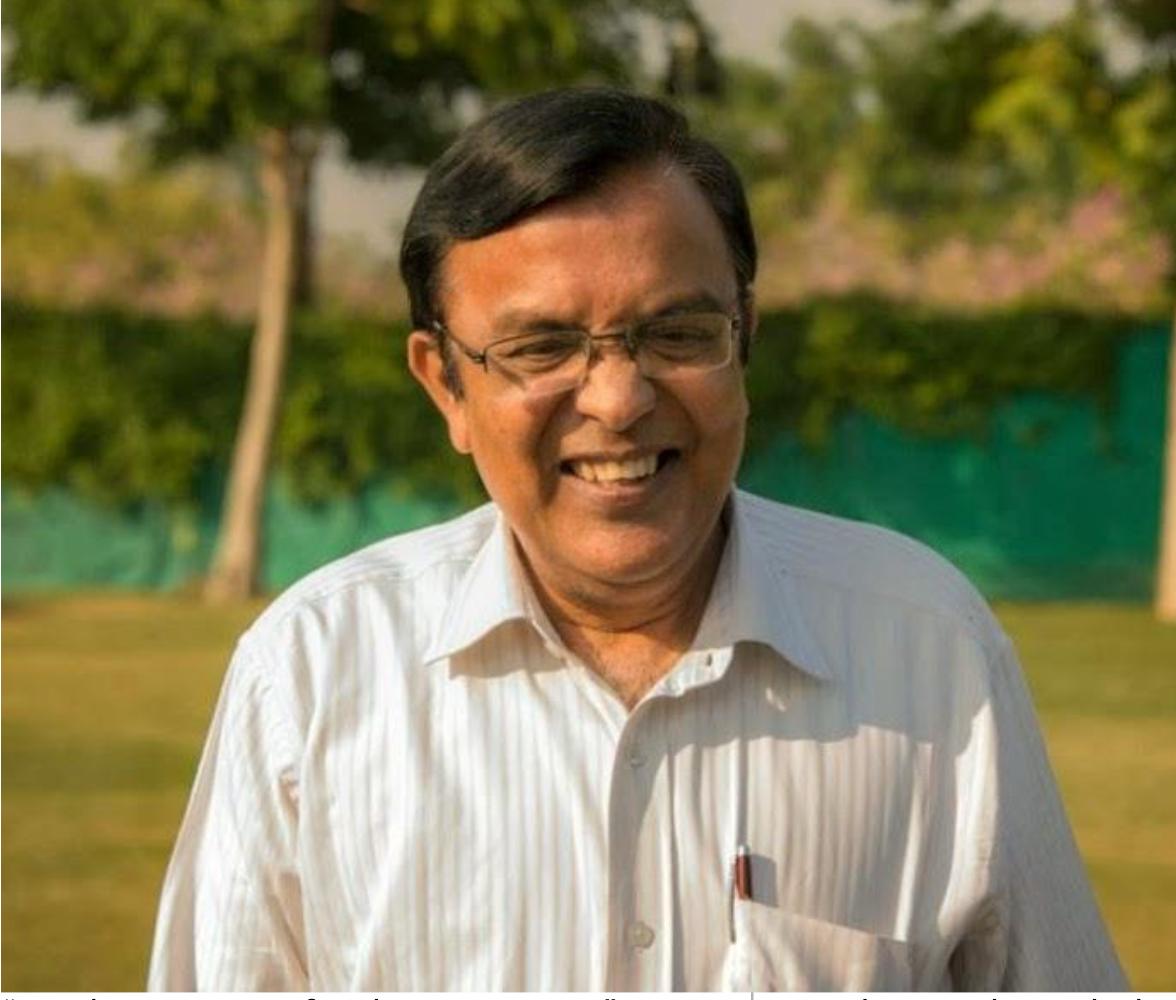
In the Vidarbha summer of 1977, while most of the Class of ’73 had fled to the relative coolness of their homes, Omprakash Singhania was designing innovative ways to keep a single room in Hostel 5 from turning into an oven. He was the only resident left in a “nearly deserted” hostel, driven by a singular, intense anxiety: the final MBBS examination was only a season away. This image of Singhania—braving the heat to master the “Science of Signs”—captures the central tension of his life: he was a man who loved the comforts of home and the pleasures of the palate, yet he was capable of a self-discipline that would eventually see him running a 24/7 diagnostic empire for nearly forty years.
The Lambretta and the Gourmet
Omprakash was a son of Yavatmal, born and schooled in the town that would eventually become his kingdom. He arrived at GMC Nagpur in 1973 with a rare distinction: he owned a scooter. His Lambretta (MH 50) was a source of “justifiable pride” and “triggered envy” among classmates like Vilas Tambe and Pramod Bangde, most of whom were lucky to own even a bicycle. But Singhania was no spoiled brat. He was known for a generosity that was as vast as his appetite.
He was the batch’s resident gourmet. His close friend Suhas Jajoo recalls how Singhania would scan the menus of every boys’ hostel each morning. If the hostel menu failed to “titillate his palate,” Singhania would offer Jajoo a pillion ride to a restaurant in Nagpur. He was a “food connoisseur” who knew where to find a dinner for two for Rs. 2.50 at the Alankar Restaurant when the hostel kitchens were closed. This love for food followed him into his internship at Bhadrawati, where he, Jajoo, and S.P. Kalantri stayed in a Jain temple. In a temple where eating at night was prohibited, Singhania was the one who would lead midnight expeditions to find hot kachoris and samosas in the village.
The Unique Pathology of Yavatmal
After obtaining his MD in Pathology from GMC Nagpur, Singhania headed to Mumbai to hone his skills in hematology and cytology. In 1984, he returned to his roots and established the “Unique Pathology Lab” in Yavatmal. The name was apt. Singhania brought a level of efficiency and accuracy that the city had not seen before.
For thirty-seven years, Singhania was a “pathologist to the community.” But his career also reflects the “historical sweep” of the generational shift in Indian medicine—the rise and eventual burnout of the 24/7 service model. By 2021, the pressure of being “always on” began to take its toll.
It started getting on my nerves. I had to offer pathology services, 24/7, 365 days a year; festival or no festival. I had to wake up in the middle of the night to answer queries from patients, their relatives and doctors. I thought enough was enough and decided to pull the plug on the lab.
This decision to “pull the plug” on February 28, 2021, was an act of self-preservation. It marked the end of an era where a single specialist was expected to be a perpetual motion machine.
The Traveler’s Reward
Today, Singhania has reclaimed his time. He has explored the tourist spots of the world—from the landscapes of New Zealand and Australia to the modern skylines of Dubai. He remains a man who has “always stood by his friends through thick and thin,” a gourmet who now travels for the pleasure of the experience rather than the necessity of the escape.
His daughter Neha has followed him into Pathology, and his son-in-law, Suraj Agrawal, is a renowned oncosurgeon at Alexis Hospital in Nagpur. Singhania’s life has completed a circle that began in a sweltering hostel room: he has moved from the isolation of the student to the center of his community’s health, and finally back to a well-earned freedom. He remains the man with the Lambretta, still looking for the next great meal and the next great horizon, proving that even a life dedicated to the microscopic can be lived with a macroscopic heart.