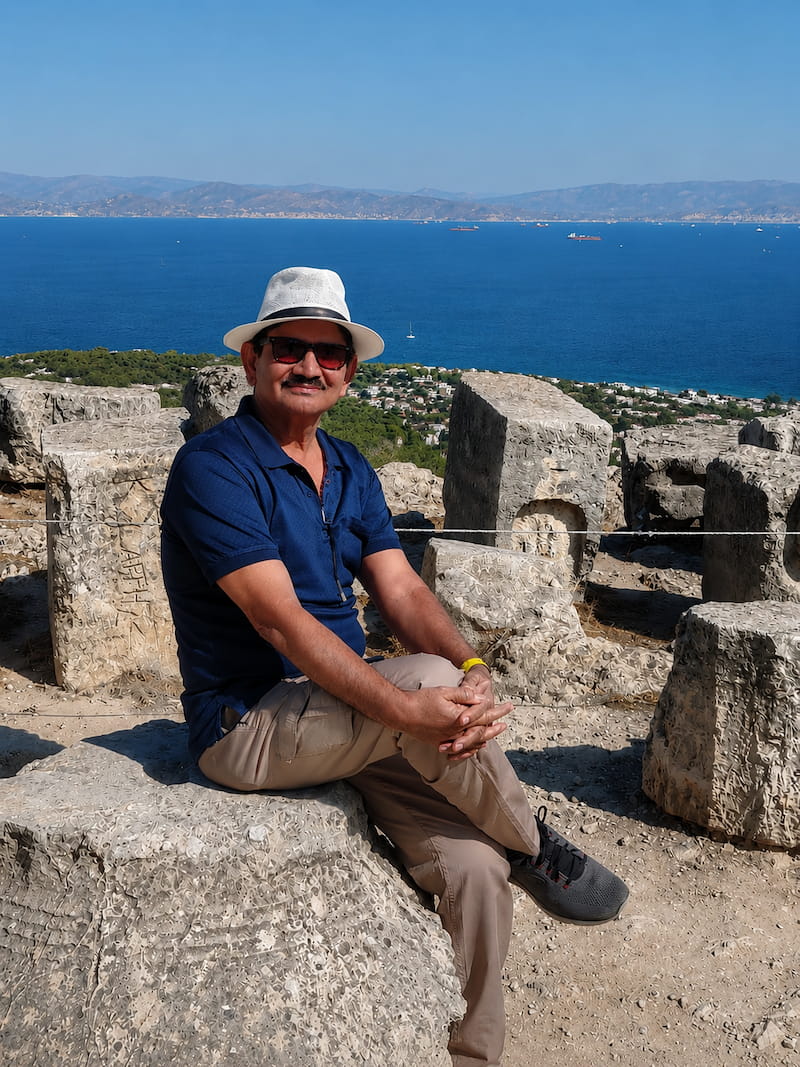
The road to Jalgaon Jamod, when Ajit Jadhao first rode it in 1980, was not much of a road at all. To reach the villages around it — Satpura range country, tribal land, country where superstition was stronger than medicine — he rode a motorcycle or climbed into bullock carts. The people he went to serve did not come to him. He went to them.
He has been going to them ever since.
The Boy from Khamgaon
Ajit was born in Khamgaon to an advocate. He attended New Era High School and National High School before moving to GS College of Science for his premedical studies, where he shared benches with Satyanarayan Rathi, Inder Ostwal, and Prakash Wakode.
At GMC Nagpur, Ajit was one of the Saptrishi — seven friends from Akola and Buldhana district who shared rooms, meals, and loyalties across the undergraduate years: Vijay Kherde, Kailash Murarka, Nandkishor Salampuria, Makhanlal Gupta, Nandkishor Taori, Inder Ostwal, and Ajit Jadhao. Dhulip Tajne joined them later. The common thread was geography — all seven came from the same two districts — and geography, in that era, was a powerful bond.
After graduation, Ajit interned at PHC Rohana with Gopal Khadse, Laxmikant Rathod, and Panjabrao Chavan, and completed his urban internship at the district hospital in Akola. He attempted house jobs in Medicine and Surgery at Ambajogai, pursued an MS (Surgery) seat, then surrendered it when MD (Medicine) — his first preference — proved out of reach. His father had suffered a stroke. The immediate options narrowed to a single practical question: where to begin.
He visited Jalgaon Jamod. The local people offered him space for a clinic. He accepted.
The Country Doctor
Nandkishor Taori began practice at Malkapur. Makhanlal Gupta began at Akola. Ajit Jadhao began at Jalgaon Jamod. Three friends, three small towns, almost simultaneously. None chose the city.
Jalgaon Jamod in 1980 was a town of thirty thousand. The tribal villages around it had almost no access to trained medicine. Superstitions about illness and healers ran deep. Ajit understood this — not from a distance, but from inside the work. He rode to villages where the roads did not go. He operated without blood banks. He delivered babies without qualified anaesthetists. He dealt with ruptured uteruses, severe anaemia, complications that in a city hospital would have had a team assembled around them. He assembled himself.
Ujwala, his wife — a GMC Nagpur 1976 batch graduate who had acquired sound obstetric skills — joined the practice. Together, they began performing Caesarean sections, laparotomies, and hysterectomies in conditions that no textbook had prepared them for. “We had to manage severely anaemic women with ruptured uterus in our setting — without a blood bank and a qualified anaesthesiologist,” Ajit recalls. They managed. Hundreds of women came out alive who might not have otherwise.
“Working in a resource-limited setting — with no diagnostics or colleagues to support — is far more challenging and demanding than working in well-equipped super-specialty corporate hospitals in the cities,” he says. “And this work gives much more sustainable satisfaction than the money you earn in big cities.”
That observation is not a complaint. It is a preference, stated plainly by a man who chose this life and stayed in it.
Beyond the Clinic
The practice at Jalgaon Jamod has grown into a ten-bed hospital. The town itself has grown fivefold — from thirty thousand to something approaching a hundred and fifty thousand — and Ajit and Ujwala have grown with it, still the couple at the centre of whatever medical life the town has.
The children who grew up watching their parents work have taken their own directions: Rewati became a radiologist in Nagpur; Swati became a gynaecologist, her husband a urologist in Karad. The next generation did not return to Jalgaon Jamod, but they did not turn away from medicine.
Outside the hospital, Ajit has not kept still. He served as a Municipal Corporator from 1990 to 1995. He was Founder President of the Youth Hostel Association in Jalgaon Jamod. He drove to Bhuj after the 2001 earthquake and offered medical aid in the rubble. He served at the Kumbh Mela in Haridwar and Allahabad. In 2013, he spent Diwali in Ganjam, Odisha, working in villages devastated by a cyclone. He treks. He has climbed mountains.
When Ajit Jadhao arrived in Jalgaon Jamod by bullock cart in 1980, the people he came to serve were among the most underserved in Maharashtra. The Indian state, in those years, was withdrawing slowly from primary care in tribal areas — leaving gaps that a handful of young doctors, trained at government expense, quietly filled. Ajit was one of them. The gap he filled has never quite closed. He is still standing in it.