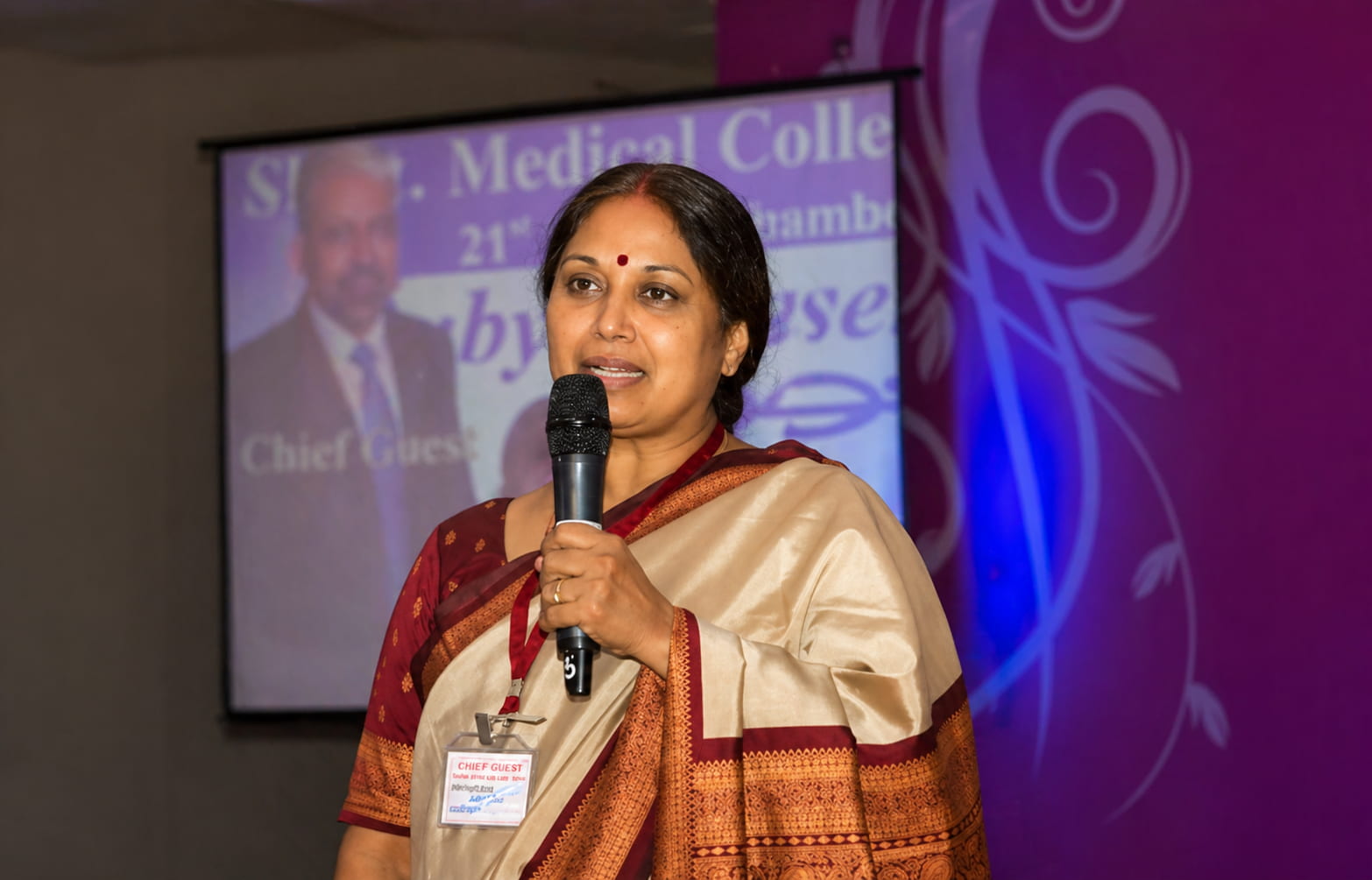
In her first year at Government Medical College, Nagpur, a seventeen-year-old Archana Srivastava was already reading Sherlock Holmes and being offered roles in professional drama. She declined the stage — Anatomy and Physiology left no room for rehearsals — but the qualities that made the offer possible never left her: a sharp eye for detail, a preference for the specific over the general, a refusal to accept the most obvious explanation when a more precise one was available. They are, as it happens, excellent qualities for an ophthalmologist. Archana spent the better part of four decades looking at what others missed.
Sainik Schools and the Art of Beginning Again
Born into the family of a Group Captain in the Indian Air Force, Archana spent her childhood moving between Sainik Schools — Purulia in West Bengal, Satara in Maharashtra — institutions built on discipline, adaptability, and the expectation that their students would function in unfamiliar surroundings without complaint. The postings moved the family; the schools changed; friendships were made and remade before they had fully taken shape. By the time Archana arrived at GMC Nagpur in 1973, beginning again was something she did without thinking about it.
At GMC she found a different kind of continuity: the friendships of the hostel, which proved durable beyond expectation. SP Kalantri, Anjali Sapkal, Ramesh Mundle, Nandakishor Chandak, and Harish Baheti were among those who stayed close. In 1973, she performed in a Hindi drama alongside Dinesh Soni and Alison Girling and received an offer of a professional stage role. She declined it politely. Medicine, she had decided, was the more serious pursuit.
She was not a person who sought attention during those years, and her classmates remember her accordingly — as someone whose intelligence was visible in what she said rather than in how often she said it. The GMC years shaped her in ways she would not fully understand until decades later, when the institutions of those years — the wards, the OPDs, the discussion sessions — provided the foundation for everything that followed.
Three Neurosurgeons and Three Ophthalmologists
Archana married during her residency. Her husband, Dr. Vinod Srivastava, trained in Neurosurgery at NIMHANS, Bengaluru — one of the country’s most demanding programmes in one of the most demanding specialities. Archana was one of three women from the class of 1973 to marry neurosurgeons: Rajshree Chaturvedi married Shekhar Deopujari of Mumbai, and Jayashree Seolekar married Charudatta Apte of Pune. In each case the pairing produced a household navigating two exacting careers across demanding institutions — and, in each case, it worked. What the arrangements required, above all, was the capacity to function independently while remaining genuinely connected. That, too, turned out to be a skill from the Sainik School years.
Archana obtained her MS (Ophthalmology) from GMC Nagpur in 1982. Her thesis examined cell-mediated immunity in phlyctenular conjunctivitis — research conceived by Dr. Harminder Dua and carried to completion under Dr. Chanchal Dhawan. The subject was chosen for its clinical relevance in the Indian context, where phlyctenular disease — driven by hypersensitivity responses to infections including tuberculosis — was, and remains, a significant cause of corneal scarring and visual loss. The work grounded her in the intersection of immunology and clinical ophthalmology that would inform her practice for the rest of her career.
Saudi Arabia and the International Standard
From 1984 to 1987, Archana worked at King Khalid Eye Specialist Hospital in Al Majmaah — a tertiary ophthalmic facility operated by the Ministry of Health of the Kingdom of Saudi Arabia. The hospital functioned at international standards: well-equipped, well-staffed, serving patients referred from across the country and running outreach, training, and research programmes alongside clinical care. For a mid-career Indian ophthalmologist in the mid-1980s, the exposure was unusual and formative. The discipline of a high-volume tertiary ophthalmic centre — the expectation of precision, the requirement of documentation, the culture of subspecialisation — shaped her clinical habits in ways that stayed with her long after she returned to India.
She came back in 1988 and settled in Aligarh, where Vinod had established himself. The city is not Nagpur or Mumbai or Delhi, but it has its own medical geography: Aligarh Muslim University anchors a healthcare ecosystem that draws patients from across the western Uttar Pradesh belt. For a consultant ophthalmologist with subspecialist training and international experience, there was more than enough work.
Twenty-Five Years at Gandhi Eye Hospital
For nearly a quarter century, Archana served at Gandhi Eye Hospital, Aligarh — an eighty-six-year-old institution with seven hundred dedicated beds, twelve surgeons, and a supporting staff of one hundred and sixty. She joined as a consultant and rose to Chief Medical Officer. Her particular domains were glaucoma and disorders of the posterior chamber: conditions that require sustained attention across the long arc of a patient’s deteriorating vision, and technical skill of a kind that does not announce itself in dramatic moments but accumulates, procedure by procedure, into outcomes that are quietly extraordinary.
The patients who came to Gandhi Eye Hospital came from across western Uttar Pradesh and the surrounding states. Many arrived late — their conditions advanced, their visual prognosis guarded, their histories marked by the accumulated disadvantage of having been told, through the accumulated patterns of a rural health system under constant stress, that their problem was not urgent enough. Archana met them where they were. She operated cases that had been declined elsewhere, because she considered it her duty to try. Over twenty-five years the volume of that work — done consistently, without fanfare, in a large public institution — changes the visual landscape of a region in ways that are impossible to fully quantify.
She left Gandhi Eye Hospital in 2011 and established her own private practice in Aligarh. The transition from a large institutional setting to private consulting is one that many doctors of her generation navigate badly — the routines change, the referral networks thin, the institutional identity disappears. Archana navigated it well, which is not surprising in someone who has been beginning again, in new surroundings, since childhood.
Three Sons, Three Directions
None of her three sons chose medicine, and the fact is offered here not as a disappointment but as a fact. Nishith pursued computer science to a PhD at the University of Minnesota and now holds a faculty position in the Department of Computer Sciences at IIT Kanpur. His wife, Anveshana, completed her doctorate in Science Education at the Tata Institute of Fundamental Research and holds a post-doctoral position at IIT Kanpur. Their household contains, between them, more intellectual firepower than most institutions can accommodate. Shashank went from IIT Kanpur to Carnegie Mellon and now teaches at the University of North Carolina, Chapel Hill; his wife Snigdha is on the faculty there as well. Rahul read law at National Law University, Jodhpur, and practices at the Chandigarh High Court. His wife Safia, also an NLU graduate, serves as Additional Solicitor General in the Haryana High Court. Between the three sons and their spouses, the family’s collective CV spans computer science, science education, mechanical engineering, environmental law, and constitutional advocacy. Archana seems to have found this entirely satisfactory.
Asked about the future of ophthalmology, her answer carried no ambivalence. “The younger doctors who will take over the reins going forward are informed, educated, socially conscious, passionate and overwhelmingly enthusiastic about both their career choice,” she said. “We need to groom and train our students and residents well, helping them turn into mature, reflective, well-meaning individuals who see ophthalmology as a means to make the world a better place.” It is the answer of a teacher — which is what she has been, alongside everything else, since 1982. The girl who declined the stage in 1973 spent forty years doing something more demanding: looking, with trained precision, at what other eyes had failed to see.