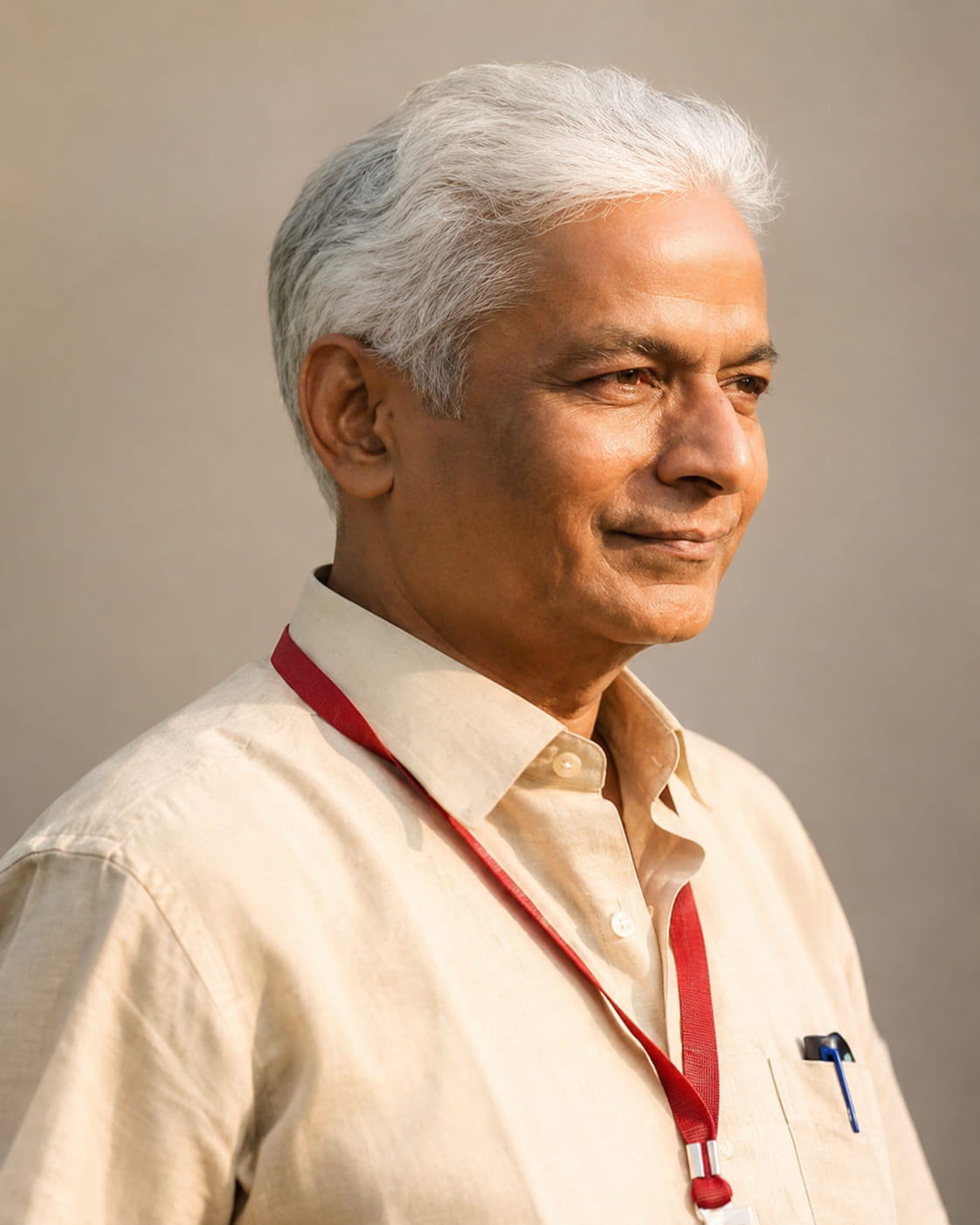
The blood disorders that Dilip Gohokar first encountered as a resident at GMC Nagpur in the late 1970s were, by any measure, death sentences. Leukaemias and lymphomas were managed with chemotherapy regimens that bought months, rarely years. Bone marrow transplant existed only in a handful of centres in the West. Electronic cell counters had not arrived in most Indian hospitals; technicians counted blood cells by eye, under a microscope, manually. Patients received whole blood — not packed cells, not platelets, not the component fractions that modern haematology has made routine.
Dilip watched all of it change. Over four decades, he built a haematology practice in Nagpur that grew alongside the discipline itself — from the era of certain deaths to the era of molecular therapy, gene editing, and targeted treatment. He has treated the same diseases for forty years and almost nothing about the treatment is the same.
The Son of a Vice-Chancellor
Dilip was born in Wani, Yavatmal district, on 30 July 1955. His father served as Vice-Chancellor of Nagpur University — an intellectual household, one that valued argument and evidence. Dilip attended Government Primary School in Wani and then Wilson High School in Mumbai before returning to Nagpur for his premedical year at St Francis De Sales College, which also sent Tapash Saha, Murtaza Akhtar, and Ravindra Jharia to GMC Nagpur in 1973.
At GMC, Dilip formed friendships that held. He was among those who gathered around Dhirendra Wagh, Vivek Kulkarni, Aziz Khan, and Kishore Kedar — a group whose bonds did not weaken with distance or time. After graduation, he interned at GMC Nagpur and chose Rohana primary health centre for his rural posting, working alongside Kishore Kedar, Prakash Bhatkule, and Dhirendra Wagh.
His postgraduation at GMC Nagpur, under Dr HC Attal, produced a thesis on the management of leukaemia — a subject that would define his career. When the MD was done, he did not go into general medicine. He went deeper.
Three Years, Two Countries, One Discipline
Three years at Tata Memorial Hospital in Mumbai and KEM Hospital gave Dilip the clinical foundation that haematology demands — the exposure to bone marrow, to chemotherapy protocols, to the full spectrum of blood malignancies. Then came a scholarship to Stockholm, a year at Ealing Hospital in London, the slow accumulation of expertise that cannot be acquired from textbooks alone.
He returned to Nagpur and opened his practice at Lokmat Square. It was the early 1980s. He was, with Maitreyan Vasudevan and Shriram Kane, one of only three students from the class of 1973 to specialise in haematology — a rare choice at the time, in a discipline that most clinicians regarded as esoteric and most patients had never heard of.
The early years were hard in a specific way. Haematology without modern tools is a discipline of inference and intuition. Dilip read blood films by hand, managed bleeds with whole blood, watched patients die of diseases he understood but could not yet treat with the weapons that would eventually arrive. “The satisfaction of changing a pale conjunctiva into a pink one keeps on motivating me,” he has said — a sentence that reduces four decades of complex medicine to its most human element: the visible, physical evidence that a treatment has worked.
What Changed
The list of what changed in haematology between 1983 and 2023 is nearly everything. Electronic cell counters replaced manual differentials. Component therapy replaced whole blood. Targeted therapies arrived — imatinib for chronic myeloid leukaemia, rituximab for lymphomas, drugs that worked by attacking molecular targets rather than killing everything fast-dividing. Bone marrow transplant, once a procedure for the very few, became standard of care for several conditions.
Inherited disorders that Dilip first encountered as incurable — sickle cell anaemia, thalassaemia, haemophilia — are now the subject of gene editing trials that may make them curable within a generation. A discipline once defined by its inability to cure has become one of the most scientifically dynamic in medicine.
Dilip built his practice through all of it. He served on the faculty at Jawaharlal Nehru Medical College, Sawangi, for a period. He ran his own clinic at Lokmat Bhawan. In October 2018, he organised a national haematology conference in Nagpur — the Haematology Master Class — pulling experts from across the country to discuss diagnostics, haemato-oncology, and the molecular advances that had reshaped the field. He chaired sessions, injecting what colleagues described as clarity into disorders that resist simplification.
Indrajeet, his son, took a different path: computer science at Yeshwantrao Chavan College of Engineering in Nagpur, then a master’s degree in Computer Science with a specialisation in Data Science from the University of Texas at Dallas, and now software verification work in Valencia, California, on neuromodulation technology. The son of a man who spent his career studying the electrical signals of the brain’s blood supply went on to work, in his own way, at the frontier of how the nervous system is understood.
Neeta, Dilip’s wife, is Vice-President of the Ladies Club in Civil Lines, Nagpur — rooted, as Dilip is, in the city where he has practised for forty years.
The Enduring Threads of 1973
The family story mirrors a larger phenomenon within the GMC Nagpur Class of 1973—a batch whose bonds have proven remarkably resilient. In 2021, the circle widened when Indrajeet, son of Dilip Gohokar, married Rutuja, the daughter of his batchmate and friend, Dhirendra Wagh. Though Dhirendra passed away far too soon in May 2022, the union remains a living tribute to a friendship forged decades ago in the wards of Nagpur.
Like the marriage between Ramesh Mundle’s son and Avinash Deshmukh’s daughter, this alliance represents a “second generation” of the Class of 1973. In a batch that eventually scattered across India and the world, these unions are the visible threads of a tapestry that has not come undone. They have transformed a fifty-year-old camaraderie into a shared family legacy, ensuring that the ties formed in their youth will endure well into the future.