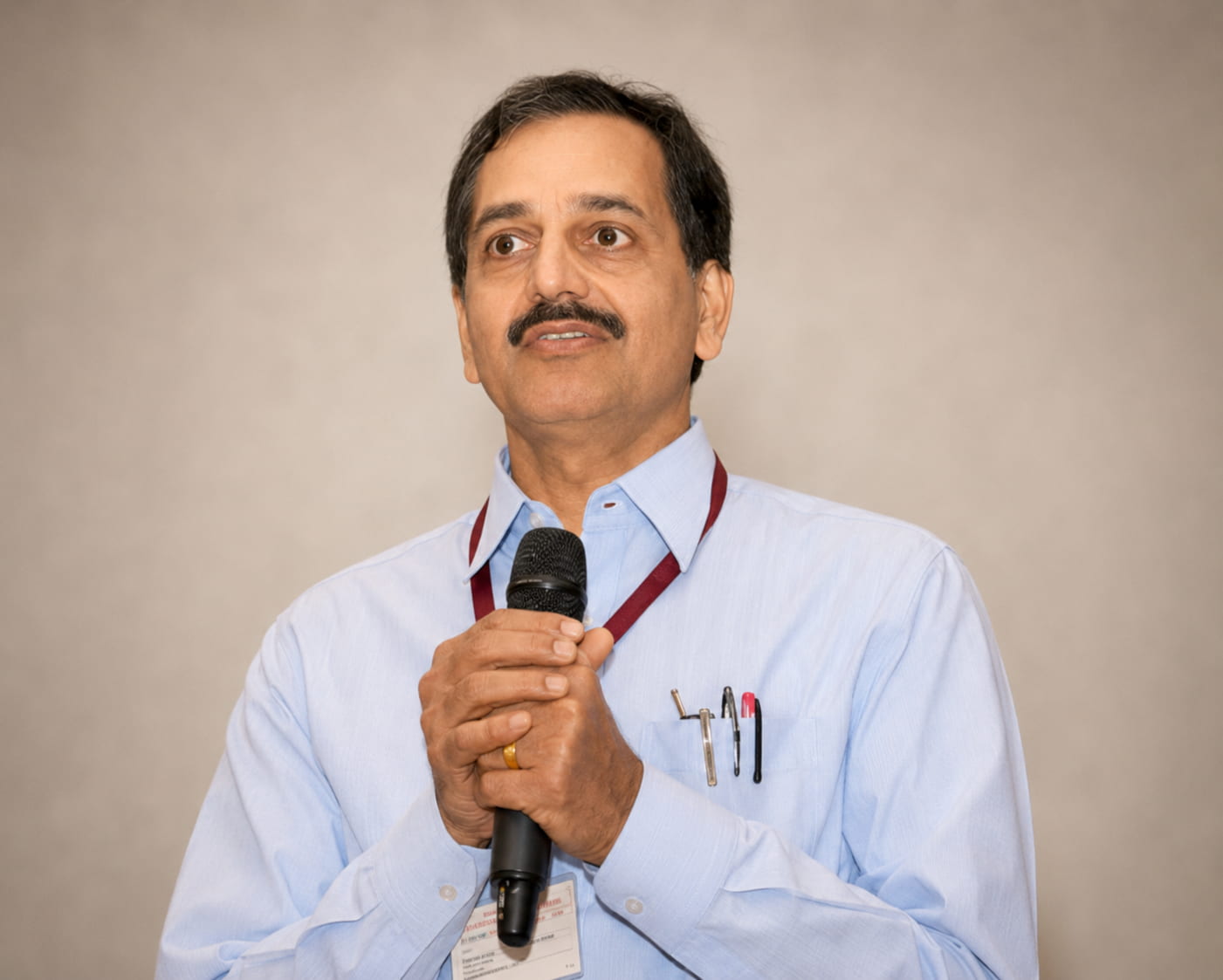
In January 2014, Harish Baheti was admitted as a patient. He had suffered an acute coronary syndrome — the same event he had spent three decades treating in others. He was operated, recovered, and then bought a 20-acre farm on Morshi Road, 26 km from Amravati. He began designing a residential wellness centre on it: yoga, hydrotherapy, massage, shirodhara, walking paths. The cardiologist’s patient had become his own most instructive case.
This kind of reckoning — steady, unsentimental, turned immediately toward action — is what those who know Harish expect from him.
The Bicycle Dealer’s Son
Harish was born in Amravati. His father ran a large bicycle business, trading and distributing cycles across the region. He went to Municipal School No. 4 for his early years, Government High School through middle school, and New High School for his final two years. His premed year was at Vidarbha Mahavidyalaya, Amravati, and he entered Government Medical College, Nagpur in 1973.
At GMC, he played basketball and kho-kho, and captained the volleyball team — a detail worth noting in a man who would spend four decades as a trusted internist. Physical seriousness and intellectual seriousness, in his case, were never in competition.
His rural internship was at Karanja Ghadge, 130 km south of Nagpur, alongside Kailash Murarka, Ravi Kasat, Rajiv Garg, Madhusudan Bagdia, and Nandkishor Salampuria. Urban internship was at the district hospital, Amravati.
The Education of a Physician
Harish did house jobs in Medicine and Infectious Diseases at GMC Nagpur. His MD thesis examined low-dose insulin infusion in diabetic ketoacidosis, supervised by Dr. Lata Patil. He presented the work at the 1982 API conference in Delhi, where it was appreciated by colleagues and teachers who had known him as a resident — thorough, hungry for knowledge, unwilling to move on from a case until he understood it.
After MD, he spent a year in Mumbai — Breach Candy, Jaslok, and Nanavati hospitals — acquiring the clinical exposure that a teaching hospital in the early 1980s could provide. He returned to Amravati in 1983 and opened a modest clinic. Over the decades, that clinic grew into a 30-bed hospital.
The growth was deliberate, not accidental. Harish built his practice on a principle he has articulated clearly: “Doctors have the enormous privilege of touching and changing lives.” And the qualities he describes in a good physician — approachable, confident, decisive, compassionate, “able to absorb people’s pain and anxieties without losing focus” — are not aspirational for him. They are descriptive.
A Trusted Physician in Amravati
By the time the 2013 class reunion arrived, Harish was what Amravati calls him without qualification: a trusted physician. Three generations of families come to him. He knows what they know and what they don’t, what worries them and what they have stopped saying. General internal medicine — the kind in which the physician must be equally at home with cardiac failure, uncontrolled diabetes, a psychiatric presentation, and a worried family in the same afternoon — has been, across five decades, precisely what he practices.
His children are also doctors. Ankita completed her MS in Ophthalmology at Sawai Mansingh Medical College, Jaipur, and married a urologist. Akshay completed his MCh in Paediatric Surgery at Lokmanya Tilak Medical College, Sion, and married an internist. The house was, by all evidence, serious about medicine.
Manju, his wife, holds a DGO and consults as a gynaecologist. The hospital on 2nd Lane, Ambapeth, runs as a family enterprise in the fullest sense.
After the Coronary
The 2014 angioplasty was the pivot. Not in the sense that it frightened him — he has said explicitly it did not — but in the sense that it forced reflection. He had seen too many colleagues overtaken by the same disease they treated. He had also worked too hard for too long without attending to what he knew about lifestyle medicine.
The farm on Morshi Road was one answer. The wellness centre under construction on it is another. He is not retreating from medicine. He is extending it — to the domain that, he now believes, formal medical training chronically underweights: sleep, nutrition, movement, stress.
“We are workaholics, often sleep deprived and keep on working day in and day out forgetting how badly we are damaging our bodies,” he said after his own recovery. It was not self-pity. It was diagnosis.