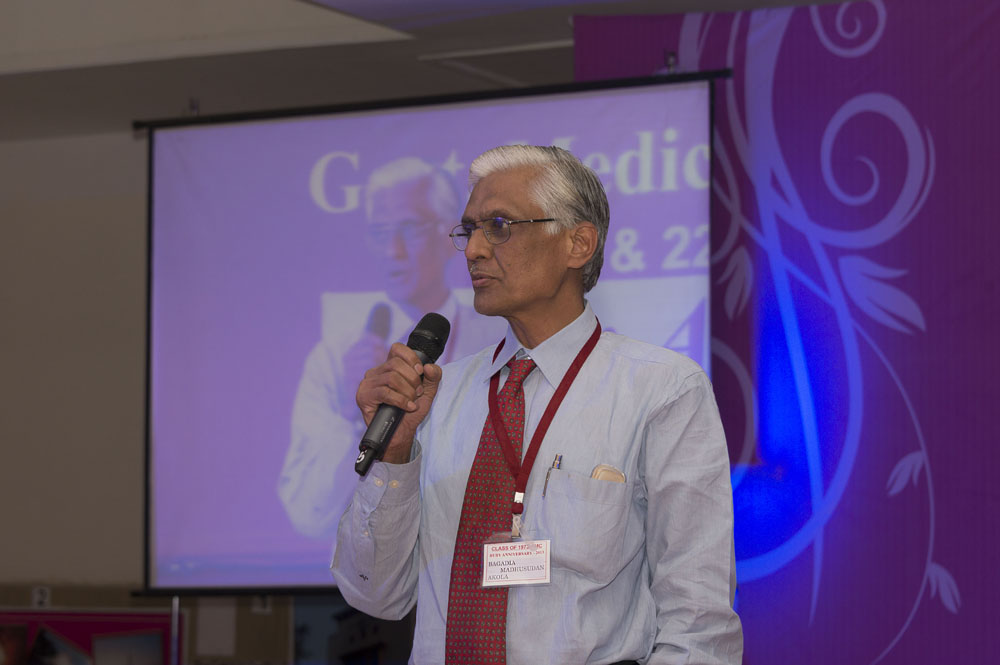
The Cobra and the Scalpel
When Madhusudan Bagdia was a resident in surgery at Government Medical College, Nagpur, he chose to specialise in Oncosurgery before the word had properly arrived in Vidarbha. He then spent three years at Tata Memorial Hospital, Mumbai, acquiring skills that barely existed in his home district. When he returned to Akola in 1985, the concept of a dedicated cancer surgeon in a non-metropolitan centre was, as he would later put it, something that “had not taken roots.”
He planted those roots himself.
“Cancer has always been something like a cobra to those who study it,” Madhu said. “Dangerous and beautiful and endlessly fascinating.”
The Akola Boy
Madhu was born in Akola, into a business family. He went to MV Bajoria Convent School and then to Shri Radhakishan Laxminarayan Toshniwal (RLT) College of Science, Akola for his premed education, before entering Government Medical College, Nagpur in 1973. After graduation, he did his rural internship from Karanja Lad, alongside Nandkishor Chandak, Ravindra Kasat, and Harish Baheti.
He enrolled in MS (General Surgery) at GMC Nagpur, fortunate to work under Dr ML Gandhe — a surgeon he would remember for the rest of his career. “He spoke to patients and obtained their history as if they were his relatives,” Madhu said of another mentor, years later. The principles of that school — careful history-taking, respectful examination, unhurried judgment — became the foundation of his own practice. His MS thesis examined gastrointestinal complications in burns patients.
He earned his MS in 1982.
Three Years at Tata Memorial
Tata Memorial Hospital in Mumbai was then, as now, the country’s foremost cancer centre. Madhu spent three years there, learning a discipline that demanded both technical precision and an acceptance of outcomes beyond a surgeon’s control. He returned to Akola in 1985 and opened his practice, finding that his potential patients barely knew what an oncosurgeon was.
That changed slowly, then entirely.
Over the decades, Madhu built a reputation for head and neck tumours, breast cancers, abdominoperineal resections, and Wertheim’s radical hysterectomy — procedures performed with, in the words of those who watched him, “exemplary ease and efficiency.” His 10-bed hospital became one of only three in Vidarbha recognised by the government for Oncosurgery. He serves as Chief Oncosurgeon at Sant Tukaram Cancer Hospital, Akola, and holds directorships at ICON, a multispecialty hospital.
His son Amit, armed with an MS in Surgery from AIIMS Delhi and an MCh in Oncosurgery from Tata Memorial, has joined the practice. Advanced surgical training in France followed. Madhu watches his son operate with a mixture of paternal satisfaction and the particular critical awareness of a surgeon who did the same procedures with cruder tools.
“When I did my MS in Surgery,” he said, “we emulated our teachers who believed that aggressive radical extirpative surgery would enhance cure rates. Now, survival is no more the sole outcome measure.”
What has changed, in Madhu’s telling, is not the difficulty of the work but its philosophy. The era of the Halsted mastectomy has given way to breast conservation. Mutilation has become, where possible, negotiable. His son’s cases arrive with rehabilitation plans already drawn before the surgical plan is finalised. To Madhu, this is not softness. It is science.
“Less-is-more,” he said, “is still based on sound biological understanding.”