In the spring of 1977, with the Emergency freshly lifted and India counting its votes through the night of 19 March, Nandkishor Chandak organised a Kachha Chiwra party on the terrace of Boy’s Hostel No. 4. He made bucketfuls of the flattened rice and distributed it to his hostel mates. None of them were political activists; most had been too absorbed in their studies to follow the campaign closely. But they had listened, ears pressed to radio sets, as the Janata alliance dismantled the ruling Congress for the first time in India’s history. The celebration was spontaneous and cheerful, and the Kachha Chiwra was, by all accounts, excellent.
The man who organised it was soft-spoken, principled, and, by the time his batchmates learned of it in 2012, had already undergone a coronary artery bypass graft surgery — a discovery that shocked them, because Nandu, as they called him, carried none of the obvious risk factors for heart disease. He had simply worked very hard, for a very long time, and the body eventually presented its bill.
From Ridhpur to Nagpur
Nandkishor was born in Ridhpur village, where his father farmed the land. He went to MS Dada School in Ridhpur and then to Manibai Gujarati High School before completing his pre-medical education at Vidarbha Mahavidyalaya, Amravati. In 1973, he entered Government Medical College, Nagpur.
His internship returned him briefly to the countryside: Kondhali primary health centre, 30 kilometres west of Nagpur, where he worked alongside Omprakash Bohra, Nandkishor Taori, and Laxmikant Rathi. The centre was modest, the work demanding, and the experience of seeing patients in a resource-limited setting left its mark on a young doctor who had grown up with very little himself.
He enrolled for MD (Medicine) at GMC Nagpur. Under Dr. Gopal Dubey’s supervision, he examined bromhexine therapy in chronic obstructive pulmonary disease — a practical, patient-centred question that suited a man drawn not to laboratory medicine but to the bedside. He obtained his MD and spent six months at Bombay Hospital, Mumbai, working in the intensive care unit alongside Harish Motwani. Then he came home.
A Practice Built on Ethics
In 1983, Nandkishor returned to Amravati and set up his practice at Shriram Hospital. He was 28 years old, trained in internal medicine, and determined to do the work with the same standards his teachers had demanded of him.
Over four decades, his patients came to trust him as a physician of unusual honesty. He did not over-investigate, did not prescribe more than was needed, and did not inflate his bills. In a time when the economics of private medicine were pulling many doctors toward excess, Nandkishor held his ground. His batchmates, when they speak of him, use the phrase “professional honesty” without qualification.
In the mid-1980s, he used that honesty in a different arena. Anguished by the conduct of private medical colleges in Amravati — their selection processes and their treatment of students — he wrote a series of articles in local newspapers, Hindustan and Jan Madhyam. The articles were specific and argued from evidence. They helped, in a small and incremental way, restore some dignity to the process of medical education in the city.
The act was characteristic: it required courage, it required clarity, and it required the conviction that saying what was true mattered more than the discomfort of saying it.
Spiritualism, and a Different Kind of Practice
In 2001, something in Nandkishor’s life shifted. He began organising Sunday gatherings — small, informal, regular — at which like-minded people discussed devotion, dhyan, and naam smaran: the inner practice of attention and recitation that forms the core of several Hindu traditions. The gatherings continue. They are not clinical, not professional, not networked. They are simply people sitting together, thinking about what matters.
The impulse behind them is not separable from the impulse behind his medical practice. Both reflect a conviction that how one conducts a life — with attention, with ethics, with some willingness to ask why — is more important than the scale of what one achieves.
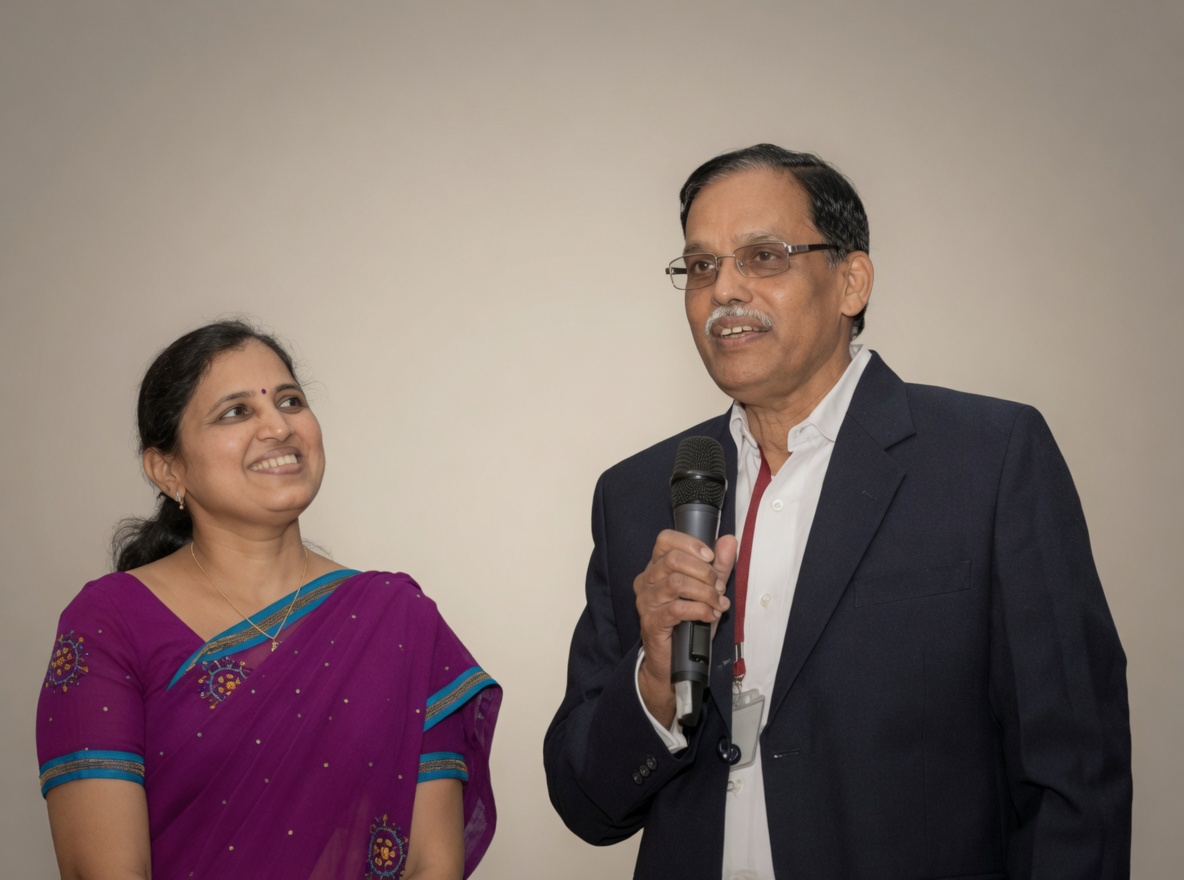
His son Sanket trained in ophthalmology and practices in Amravati. His daughter Sneha trained in pathology and practices there too. Both married doctors. The household Nandkishor and Chhaya built over forty years has produced two physicians, both of whom work in the same city where they grew up.
The Man Who Made Chiwra on a Terrace
The bypass surgery in 2012 was, by his batchmates’ account, a rude shock. There were no warning signs, no obvious risks, no reason to expect it. The years of sustained work had taken a toll that only the surgeon’s eye could detect. He recovered well, returned to his patients, and continued the practice he had built.
Many of his patients, his batchmates say, regard him as something close to a demigod — a word that captures not supernatural power but the particular trust that forms when a doctor has been honest with you across decades, when you know that whatever he says, he means.
The Kachha Chiwra he made on the terrace in 1977 was a small act of civic joy — a celebration of something larger than any individual, shared freely among people who had nothing to spare. It is a good image for the man. He has spent forty years doing the same thing in a different form: offering what he has, honestly, to people who need it.