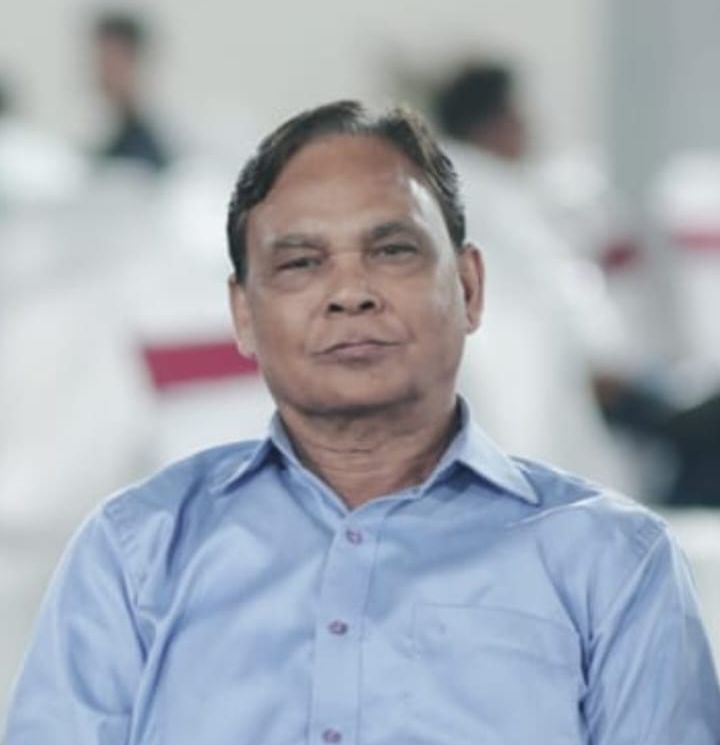
Every Sunday, Narayan Dongre made the journey from Amravati to Yengaon—a village on National Highway 6, about 35 kilometers from Nagpur, where he was born.
In his ancestral home, he operated a clinic where he treated approximately 75 patients each week. He provided both consultations and medicines free of charge, funding the supplies entirely out of his own pocket from a local pharmacy. He never advertised this service, nor did he talk about it much; he simply began on December 29, 2014, and continued without interruption.
This streak lasted for six years. Ultimately, he was forced to pause his philanthropy—not because of the poor roads that hindered his travel, but because he found the lack of cooperation from the patients more challenging to navigate than the village terrain.
“Each time I go home after finishing the work,” he said, “I find my heart filled with a serene sense of satisfaction and happiness.”
This is the essence of Narayan Dongre. Everything else—the four decades spent teaching anatomy, the years of service in Melghat and Amravati, and the 500 Covid patients he treated from his own home—is simply an extension of that inner quietude.
From Yengaon to GMC
Narayan was born in Yengaon, Taluka Karanja Ghadge, Wardha district, to Marotrao, a farmer. His early schooling was at the village school; he then moved to Model High School, Karanja for the eighth standard, and to Model High School, Arvi for the ninth and tenth, where he topped the higher secondary examination. He came to Wardha for premedical studies at Jankidevi Bajaj Science College — the college that also sent Suhas Jajoo, Rekha Sapkal, Avinash Joshi, SP Kalantri, Rajan Bindu, Pramod Mahajan, and others to GMC Nagpur in 1973.
After joining GMC, he rented a room in Reshimbag alone for his first year, then moved to Hanuman Nagar sharing with Nandkishor Taori, and later settled into the GMC hostels in 1975.
His rural internship was at Samudrapur — with Pramod Bhise, Vijay Thakre, and Prabhakar Patil — and his urban posting at the District Hospital, Wardha.
The Road Through Melghat
In 1979, Narayan and Vivek Kulkarni enrolled together in the MD (Microbiology) program at GMC Nagpur. Four months in, Narayan made a decision that shaped the next decade of his life: he could not reconcile himself to a laboratory existence among cocci and bacilli. He quit the MD and accepted a posting from the Government of Maharashtra — medical officer at a primary health centre in Dharani, in the Melghat region of Amravati district.
Few doctors volunteered for Melghat. It was remote, resource-poor, and confronted daily with the consequences of malnutrition among the Madia tribes. Narayan went anyway, and spent two and a half years learning how to practice medicine in conditions that stripped away every convenience and left only judgment. He ran the Integrated Child Development Programme. He learned what malnutrition looked like from the inside, not from a textbook.
In 1982, he moved to Civil Hospital, Amravati, and four years later, when Nagpur University permitted the founding of a private medical college named after Panjabrao Deshmukh, he applied for a faculty post in Anatomy. He was appointed Assistant Professor, and spent the next 29 years teaching the structure of the human body to generation after generation of medical students.
Teaching, and What Comes After
Anatomy is not a subject most doctors remember with warmth. Narayan’s students did. He taught with the patience of someone who had learned in difficult circumstances what it actually means to know a subject, rather than merely pass an examination in it.
When he retired, he did not stop. He began outpatient consultations from home, set up a small inpatient ward, and then — when the Covid pandemic arrived in 2020 — found himself treating approximately 500 Covid-positive patients from his home practice, counselling, testing, and managing them through what he described as a period when, by February 2021, 90 percent of his outpatients were seeking care for Covid-related symptoms.
He did not retire from that either.
The Sunday Clinic
The weekly drive to Yengaon was Narayan’s own accounting—his way of settling what he considered a debt. “Those poor people could not afford any charges,” he had said, “and it is our moral duty to fix their health-related problems.”
He had been doing this since 2014. He bought the medicines himself. He made the drive himself. The village where he was born was 35 kilometers from Nagpur on a national highway—close enough for him to reach on a Sunday, and far enough that without him, many of those 75 weekly patients would have gone without care.
Three of his children chose architecture and engineering, while one daughter taught in a junior college. His grandchildren, Neev and Kashavi, were growing up in Pune and Bhubaneswar. The map of the Dongre family had spread outward—as the maps of GMC 1973 families always do—but the man at the center of it remained tethered to his roots.
Every Sunday morning, he made that familiar drive to Yengaon, parked outside his ancestral home, and opened his clinic. He continued this quiet service until the challenges of uncooperative patients and deteriorating roads finally forced him to close the doors. The debt, however, had been settled; for six years, he had been the bridge between a village and the care it otherwise would have never received.
SP Kalantri recalls: Cricket fascinated Dongre. I vividly recall his ecstasy in April 1976, when India clinched a historic victory by scoring 406 runs to beat the West Indies at Port of Spain.
In 1978, while I was doing my rural internship at Bhadrawati—130 kilometers south of Nagpur—our shared passion for the game bridged the distance between us. These were the days before cell phones, computers, or television. We stayed in touch by mailing dozens of inland letters back and forth, and these letters had only one theme: cricket.
We spent pages dissecting the ailments of Indian cricket. We compared and contrasted Kapil Dev with Ian Botham, debated how Anshuman Gaekwad might best shield himself from the West Indies’ “fearsome four,” and marveled at how the spin quartet baited batsmen over after over.
“Prasanna is like a chess player in the guise of an off-spinner,” Dongre once wrote to me. “He outthinks his victims before he even delivers the ball.”
Although he never played the game himself, Dongre was a master of its statistics; he knew exactly who had scored what, and when, where, and how every wicket had fallen.