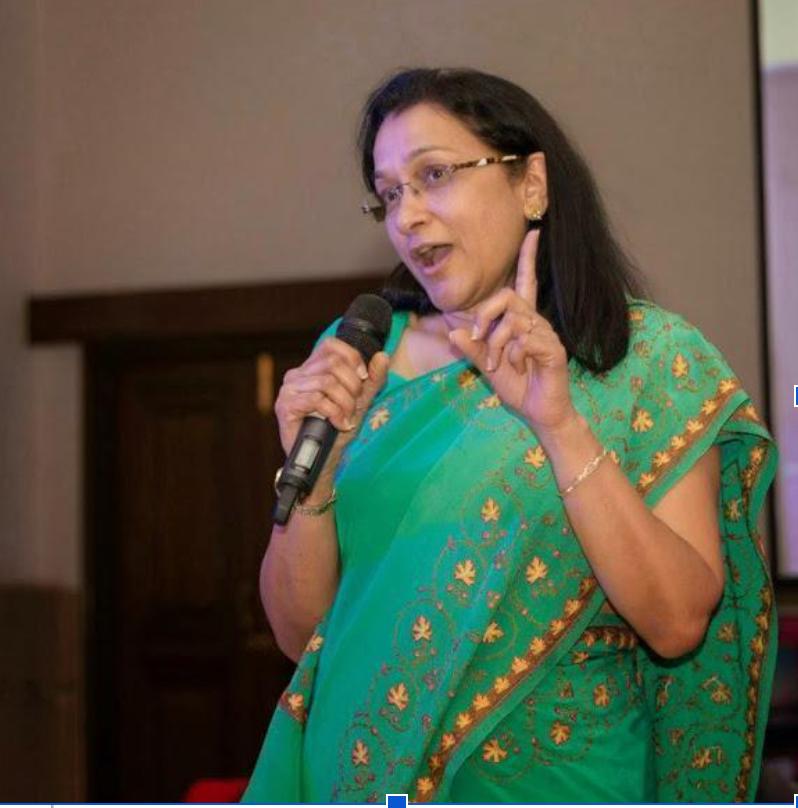
Her father gave his children a simple rule he never had to argue about: education was the sole possession no one could ever strip away—immune to tax, theft, or rising inflation. Because his work with Burmah-Shell shunted the family constantly across Gujarat, Maharashtra, and Madhya Pradesh, his children mastered the art of restarting early. New schools, strange towns, unfamiliar classmates, and a single, unchanging refrain: learn wherever you are planted.
Nasrin Raina, who would rebuild her career in America decades later in her fifties, lived by that rule long before it became her survival.
Cambay to Nagpur
Nasrin was born in Cambay—now Khambhat—a quiet, ancient town in Gujarat’s Anand district whose historical footprints far outlast its modern bustle. Her early education was scattered across central India: St. Aloysius High School in Bhusawal, St. Mary’s School in Mhow, and finally Nagpur for college. At the Institute of Science, she completed her pre-medical year in a building directly across the street from her home, rubbing shoulders with the very peers who would soon form her medical school batch.
Faced with admission offers from JIPMER, Pondicherry, and GMC Nagpur, she chose Nagpur. Surrounded by familiar faces—including Alison Girling, whose father worked alongside Nasrin’s at Burmah-Shell, and a close-knit cohort of women who would remain lifelong friends—the choice felt natural.
“We were privileged to see many places because my father was often transferred,” Nasrin recalls. In childhood, those constant moves felt like disruptions. Fifty years later, they read like preliminary training.
After earning her degree, she completed house jobs in Obstetrics and Gynecology and Ophthalmology before securing a postgraduate seat. Under the mentorship of Dr. Asha Deshpande, she penned her MD thesis on the anti-lactogenic effect of pyridoxine—a focused, rigorous clinical inquiry that demanded absolute honesty and precision. Earning her DGO and MD from GMC Nagpur, she moved to Jammu in 1984 following her marriage.
Two Decades in Jammu
For twenty years, Nasrin ran a private Ob-Gyne practice in Jammu through a harrowing chapter of Indian history. Throughout the 1980s and 1990s, the city was cast in the long shadow of the Punjab insurgency and the burgeoning conflict in Jammu and Kashmir. Doctors practiced against a backdrop of frayed civic life, where security alerts dictated daily routines and sustaining a medical practice required courage that transcended clinical competence.
“That was a difficult time,” she notes quietly. Her family remained safe. Her practice endured.
The American Chapter
My brother was an engineer who swapped circuit boards for retail shelves, taking over a few General Nutrition Store (GNC) outlets across the US. When he brought us over in 2001, I didn’t expect my medical career to stall behind a counter. After two decades of clinical experience in Obstetrics and Gynecology—delivering babies, managing high-risk pregnancies, and navigating hospital wards—I found myself wearing a store apron, standing on linoleum floors, and explaining the benefits of Vitamin C and magnesium to shoppers.
Three months of that was enough.
One afternoon, my brother crossed his arms and looked at me across the register. “You’re wasting a medical education, a specialization in Ob-Gyne, and decades of clinical experience on trivia,” he said.
That evening, he set up a desktop computer with a high-speed internet connection. I enrolled in Kaplan Test Prep for USMLE Part 1. The fee was a staggering $3,300—a princely sum back then that made my stomach drop every time I thought about it. What if I fail? The fear wasn’t just about the money; it was the terrifying prospect of losing those dollars and watching my career vanish into thin air.
My daily routine became a grueling marathon. I sat in the back of the store for ten hours a day, carving out seven to eight uninterrupted hours to devour dense medical texts, dissect pathology notes, and crack complex case scenarios, glancing up only to spend two or three hurried hours ringing up customers.
When exam day came, I passed Part 1. Parts 2 and 3 followed smoothly, requiring just $200 each and clearing the path forward.
“All my patients have charming smiles,” her daughter Jasleen, a U.S. board-certified orthodontist, often observes of her own profession. The sentiment captures the ethos of the family: medicine isn’t about prestige, but about the quiet grace of sitting across from someone vulnerable and offering steady, healing counsel.
Nasrin retired from active practice in February 2025 in Ponte Vedra, Florida. Her husband, a former national field hockey coach, has set aside his clipboard after a lifetime on the turf. Their daughters are settled and flourishing. Her father’s axiom—that an educated mind, carefully tended, can never be stolen away—stands fully vindicated.