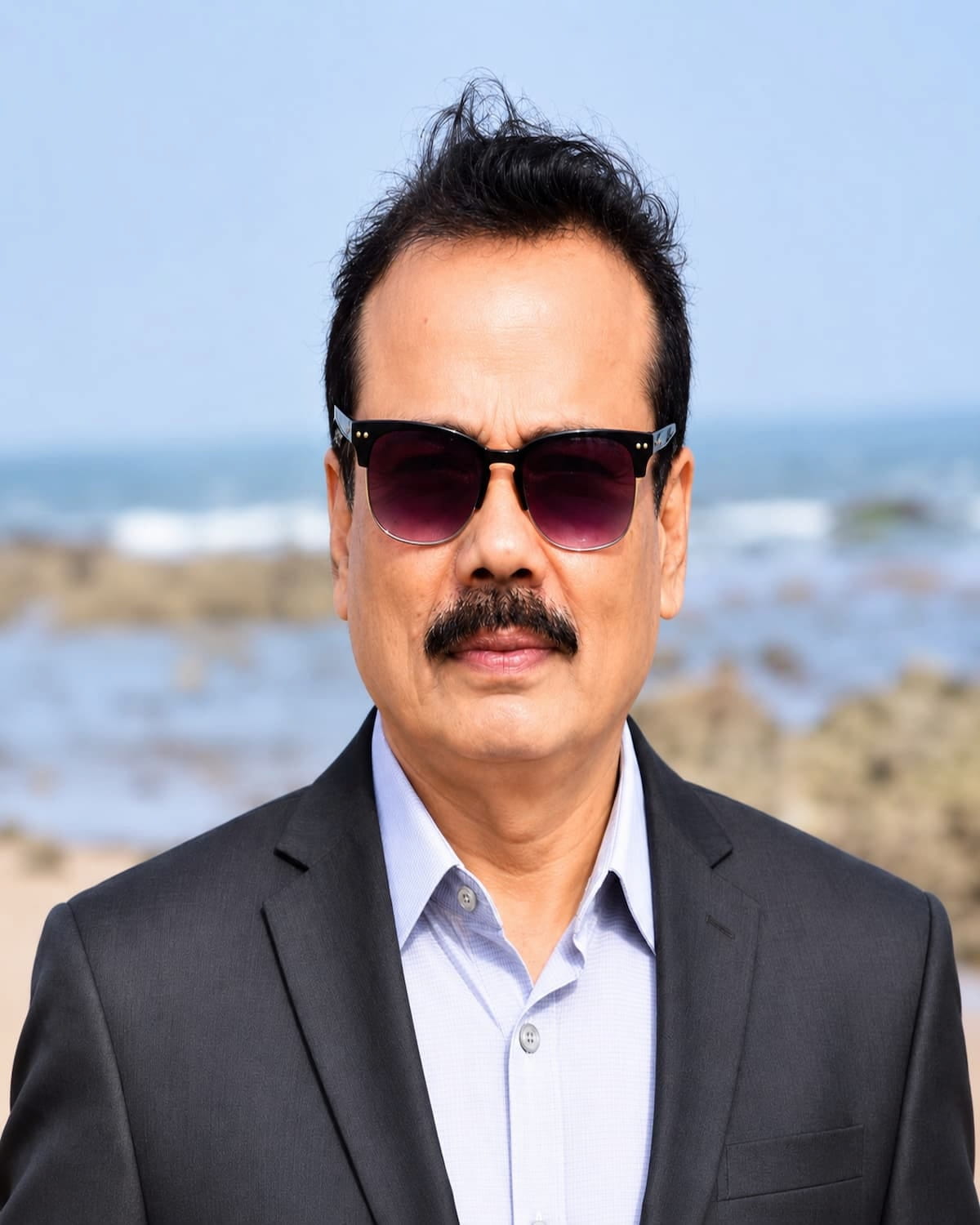
The patient had drooping eyelids, blue nails, and respirations so shallow they barely moved the chest. Krait venom, of the neurotoxic variety, works fast and leaves little margin. In the resource-limited setting of a cottage hospital in Pandharkawada, Prabhat Deshmukh had an endotracheal tube, an Ambu bag, atropine, and neostigmine — and the steadiness to use them. The patient went home. Prabhat moves on to the next case with the same matter-of-factness he brought to the first.
That is the surgeon Yavatmal has known for more than three decades: precise, ethical, and free of the performance of eminence that so often attaches itself to the profession.
From Pusad to GMC
Prabhat was born in Pusad, in Yavatmal district, to a farming family. His primary school was a village school in Lewa, in the Pusad taluka; he then moved to Pusad itself, where he shared classrooms with Deepak Bahekar, Shyam Bawage, and Satish Bhaskarwar. For premed college, he went to Vidarbha Mahavidyalaya, Amravati, before earning admission to Government Medical College (GMC), Nagpur, in 1973.
His rural internship took him to a primary health center in Adyal, 86 km southeast of Nagpur in Bhandara district, where he worked alongside Satish Bhaskarwar and Sharad Adoni. The three of them, finding clinical work thin, improvised. They drove to a village six kilometres away, armed with three vehicles and four microscopes, and conducted a door-to-door survey for filariasis — examining 4,000 people and taking night blood samples. One in six tested positive for microfilariae. The findings were published in a WHO bulletin and in the International Journal of PSM. They then procured over 400,000 tablets of diethylcarbamazine and distributed them through the village.
It was a feat of initiative that few would attempt during an internship, and it set a tone.
The Surgeon’s Formation
Prabhat enrolled in the MS (Surgery) programme at GMC Nagpur in 1980. During his residency, he secured an ICMR scholarship to study immune status in patients with breast cancer. His guides were Dr. ML Gandhe and Dr. BP Deshraj; his thesis examined immune response in malignancy. After MS, he wanted to specialise in surgical oncology and went to Mumbai in search of a training programme — a long-held ambition that circumstances would not permit him to fulfil.
He spent six months at a cottage hospital in Pandharkawada instead, where the krait patient arrived and was saved. Then came six months as a medical officer at the district hospital, Yavatmal. In 1985, he began his private practice in Yavatmal.
The generation of surgeons trained in Maharashtra’s government medical colleges in the late 1970s arrived in their home towns at a particular moment: the corporate hospital sector was nascent, insurance barely existed, and a surgeon’s income depended on the volume and trust he could build one patient at a time. Those who stayed in smaller cities took on everything — emergencies at three in the morning, patients who could not pay, referrals that arrived too late. Prabhat built his practice in that tradition, becoming one of Yavatmal’s most trusted surgeons over more than three decades.
A Surgeon Who Operates Carefully
Ask Prabhat about his craft, and he returns to a single idea: knowing when not to operate is as important as knowing how. That instinct — the restraint to wait, to observe, to question whether the knife is truly needed — distinguishes the surgeon who is genuinely good from the one who is merely skilled.
“The lack of ethics and commercialisation in the medical profession deeply hurts me,” he said. He meant it. His practice has been built on trust, not volume; on referrals that came because patients recovered, not because margins were attractive.
His wife, Sheela, is an MBBS graduate of the GMC Nagpur 1978 batch. They have two daughters: Vidula, who holds a PhD in Biotechnology from DY Patil College, Mumbai, and now works at Eli Lilly in Indianapolis — married to Abhinav Garud, employed at Deloitte; and Vaidehi, who completed an ME from Father Agnel College, Vashi, and an MS from Arizona State University, and works at Mitsubishi in Wichita — married to Nakul, employed at Case New Holland. There is a grandson, Vivan, in Indianapolis.
The Late Years
The pandemic cancelled a planned trip to attend his daughter’s convocation. He and Sheela rescheduled and travelled in March 2021, arriving just as Vidula’s son was born prematurely. Prabhat watched the NICU team work. “This was my first personal experience witnessing nano prematurity,” he said. The professional and the personal collapsed into the same moment — the surgeon who had spent decades pulling people back from the edge, watching a team do the same for his grandson.
He and Sheela now divide their time between Yavatmal and the United States. Neither practises medicine any longer. His hobbies are travel — national parks, historic sites, religious places — and a quiet attentiveness to the world that has always been part of how he works.
“Good surgeons have to have compassion and humanity,” he said. In Yavatmal, over more than three decades, that was not a philosophy. It was a daily practice