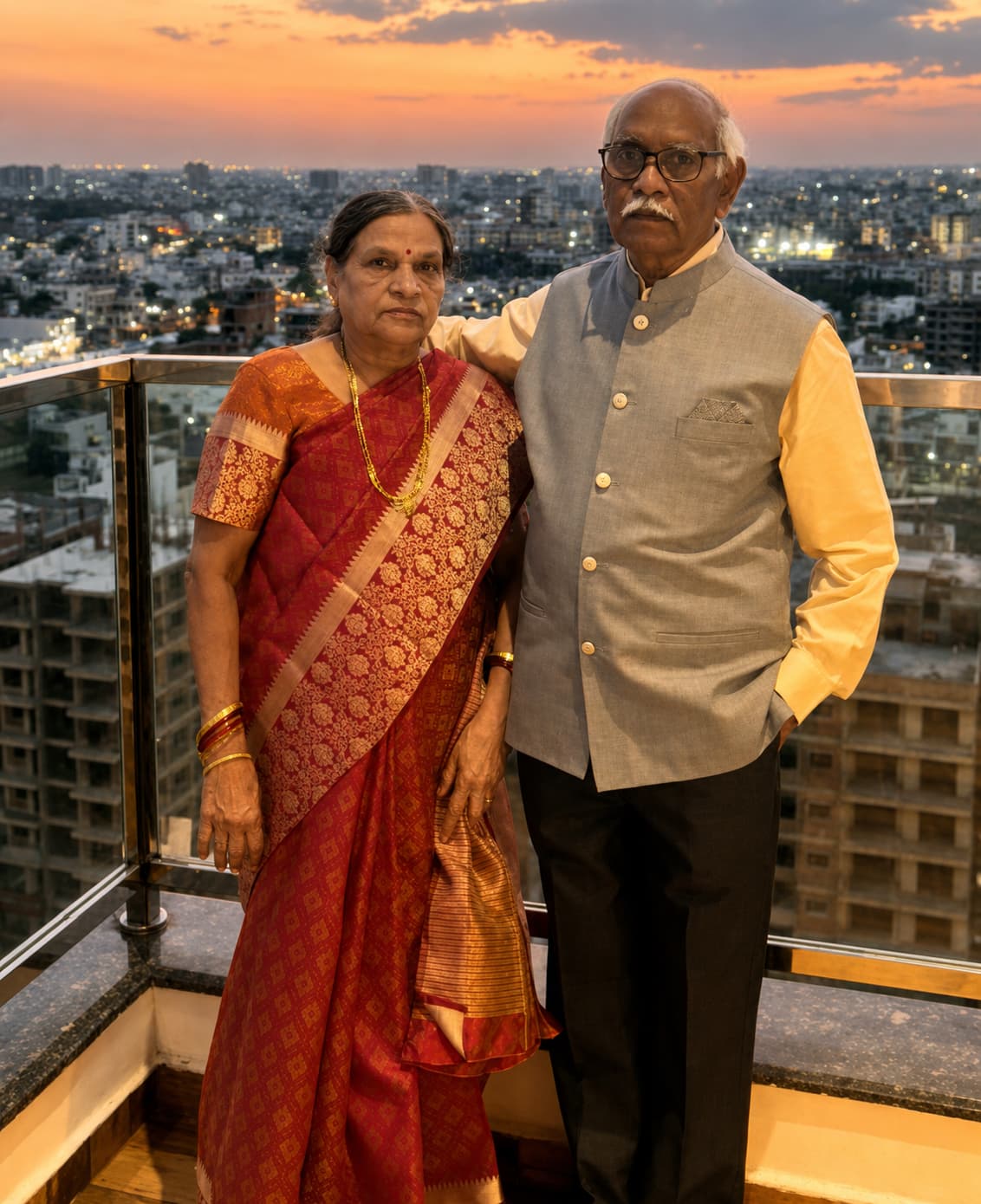
Prakash Bhatkule has spent forty years looking at “the community” through the lens of a social scientist. After a career spent rising to the head of the Department of Community Medicine at GMC Nagpur, he has traded the academic halls for the quiet of Adegaon’s River Stone Farm. Yet, the man who once studied the nutrition of preschool children is now the president of a senior citizens’ association. He has proved that for a true practitioner of social medicine, retirement is not a withdrawal, but a “second innings” in the field.
The Rank Student from Karajgaon
Prakash was born in Karajgaon Bahiram, a small village in Amravati district, into a household where learning was both livelihood and discipline. His father, Shri Ruprao, and mother, Kalawati, were primary school teachers; at home, the same quiet rigor shaped their son. He walked to the village school, studied under familiar roofs, and grew into a student who did not merely do well—he consistently led. From Shree Shankarrao Vidyalaya in Karajgaon to VMV College in Amravati, his name appeared where it often did for years: at the top.
Prakash interned from Rohna primary health center (with Dhirendra Wagh, Kishore Kedar, Aziz Khan and Dilip Gohokar) and did his urban internship from Civil Hospital Amravati (with about a dozen-and-half boys from the class of 1973). In 1980, he joined GMC as a lecturer after spending a couple of months in a Gondia hospital. While serving the department of Preventive and Social Medicine, he also completed his MD, writing his thesis under Dr. DL Ingole.
At GMC Nagpur in 1979, he made a choice that surprised his peers. In a batch full of aspiring surgeons and physicians, Prakash chose Preventive and Social Medicine (PSM). This was the road less traveled. PSM was often viewed as a “theoretical” branch, far removed from the glamour of the operating theater. But for Prakash, the community was the most complex patient of all.
During his MD under Dr. D. L. Ingole, he studied the impact of vitamin A and iron on the haemoglobin status of preschool children. The work was grounded, patient, and quietly ambitious. It moved beyond treating disease to understanding its roots—nutrition, deprivation, and the long shadow of social conditions. This inquiry into fundamentals became a defining thread in his career.
He grew steadily within the academic system—Associate Professor in 1989 and Professor in 2008—while serving across several government medical colleges: Saoner, Yavatmal, Akola, and IGGMC Nagpur. Each posting added a layer, each district a different lens on the same enduring question: how to bring medicine closer to the lives people actually lived.
In 1985, he was awarded the Young Scientist Award by the Nutrition Society of India, Hyderabad, in recognition of his research in community nutrition.
The Arogyachi Gurukilli
Bhatkule’s academic output was prodigious. He published 21 research papers and authored a landmark book on health education in Marathi titled Arogyachi Gurukilli (The Key to Health). He believed that medical knowledge should not be locked in English-language journals; it had to be accessible to the people it concerned. This commitment to public communication earned him the Best Teacher award at GMC Nagpur in 2018, the year he superannuated.
But Bhatkule’s greatest legacy is perhaps his role in the “historical sweep” of Indian public health. He oversaw the transition of PSM from a branch focused purely on infectious diseases to one that handles the modern “lifestyle” epidemics of a changing India. He served as the secretary of the Maharashtra chapter of IAPSM and delivered the prestigious Dr. D.K. Ramadwar Oration. He was the assessor for the Medical Council of India, ensuring that the standards he lived by were passed down to the next generation.
The River Stone Second Innings
Prakash’s retirement in 2018 was merely a change of venue. He spent some time at AMMIMR in Bhilai and SSIMS, but eventually, the countryside called him home. At River Stone Farm in Adegaon, he has traded the classroom for the orchard. But the social scientist in him remains active.
He now serves as the President of the Adarsh Jyestha Nagrik Mitra Mandal. He has shifted his focus from the nutrition of children to the dignity of elders. He understands that the rural-urban migration of doctors has left an aging population in Vidarbha that requires advocacy and support. He continues to write health articles and recently penned the foreword for the Marathi novel Anahita.
After four decades in community medicine, I am now enjoying the ‘second innings’ of my life in Nagpur, surrounded by family, friends, and the quiet fulfillment of social service. I have traded the classroom for the countryside.
He lives in Nagpur with his wife, Pramila, and his two sons. Mangesh, a software entrepreneur, and Swapnil, an Ayurveda and Panchakarma specialist, represent the modern diversification of the GMC 1973 legacy. Prakash travels the world—Dubai, Vietnam, Srinagar—but he always returns to the community. He remains a man who knows that health is not merely the absence of disease, but the presence of purpose. At the end of his “second innings,” the rank student from Karajgaon is still teaching us how to live.