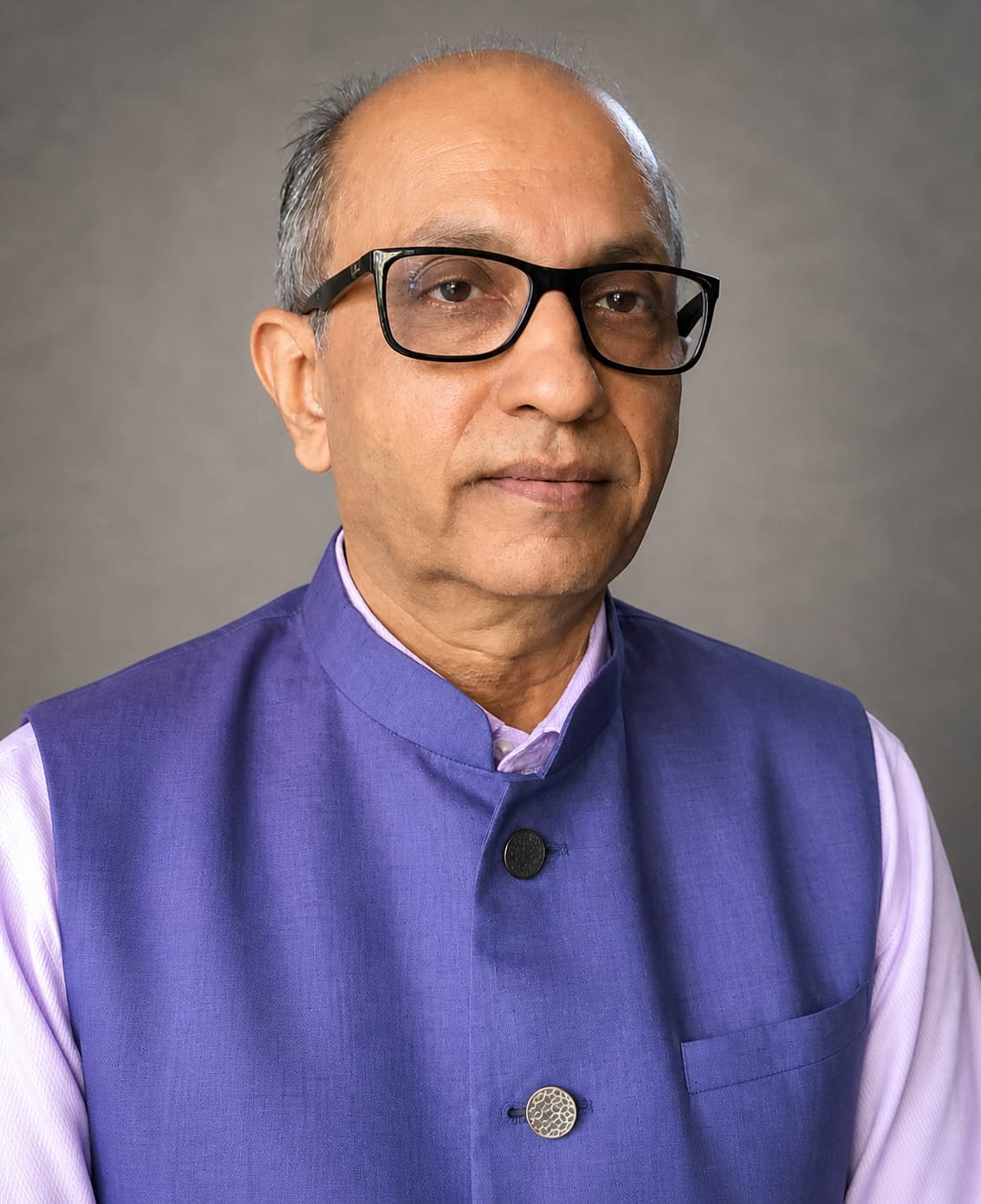
He runs at 58 years old. Not jogging — running. At the 2015 Mumbai Half Marathon, he clocked 2 hours 13 minutes, his seventeenth half marathon, his personal best. Cars whiz past, auto-rickshaw drivers speed away without a glance. He keeps running, because, as he explains, running generates a particular tranquility that nothing else quite replicates. The man who won a gold medal in his MD, who was then shown the door because there was no vacancy, found his equanimity not in medicine’s recognition but in 22 kilometres of Mumbai road.
The Gold Medal and the Closed Door
Rajeev was born in Nagpur in November 1956, into a household shaped by medicine on both sides. His father was a chemical engineer at the National Environmental Engineering Research Institute (NEERI). His mother was a gynaecologist and director of the ESI Hospital, Nagpur. The specialty, in one sense, was already in the room.
He attended Hadas High School and Hislop College — where VD Deshpande was a classmate — before entering GMC Nagpur in 1973. After graduation, he interned at Mohadi with Maitreyan Vasudevan, Vikas Chitnavis, and Ramesh Mundle, completing his urban internship at GMC Nagpur. He enrolled in the MD (Obstetrics and Gynaecology) programme at GMC, worked under Dr. Shastrakar, and graduated with a gold medal.
The gold medal was not enough. He badly wanted a faculty position in the department. The department head told him there was no vacancy.
It is one of Indian academic medicine’s recurring cruelties: the graduate who excels, who wins the prize, who is precisely the person an institution should retain — turned away not for any failure of merit but for the absence of a line in a budget. Rajeev left, spent six years working as a lecturer at GMC Nagpur and Indira Gandhi Government Medical College, Nagpur, and then received a transfer to Topiwala National Medical College and Nair Hospital, Mumbai in 1988. He served as a reader in the department until 1992 — and then, once more, there was no vacancy.
Renuka Nursing Home, Thane
In 1993, Rajeev left government service and founded Renuka Nursing Home at Khopat, on LBS Marg in Thane. He subsequently joined Rajiv Gandhi Medical College, Thane, rising to Professor of Obstetrics and Gynaecology. The private practice and the academic appointment ran alongside each other.
Over three decades in Thane, he built the practice that government institutions had twice declined to give him space to build. Deliveries, infertility, laparoscopic surgery — the full range of a busy gynaecological practice in a growing city. His wife Anushree brought hospital management expertise. His daughter Sumedha, MS Surgery from NKP Salve Medical College, Nagpur, married Dr. Rohit Gosavi, a physician based in Islampur, Sangli.
The generation of doctors who entered government medical colleges in 1973 did so at a specific historical moment — before the private hospital sector expanded, before corporate chains made private practice a first rather than a fallback. Many of them spent their most productive years navigating government institutions that lacked the resources to use them well. Rajeev’s two encounters with “no vacancy” represent a structural failure dressed up as administrative fact. He found his way around it. Most did.
The Runner
The running began at 49 — late, by most standards, for someone who would eventually run 17 half-marathons. He began with walking, a stress-buster after years of night deliveries and the ambient urgency of an obstetric practice. The walking became short runs. The runs became longer. The stamina accumulated.
He reads Robin Sharma and Deepak Chopra. He practises yoga twice a day. He starts his mornings with an hour of badminton, swims twice a week, cycles 8 kilometres twice a week, runs seven flights of stairs three times a week. And when time remains from these self-imposed demands, he practises gynaecology.
“As I run, cars whiz past me, auto-rickshaw drivers speed away disdainfully, the whir of bikes vibrates in my ears — but I keep running,” he said at the class reunion. “And now I can run 22 km with reasonable ease.”
The gold medal sits somewhere in a drawer in Thane. The marathons keep accumulating. He runs, he says, because of the tranquility. After two government departments that showed him the door, a city that roars past him without recognition, he has earned the tranquility the hard way.
At 71, he continues to lead a life marked by discipline, energy, and quiet artistry. A seasoned obstetrician, he carries decades of clinical experience—each case demanding vigilance, judgment, and emotional steadiness. To balance the inherent tension of obstetric practice, he turns to pursuits that restore both body and mind.
A regular marathon runner, he maintains a rigorous fitness routine, often seen on long, steady runs that reflect his endurance and resolve. Alongside this physical commitment, he nurtures a deep love for music. A trained classical singer, he frequently performs Indian film songs, captivating audiences with a voice that is both expressive and controlled, capable of holding listeners in rapt attention.
For him, music is more than a pastime—it is a refuge. As he puts it, “Singing is another hobby which keeps me calm and stress-free. In obstetrics, there is tension in every case.” In that simple reflection lies the balance he has crafted over a lifetime: the intensity of medicine softened by the healing cadence of music.