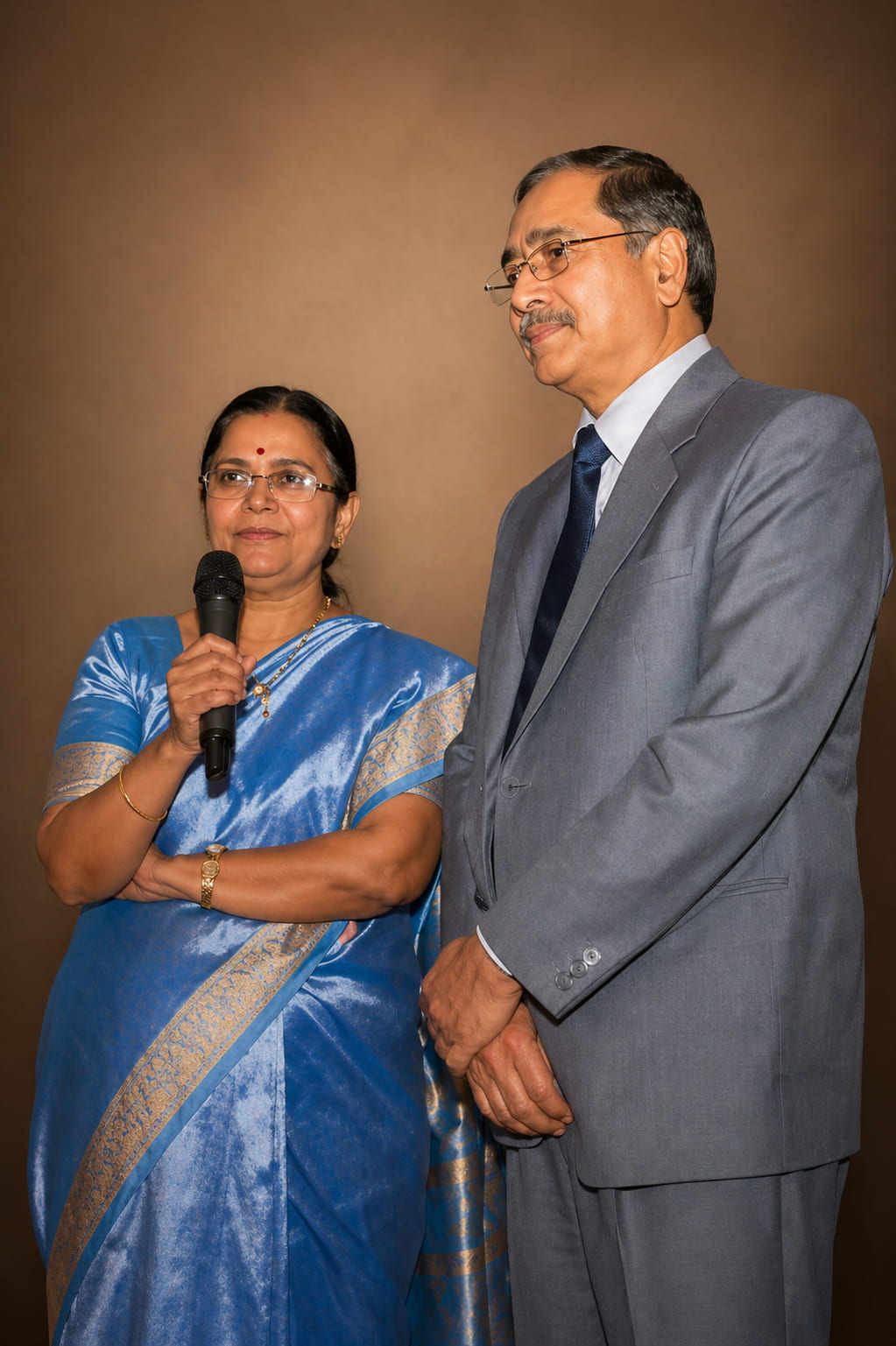
Fifteen thousand tubectomies. Over thirty years, in the primary health centres scattered around Paratwada, Rekha Shete performed fifteen thousand tubectomies — a number that represents fifteen thousand women who came to her, trusted her with their bodies, and left with their futures altered. She never announced it. She simply kept doing it.
From Nagpur to Wardha to the Hills
Rekha was born in Nagpur, the daughter of an Assistant Commissioner in Revenue and an Ayurvedic physician. Her father’s postings took the family across Vidarbha — Buldhana, Warora, back to Nagpur — and so Rekha attended several schools before she was done: St. Ursula Girls’ High School, Nagpur, Swawlambi Vidyalaya in Wardha, and finally Jankidevi Bajaj Science College, Wardha, for her pre-medical education.
That college sent eleven students to Government Medical College, Nagpur in 1973: Suhas Jajoo, Rekha Sapkal, Avinash Joshi, SP Kalantri, Rajan Bindu, Narayan Dongre, Pramod Mahajan, Prabhakar Patil, Laxmikant Rathod, Ashok Gambhir, Nandkishor Taori, and Maya Khati. A college from a small Vidarbha town — and eleven of its students entered one of Maharashtra’s most respected medical schools in the same year.
Rekha completed her MBBS from GMC Nagpur and married Dr. Pramod Shete, a paediatrician, on 29 June 1979. They went together to Gangtok, Sikkim, where Rekha served as a medical officer for three years — far from Vidarbha, in the hills above the plains, doing the work that needed doing.
Paratwada
In 1983, she returned — to Paratwada, in Amravati district, where Dr. Shete had his ancestral home. She joined the Subdistrict Hospital, Paratwada, as a medical officer. And then the tubectomies began.
Thirty years of them. Fifteen thousand procedures. In primary health centres around Paratwada — places without specialists, without private hospital infrastructure, where women came because Rekha was there and Rekha would help them. The scale is not incidental. It represents a quiet, consistent presence across a generation of women’s lives in one district of Vidarbha.
In the years that Indian medicine was rationalising, specialising, corporatising — shifting toward urban centres and private practice and technology-heavy medicine — Rekha Shete stayed at a subdistrict hospital in Amravati district and performed tubectomies. The larger forces of Indian healthcare ran in one direction. She ran in another.
The Next Generation
Her daughter Akshara is an ophthalmologist — MBBS and DOMS from Dr. Panjabrao Deshmukh Memorial Medical College, Amravati, married to Dr. Kamlesh Gotiwale, an anaesthesiologist at Lokmanya Tilak Municipal Medical College, Sion, Mumbai. Her son Bharat is a surgeon — MBBS from JNMC Sawangi, MS in Surgery from Annasaheb Chudaman Patil Memorial Medical College, Dhule, with a laparoscopic surgery fellowship, practicing at PDMC Amravati with his wife Dr. Rucha Gulhane, an ophthalmologist.
The children of a general practitioner who stayed became specialists who also stayed in Maharashtra. The Shete Nursing Home at Tilak Chowk, Paratwada, carries on.
Rekha is a grandmother now. She tends her grandchildren — Vedant, Vinaya, and Advait — and tends her patients, with the same unhurried attention that has characterised her practice since 1983.
Fifteen Thousand
There is a kind of medicine that does not seek attention and does not receive it. No research papers, no conference addresses, no fellowship certificates. Just a doctor in a primary health centre in a small town, doing the same procedure fifteen thousand times because fifteen thousand women needed it.
That is Rekha Shete’s record. The arithmetic speaks for itself.