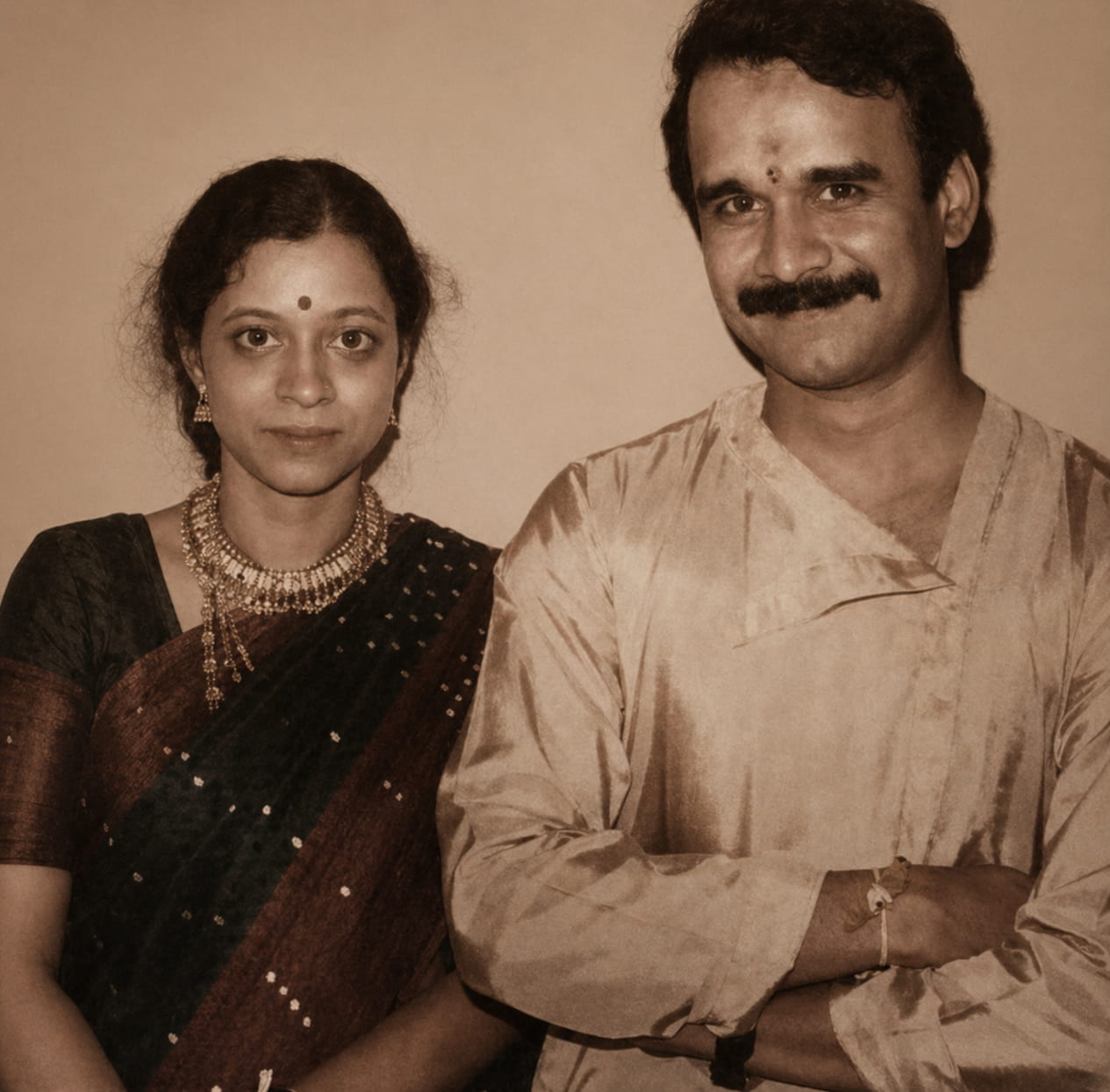
In the fourth standard, Shriram Kane was handed a sitar. He did not put it down.
More than six decades later, he still practises weekly — refining a raga the way he might return to a difficult blood film, with patience, precision, and the understanding that mastery is never declared but only approached. The two vocations, music and medicine, have run parallel through his life with such consistency that it is no longer possible to say which one illuminates the other. He is a haematologist who plays the sitar. He is a sitarist who reads bone marrow biopsies. Neither description is complete. Both are true.
The Son of the Laboratory
Shriram was born in Nagpur, the son of the man who ran the Kane Parande Laboratory — one of the city’s most respected diagnostic centres, established in 1954. Growing up with a laboratory as a backdrop, he absorbed early the idea that medicine was not confined to the bedside. There was a world of slides, stains, and microscopes in which diseases revealed themselves to those patient enough to look.
He attended Corporation School, Shankar Nagar for primary education, then Dharampeth High School for his middle and higher years. In 1971, he enrolled at the Institute of Science, Nagpur, and entered Government Medical College, Nagpur in 1973. He completed his internship at the primary health centre, Narkhed — a cluster of villages 90 kilometres northwest of Nagpur — alongside Uday Gupte and Shriniwas Shelgaonkar.
After earning his MD (Medicine) from GMC Nagpur in 1981, Shriram did something that marked his direction clearly. He spent four years at Tata Memorial Hospital, Mumbai, learning haematology and bone marrow transplant under Dr. S.H. Advani — one of the foremost haematologists in the country. Mumbai in those years was formative in another sense too. He found his way to Kishori Amonkar and took lessons from her. “My Mumbai days were the best days in my life,” he said at the class reunion, “for I got a chance to learn music from Kishori Amonkar.” The coincidence of a great teacher in each discipline, at the same time, in the same city, was not something he has ever taken lightly.
He returned to Nagpur in 1985, set up his haematology practice, and joined the faculty at Jawaharlal Nehru Medical College, Sawangi, where he served for 13 years. He later headed the department of Medicine at a newly opened medical college in Nagpur from 2019.
Saptak
On 10 August 1980, seven young men who loved Indian classical music gathered in Nagpur and founded Saptak. Shriram Kane and Uday Gupte — both GMC 1973 — were among the founders. The first artist to perform on the Saptak stage was Parvin Sultana. Bhimsen Joshi followed. Hari Prasad Chaurasia, Kishori Amonkar, Asha Bhosle.
In 43 years, Saptak has grown from a small gathering of enthusiasts into one of the most anticipated cultural institutions on Nagpur’s musical calendar. Shriram and his group play through the full range of Hindustani classical music — Bhairavi, Yaman, Bahar — creating a stage on which performers can invoke the muse without restraint. He has appeared on All India Radio broadcasts since 2001. The Society for Indian Music and Dance invited him to perform a full concert in Manchester. He has collaborated with sitarists and vocalists across the country, and continued, decade after decade, to practise.
His batchmates remember his calligraphy. Ramesh Mundle, at the class reunion, recalled the histology diagram of amyloidosis — vivid, precise, drawn in Shriram’s hand — as still fresh in his memory, forty years on. The same eye that produced those diagrams still looks down a microscope.
Blood and Bone Marrow
Haematology occupies a particular place in the structure of medicine. It is, as Shriram puts it, a field that crosses every discipline. Patients arrive with unusual constellations of symptoms, with rare diseases that general physicians have not encountered, with bleeding or clotting crises in which the margin for error is thin. He is, as he describes himself, both a patient’s primary physician and a doctor’s doctor — consulted when the situation is complex and the diagnosis has eluded others.
Over four decades, he has watched the field transform. He said:
“Hematology is a very interesting and complex field that crosses all disciplines. A lot of patients come to see me either because they have an unusual constellation of symptoms without a diagnosis and are seeking answers, or because they have a rare disease that is unfamiliar to other physicians. I enjoy being both a patient’s primary physician and a doctor’s doctor.
Over the last four decades, I have seen Hematology changing rapidly. Inherited diseases like sickle cell anemia, thalassemia and hemophilia, long-viewed as chronic, life-altering conditions, are becoming curable with the promise of gene editing.
I constantly have to do my part to stay on top of the literature and remain ‘in the know’ for the sake of my patients. The stakes are incredibly high — with high risk and the potential for high reward. It took me years to get to the point where I truly had a grip on all the many nuances of hematology and was able to provide patients and other physicians with the expertise they need.”
His wife Vidya — a microbiology graduate with a diploma in clinical analysis — manages the haematology laboratory. Their son Prathamesh holds an MS in Orthopaedics from Topiwala National Medical College, Mumbai, and has joined the Department of Orthopaedics at Watford General Hospital in the United Kingdom, married to Dr. Radhika Dashputra, a senior registrar in ophthalmology at the Royal London Hospital who is pursuing a fellowship in oculoplasty. Their grandson Aneesh arrived to complete this picture.
The Half-Smile
Those who work with Shriram describe a particular quality: he is simple, unassuming, gentle. He wears a trademark half-smile. He plays down his achievements without effort — not as performance, but as disposition. He spends most of his professional time in the company of blood and bone marrow samples, switching between benchtop and bedside with a fluency that took decades to acquire.
He still practises the sitar. He still reads every week. The same discipline he brought to mastering Bhairavi — repetition, patience, the refusal to hurry past difficulty — is the discipline he brought to haematology. In a batch that produced physicians, surgeons, gynaecologists, and professors, Shriram Kane may be the only man who mastered two crafts simultaneously, in the same city, under the same teachers, and carried both forward across an entire working life.
The sitar was placed in his hands in the fourth standard. He did not put it down.