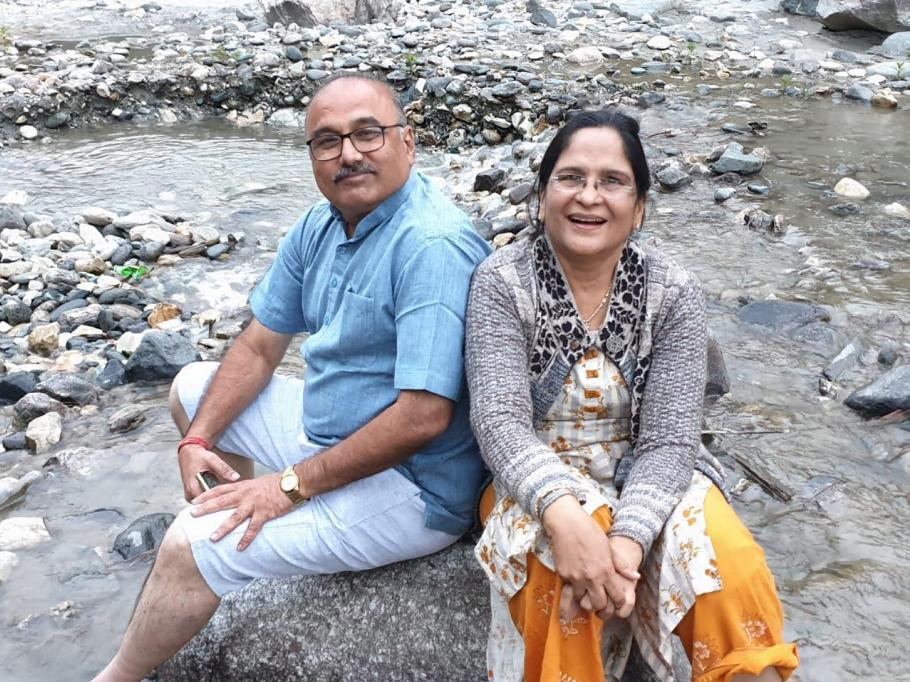
At 4:30 every morning, while Wardha is still asleep, Suhas Jajoo is already scrubbed and standing at the operating table. By the time the city stirs, he has completed two or three procedures. Until a year ago, his afternoons belonged to Jawaharlal Nehru Medical College at Sawangi. His evenings to his outpatient clinic, which routinely runs until midnight. Somewhere in the margins of this schedule — at a wedding, a funeral, a naming ceremony — you will find him, because Suhas Jajoo does not absent himself from the life of his community. He is the surgeon Wardha calls. He is also, as it happens, the surgeon other surgeons call.
The Boy in Khadi
Born in November 1955 in Wardha—where khadi represents conviction rather than costume—Suhas Jajoo was raised in a family defined by a deep, quiet inheritance. His grandfather, Shrikrishnadas Jajoo, an imprisoned freedom fighter, famously declined high political office in favor of a life of service—an example that anchored their household. His parents continued this grounded life, with his father teaching at GS Commerce College and his mother heading Ratni Bai Vidyalaya. In their home, simplicity was a daily practice, not a lesson.
He shared this background with his elder brother, Ulhas, a 1968 GMC alumnus who built a formidable reputation teaching medicine at MGIMS and designing rural healthcare. While it was unfair to compare them, Suhas embraced the challenge, taking the time to carve his own niche and identity, even as he shared his brother’s unwavering principles.
His path was not without its hurdles. After Buniyadi School and Cradock High School, his pre-medical year at Jankidevi Bajaj College of Science proved testing. Educated in Marathi, he had to master English textbooks while pivoting from his strength in mathematics to biology. He navigated this difficult year through sheer persistence. Entering GMC Nagpur in 1973, he wore khadi, just as he does today. He made no attempt to match his brother’s legacy; instead, he stepped comfortably aside from it. Gregarious, warm, and entirely himself, he left his classmates with a lasting memory—not just of the khadi he wore, but of the remarkable ease of his presence.
The Making of a Surgeon
His graduation with an MBBS in 1977 led to a defining rural internship at Bhadrawati alongside S.P. Kalantri, Suresh Batra, and Omprakash Singhania. It was there he learned that rural medicine required absolute readiness over abstract theory. Returning to GMC Nagpur, he pursued an MS in General Surgery under Dr. P.H. Soni, culminating in a 1982 thesis on sepsis in burns. The discipline, decisiveness, and immediacy of surgery suited him entirely, making his subsequent shift to plastic surgery feel inevitable: while general surgery saved a life, plastic surgery restored its dignity. He secured his MCh seat at GMC Nagpur during a time when training was demanding and specialized expertise was scarce. To master advanced reconstructive techniques like myocutaneous flaps, he relied on the only resource fully available to him—the dissection hall. By relentlessly practicing on cadavers, he learned through quiet repetition what others acquired through formal instruction, eventually submitting a three-hundred-page thesis typed by hand. This was never a matter of improvisation; it was a matter of sheer resolve.
Sevagram: The Choice That Defined Him
The path ahead was already paved with comfortable prospects: a surgical nursing home in Jalgaon, lucrative opportunities in major cities, financial security, and undeniable professional recognition. Yet, he chose Sevagram. Though close to home, it was far from conventional opportunity, offering only modest facilities and little visibility, but an overwhelming volume of sheer human need. At the Mahatma Gandhi Institute of Medical Sciences, he entered a demanding world where the rural poor arrived late, often on the brink of being beyond help. He faced burn victims, children with cleft deformities, and leprosy patients with crippled limbs—complex cases demanding immense patience, skill, and physical endurance. He knew exactly what awaited him in that quiet town, and that was precisely why he went.
The Burn Unit and Beyond
Before he established a dedicated burn unit at MGIMS in 1986, burn care was inconsistent, with patients often dying from preventable sepsis and malnutrition. He changed this trajectory by building systematic care protocols and introducing early wound excision alongside skin grafting. He transformed outcomes so profoundly that Sevagram became the primary referral centre for rural Vidarbha. Yet, he never allowed his skills to be confined strictly to plastic surgery. Driven by sheer necessity, he trained in gastrointestinal endoscopy and TURP, allowing him to step into places like Dattapur to offer definitive surgical relief to leprosy patients who had lived for years with indwelling catheters. In every phase of his career, he chose to work exactly where the gap was widest.
Teacher, Surgeon, Dissenter
In the operating theatre, he taught without reservation, stepping back to let residents operate while guiding them with essential questions. “Why this diagnosis? Why this step?” he would ask—never to intimidate, but to sharpen their clinical reasoning. This same approachable ease extended far beyond traditional hierarchies, making him a deeply accessible colleague to nurses, technicians, and junior doctors alike. However, his growing, quiet influence was not welcomed by everyone. In 1989, he was instructed to restrict his practice solely to plastic surgery, a directive that made little clinical sense in a hospital where surgical manpower was already stretched thin. When he naturally resisted, the disagreement deepened and institutional support began to wane. Recognising that the environment had fundamentally shifted from patient care to politics, he made a quiet but firm choice: in 1992, after nine years of dedicated service, he left Sevagram.
Sushruta Hospital: Building from Home
Returning to Wardha, he and his wife Shubhada—a gynecologist he married in 1982—began anew. Within their ancestral home, they established Sushruta Hospital, nurturing it from humble beginnings into a comprehensive forty-bed facility equipped with surgical and gynecological units, laboratory support, and blood storage. Patients traveled from surrounding villages and towns, drawn less by the growing infrastructure than by a profound sense of trust. Today, alongside managing a high volume of complex cases, the team performs advanced operations year after year. It is demanding, essential work, executed entirely without spectacle and sustained by lifelong partnerships. His anesthesiologist, Dr. Vijay Chandak, shares his quiet rigor, routinely waking at 4:30 a.m. to begin surgeries by five. Dr. Rajendra Daga remains an ever-reliable presence, answering every call the moment a baby is born in the labor room. Perhaps most telling of Suhas’s philosophy is Suresh—a man who never set foot inside a medical college, yet was personally trained by Suhas into an indispensable, highly skilled surgical assistant.
Return to Teaching
In 2000, Suhas joined Jawaharlal Nehru Medical College, Sawangi, as an Associate Professor, quickly rising to Professor of Surgery. Shubhada followed a year later. For over two decades, they balanced teaching with rigorous clinical work. His philosophy remained steadfast: the patient is the surgeon’s laboratory. He trained his students not by mere instruction, but by active participation—empowering them to operate, to think, and to decide.
Then, sensing a shift in the wind, they withdrew. Exactly a year before the Meghe Group handed the institution over to Gautam Adani, both Suhas and Shubhada resigned. Almost as if they knew what was coming, they left the college behind and redirected all their energy into their own practice at Jajoo Wadi Hospital.
The Surgeon Wardha Calls
Suhas Jajoo does not fit the stereotype of the flamboyant or distant surgeon; rather, he is a teetotaller, a non-smoker, and a vegetarian who dresses simply and always arrives early. He frequently speaks of three clinical essentials—availability, affability, and ability, in that precise order—which, in Wardha, is not treated as a catchy slogan but as a rigorous daily practice. His operating team has worked seamlessly with him for decades, and that profound continuity has cultivated something difficult to measure and entirely impossible to replace: absolute trust.
Family and Continuity
Medicine runs deep within the family, a commitment now shared by his daughters. Rucha, a surgeon, and her husband, Dr. Suyash Naval, a gynecologist, have established their own practice while remaining actively involved with Sushruta Hospital. Shruti, an anesthesiologist, and her husband, nephrologist Nikhil Rathi, have built their lives and careers in Pune. Despite his family’s widening reach, Suhas’s own life remains defined by its steadfastness. He anchored his parents in their final years with the same steady presence he offered his patients, choosing to live and serve in the exact place where his story started.
The Measure of a Life
His classmates remember the khadi. They remember the warmth. They remember how easily he belonged.
But beyond memory lies something steadier.
A surgeon who chose need over comfort.
A teacher who gave without holding back.
A life built not on display, but on work that endures.
His batchmates from GMC 1973 will remember Suhas for the Khadi. For the warmth. For the way he showed up — at the operating table at 4:30 in the morning, at the wedding in the evening, at the bedside in the years that followed. He is, as someone once said of him, the surgeon society needs: consulted not only by patients but by other surgeons, and by their families, when the situation is serious and the margin for error is thin.