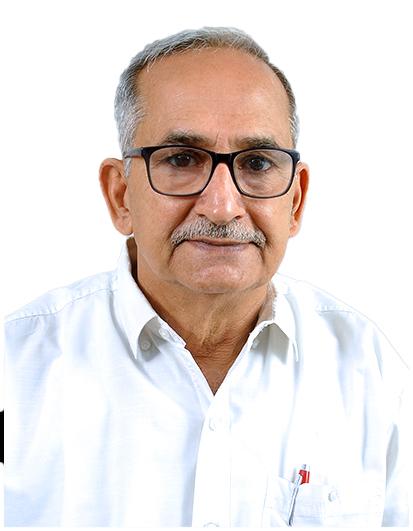
When the interview panel at Visvesvaraya Regional College of Engineering — later VNIT — called Suresh Batra in 1984, his MD practicals were already underway. Dr. G.K. Dubey and Dr. Mitra gave him three hours of leave, mid-examination, to appear for the interview. The panel included Dr. Ramesh Salkar, then associate professor of medicine at GMC Nagpur. Suresh was selected. He returned to complete his practicals. The result was thirty-two years at a single institution — nearly four thousand students and five hundred families, a campus physician in a technical college who understood, with unusual clarity, what engineering students did to their bodies in the name of study.
Wani to Warora to Nagpur
Suresh was born in Wani, Yavatmal district. His father Shri Jeevandas ran a cloth shop. He studied at Shikshan Prasarak Mandal High School in Wani, then moved to Warora for his pre-medical year at Anand Niketan College — a college that sent five students to GMC Nagpur in 1973: Suresh Batra, Nandkishor Kasturwar, Rajendra Sarda, Anand Patil, and Nabatosh Biswas.
At GMC, Suresh rented a room with Pramod Bangde and Vijay Karmarkar in Hanuman Nagar, then moved to Smruti Bhavan in Reshimbag. After graduation, he interned at the district hospital in Chandrapur for his urban placement, and at the primary health centre in Bhadrawati — alongside Suhas Jajoo, SP Kalantri, and Omprakash Singhania — for his rural posting.
Postgraduation brought a pivot. He enrolled for MD in Pharmacology at GMC Nagpur, then in his third year, the pull of clinical medicine became too strong. He quit Pharmacology and re-entered as an MD (Medicine) candidate. To do so he had to compete against applicants from the GMC 1975 batch, three years his junior, and he ranked above them. His MD thesis — supervised by Dr. B.G. Waghmare — studied early arrhythmias after acute myocardial infarction: the “stormy petrels,” as Waghmare put it, that arrive in the first hours after a heart attack. He completed the degree in 1983.
The Campus Physician
VNIT gave Suresh a career of unusual shape. A general physician in a technical institution is not quite a hospital doctor and not quite a GP: the population is specific, the pathologies are particular, and the role demands as much counsellor as clinician. He identified a syndrome among engineering students that he named the 4S — Sleep deprivation, Skipping breakfast, Sickness, and Scholastic backwardness — and built his clinical approach around addressing it. He explained to students that if they ate and slept well, exercised, and kept their focus, their time at VNIT could be something other than damage to their health.
He designed prevention programmes aimed at students arriving from households where metabolic syndrome was already taking hold — addressing it before it could establish itself in the young. This was public health thinking applied at the scale of a campus, without any of the institutional infrastructure that public health usually requires.
In 1994, his wife Bharati was deputed by the Government of India to the Maldives, to develop a paediatric ward at Indira Gandhi Memorial Hospital in Malé. Suresh obtained a two-year lien from VNIT and went with her, working under the Ministry of Health of the Republic of Maldives. He returned to VNIT afterward and continued until his retirement in 2016.
After VNIT
In December 2013, the GMC 1973 class held its reunion. Shortly after, Suresh underwent coronary artery bypass grafting — a CABG surgery that arrived without the usual risk factor profile. It was, by his own account, a shock. He did not dwell on it in those terms. He took it in his stride and moved on.
After 2016, he spent time at the National Institute of Technology, Srinagar, Garhwal, and served as a physician at the Ramakrishna Math, Nagpur — where his batchmate Manik Khune also volunteered — running an outpatient clinic. He recently joined the clinic at IIM Nagpur, working alongside classmate and fellow physician Uday Gupte to offer care to management students. He has adopted intermittent fasting, a metabolic intervention developed by Dr. Jagannath Dixit, as a clinical tool for preventing and reversing type 2 diabetes.
His wife Bharati retired as vice principal of the School of Nursing, Indira Gandhi Government Medical College and Hospital, Nagpur. She has since served as a technical consultant to the Tata Education and Development Trust for the upgrade of Regional Mental Hospital, Nagpur, and now guides PhD students at SRK University, Bhopal. His elder son Dhruv — MBBS from Armed Forces Medical College Pune, MD Medicine from GMC Solapur, DM Neurology from King George Medical University Lucknow, and a post-doctoral fellowship in Movement Disorders at NIMHANS Bengaluru — practises Neurology at Viveka Multi Super Specialty Hospital, Nagpur. His younger son Nitya holds a B.Tech and M.Tech in Mechanical Engineering from IIT Powai, Mumbai, and works as technical business analyst with British Petroleum in Pune.
Suresh is, as those who know him tend to observe, a man at peace with what he built. The generation he belonged to at GMC — the one that entered medicine without the corporate infrastructure that now surrounds it, and practised it without the defensive anxieties that corporatisation has introduced — finds its best representative in him: honest, unhurried, sufficient.