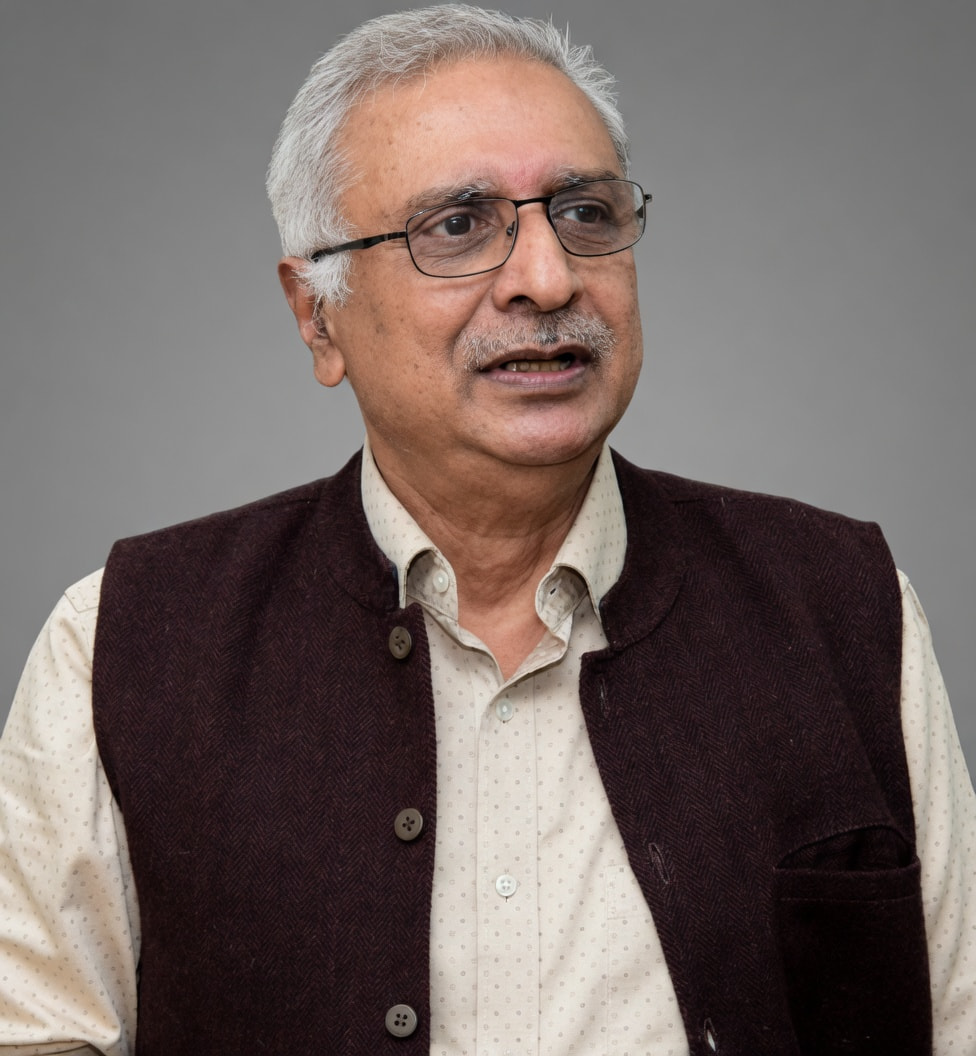
The most challenging position Thomas Chacko held during his student years at GMC Nagpur was not academic. It was goalkeeper on the college hockey team — a position, he notes, that in the early 1970s came with pads and gloves and nothing else. No helmet. No throat guard. No reinforced shin protection. The ball came at you, and you stopped it, or you didn’t.
“With God’s Grace,” he says now, “I can face any challenges in life without fear or favour.” The hockey goal — open, vulnerable, requiring composure under pressure — turns out to have been good preparation.
Born in Badnera
Thomas was born in Badnera, in Amravati district, where his father served as Chief Health Inspector for the Nagpur division of Central Railway . He studied at Holy Cross Convent, Dnyanmata School, and Government Higher Secondary School in Amravati, completed his pre-medical year at Vidarbha Mahavidyalaya, and entered GMC Nagpur in 1973 . During his first MBBS year, he lived in a succession of modest lodgings—Dhantoli, Central Avenue Road, Hanuman Nagar—before finally shifting to the GMC hostels in 1975 .
His Amravati contemporaries who entered GMC that year numbered more than a dozen, a small town cohort that would disperse across Indian medicine over the next five decades . Thomas himself was technically underage—born on 2 January 1956 and short of the cut-off by two days—and so found himself with BSc Part I contemporaries in both the 1972 and 1973 GMC batches, straddling two academic worlds at once .
After graduation, Thomas interned with Looi Wan Chong and Tapash Saha at the Adyar Primary Health Centre in Pavni Tehsil, 14 miles south of Bhandara—a posting that anchored his early medical practice in rural Maharashtra . He returned to GMC to pursue an MD in Preventive and Social Medicine under the guidance of Dr. Ingole, writing his thesis on methods for detecting latent diabetes in pregnancy . Midway through his residency, he married Marina, an MBBS graduate of Gandhi Medical College, Bhopal, who later completed her MD in Microbiology at GMC Nagpur and now serves as Professor of Microbiology and Laboratory Director at Believers Church Medical College and Hospital, Thiruvalla.
The Long Arc: Saudi Arabia, Coimbatore, Kerala
Thomas lectured briefly at GMC Nagpur after completing his MD, a short academic pause before his responsibilities widened. At 26, he became one of the youngest district health officers in the country, an early indication that his career would keep stepping into larger rooms. A year later, he left for Saudi Arabia to serve as Director of Public Health in Sabya, a sub-division of Jazan Province in the country’s southwest, a role he held for six years.
He returned to India in 1989 and joined PSG Institute of Medical Sciences and Research in Coimbatore, where he stayed for 28 years, long enough to watch batches of students turn into colleagues. In March 2017, he moved to Believers Church Medical College in Thiruvalla, Kerala, as Dean of Medical Education, a role he held until he retired at 70, passing on the mantle but not the vocation.
The shape of Thomas’s career is unusual for a GMC Nagpur 1973 graduate: not a private practice anchored in one city over four decades, but an institutional life carried across countries and regions, each posting a little broader in scope than the last. He spent his professional years less at the bedside and more in the spaces that determine how well those bedsides are served, building the conditions in which better doctors could be made.
Medical Education as Vocation
Since 2007, Thomas has directed the Foundation for Advancement of International Medical Education and Research (FAIMER) Regional Institute—first from Coimbatore, now from Thiruvalla, where he continues as Founding Director. The institute runs a two-year fellowship programme designed to strengthen the teaching and leadership capacities of medical college faculty across South Asia.
His academic output spans 100 articles in peer-reviewed journals. In September 2020, he published a paper in the Indian Journal of Community Medicine examining the factors behind Kerala’s early success in containing Covid-19 — and, as he notes with some wryness, the state’s subsequent surge arrived shortly after the paper appeared. The mysteries of viral transmission, it turned out, were not fully solved.
He serves as Secretary-General of SEARAME, the regional body of the World Federation for Medical Education in South Asia. Outside medicine, he adheres to the Rotary International principle of service above self, and has served as a Rotary Community Service Director.
His son Jim works as an independent IT consultant in Sydney. His daughters have scattered further still: Sarah leads HR initiatives in Dubai, while Annette specializes in ERP systems in Kuwait. They have built lives as geographically distributed as his own once was. Six grandchildren—Anishka, Vihaan, Malaika, Renae, Arielle, and Caleb—bring the particular joy and chaos that only grandchildren can.
The boy who stood in the hockey goal without protective equipment, stopping what came at him with the equipment he had, became the man who spent 50 years building institutions that produce better doctors. The connection is not metaphorical. It is a character.
Thomas retired as Dean of Medical Education and Head of Community Medicine from Believers Church Medical College, Thiruvalla. The institution now recognizes him as Professor Emeritus—a title he carries back to his ancestral home in Kuriannur, Kerala, where his journey had begun decades earlier.