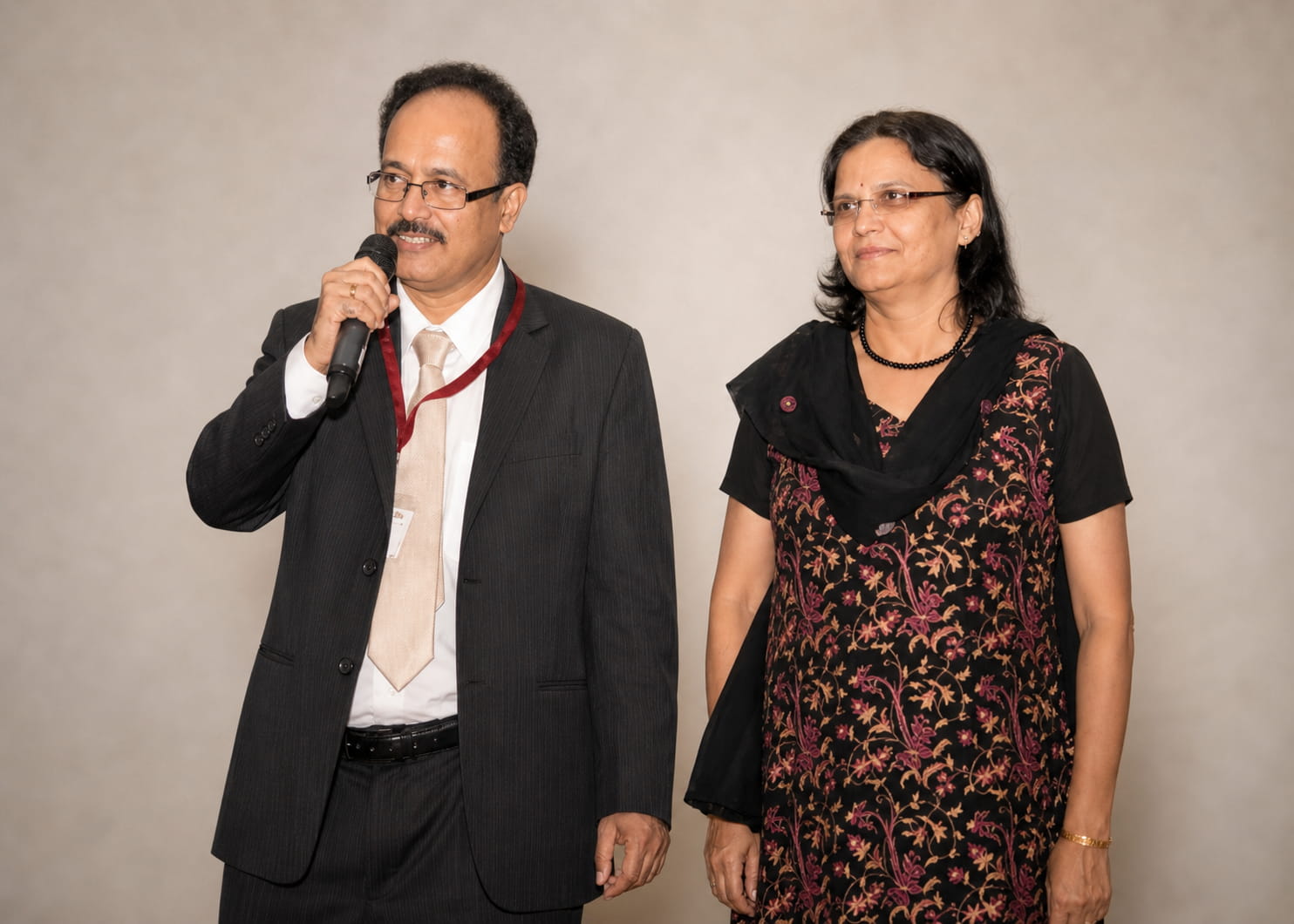
In 1974, Uday Gupte went looking for a mandolin teacher in Nagpur and found none. The one mandolin available at a shop in town was damaged beyond repair. Another person might have given up. Uday picked up a sitar instead.
That instinct — to find a way when the obvious route is closed — has shaped everything that followed.
The Sitar and the Stethoscope
He was born in Amravati, where his father worked in audit and accounts for the central government. The family moved in the orbit of government postings, and Uday’s schooling ran through Dharampeth High School and Manibai Gujarati High School before he found his way to Vidarbha Mahavidyalaya for premed, and then to Government Medical College, Nagpur, in 1973.
At GMC, he fell in easily into a circle of friends — Shriram Kane, Shriniwas Shelgaonkar, Vinayak Sabnis, Sanjay Warhadpande — whose appetites ran well beyond medicine. It was Kane who first introduced him to the sitar. Most teachers Uday approached told him the same thing: neophytes lack the patience. Uday didn’t argue. He began visiting Kane’s home, learned to balance the instrument between left foot and right knee, and pulled the strings until melodic notes came. They came.
In 1980, he became a founder member of Saptak, the classical music society that Kane and he built from scratch in Nagpur. The first artist to perform on the Saptak stage was Parvin Sultana. Bhimsen Joshi, Kishori Amonkar, Zakir Hussain, Lata Mangeshkar, and Asha Bhonsale followed in subsequent years. Uday has since performed on All India Radio and Doordarshan, and carries the distinction of being a B-Grade qualified artist of All India Radio — a formal recognition that most doctors never seek and fewer achieve.
The music, in other words, was not a hobby. It was a parallel vocation.
The Long Way Around
The medical career moved at its own pace, and not always in straight lines.
After graduation, Uday joined the Central Government Health Service — a decision made with minimal preparation, or so he says. He cleared the UPSC examination anyway, covering theory, practical, and interview, and found himself in a stable government berth when many classmates were already building private practices. In February 1985, he married Smita, an intern from Indira Gandhi Government Medical College and a university topper, who would go on to MD (Medicine) and then to a fellowship in oncology at Tata Memorial Hospital.
The itch for postgraduation did not go away. In 1986, Uday applied for the MD (Medicine) program at GMC Nagpur. The window was nearly shut — it was Vivek Kulkarni who secured him the form on the last possible day of submission. He obtained full paid study leave from CGHS against considerable odds, completed the residency under Dr. P.Y. Deshmukh with a thesis on polymyositis, and emerged with his MD in April 1988 — six years after classmates who had long since established themselves in private practice.
Six years is a long time to wait for something the market had already moved past. But Uday was not building a market position. He was building a foundation, and he knew the difference.
The Doctor of Engineers
For nearly four decades, Uday’s professional home was the Central Government Health Service. He designed and taught courses on emergency trauma management, disaster preparedness, chemical warfare, and nuclear and biological hazards — training civilians, defense personnel, railway employees, and home guards in basic life support and cardiopulmonary resuscitation. It was unglamorous work by the standards of a specialty-driven profession, but it reached people that specialty-driven medicine rarely does.
Retirement That Never Quite Was
When Uday retired from CGHS in 2015, his batchmate Suresh Batra understood what others might have missed. Batra, another physician who had chosen institutional service at Visvesvaraya National Institute of Technology over private practice, recognized in Uday a kindred spirit—someone for whom medicine was never merely a profession to be concluded at sixty. The two found common ground not in leisure, but in purpose redirected.
By 2017, Uday had carved out two hours each morning for IIM Nagpur, tending to the health of faculty and students. A year later, he joined forces with Batra and Dr. Sane to launch something ambitious: a diabetes reversal program built on Dr. Jagannath Dixit’s intermittent fasting protocol. The results spoke quietly but clearly. “We were able to reduce or stop insulin for individuals who had been dependent on it for years,” Uday reflected, “and achieved better metabolic and glycemic profiles in quite a few cases.” Numbers became narratives of transformation.
His own clinic on Hingna Road runs parallel to all of this—a small OPD where mornings and evenings blur into consultations. His daughter-in-law Apurva sits beside him now. In the afternoons, his GMC classmate VD Deshpande drops by for an hour or two to see gynecology patients. On alternate days, Uday returns to IIM, spending an hour each morning addressing whatever health concerns the institution brings him.
Yet of all the things he has taken up and set down across seven decades, one remains untouched by retirement’s logic: his sitar. He practices daily with what can only be called religious zeal—not discipline imposed from without, but devotion rising from within. This is where pleasure lives, undiminished.
What the Children Chose
Smita, his wife, built her own career in medical oncology and now practices at Shree Vardhan Complex, Nagpur. Their paths diverged professionally but remained parallel in purpose.
Their daughter Mugdha chose differently. Electronics engineering led to an MBA from the Goa Institute of Management, which led to Google’s Bengaluru office, where she now works as a marketing manager. Their son Sopan, however, returned to medicine—an MBBS from Indira Gandhi Government Medical College, followed by DNB in Ophthalmology and a fellowship in retinal surgery. He practices as a retina surgeon in Dhantoli. His wife Apurva, MS in Ophthalmology with a cornea fellowship, practices on the ground floor of their building on Hingna Road. Two doctors, one building, and between them, two daughters named Ira and Meera.
The generation that followed turned out to be, in its own quiet way, as purposeful as the one that preceded it—proof that values outlast vocations.
The Founder Still Plays
The Saptak concerts continue. The sitar still emerges, evening after evening. What began with a damaged mandolin in a Nagpur shop and a young student’s refusal to accept that as the end has continued, without interruption, for more than five decades.
Today, Saptak’s management rests with Shriram Kane, Uday Gupte, Vilas Manekar, Uday Patankar, Arun Poflee, Pradeep Munshi, Nitin Sahastrabuddhe, Shriram Deshpande, and Arvind Chopade—custodians of what one stubborn music lover set in motion.
Medicine and music, Uday has always understood, are not different in kind. Both require patience that borders on faith. Both reward the kind of attention that refuses shortcuts. Both ask the practitioner to stay with a problem—a raga, a diagnosis, a difficult passage—until something opens.
The mandolin never arrived. The sitar did. And with it, a life measured not in what ended, but in what endured.