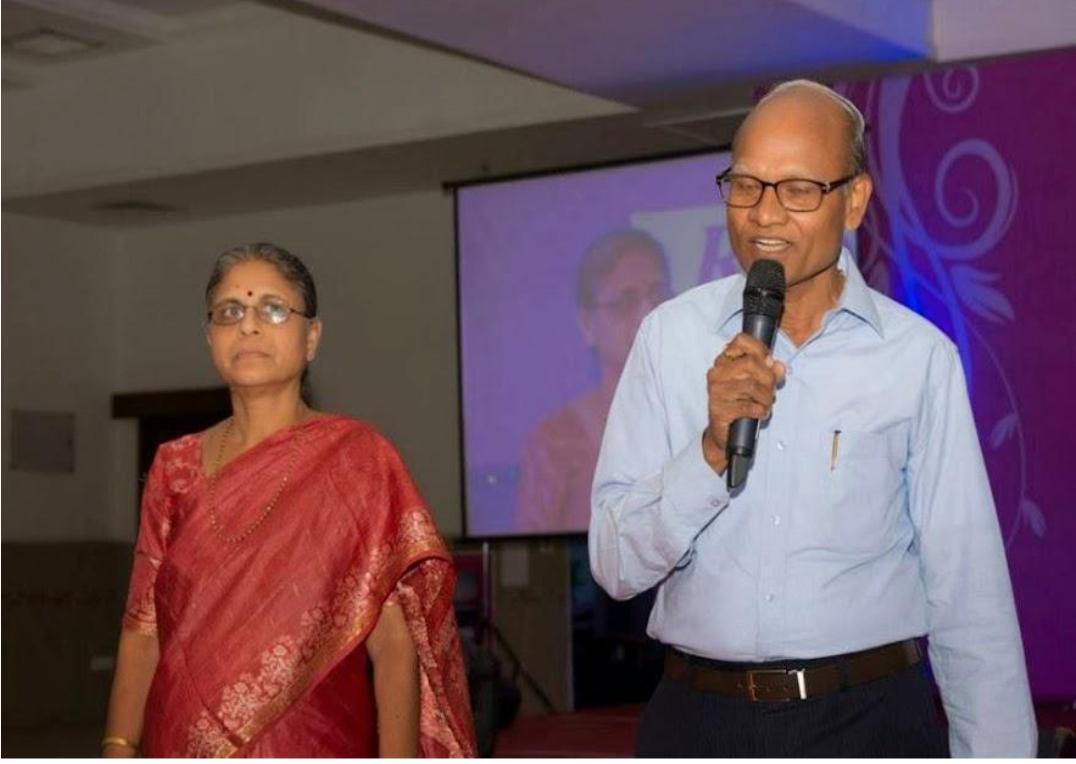
Yogendra Bansod believes that for a doctor, the windows must always stay open. “Humility is important if one has to progress,” he says. “It keeps all the windows open.” It is a philosophy he carried from a Gandhian school in a small village to the head of the busiest medicine department in Central India. His journey was not a climb up a corporate ladder but a slow, deliberate construction—building hospitals where there was only dust, and maintaining integrity where the system offered only shortcuts.
The Ghost of Acharya Bhansali
Bansod’s character was forged in the shadow of a hunger strike. His roots lie in Kanyadhol, a village northwest of Nagpur, but his moral compass was set at the Bhansali Buniyadi Vidya Mandir in Takli. This school was founded by Acharya Prabhudas Jaikrisna Bhansali, a professor of philosophy who had fasted for 63 days during the 1942 Quit India movement to protest British atrocities. By the time Bansod arrived as a student, Bhansali kaka was an old man, a quadriplegic who had to be physically lifted, yet his spirit remained an immovable object.
I was heavily influenced by the thoughts and life of Bhansali kaka. In the evening of his life, he was paralyzed. Yet, his passion for working for the tribal poor children, educating them and advancing their career, would make us teary eyed. He was indeed a hat yogi whose commitment to the ideals he stood for had to be seen to be believed.
This exposure to Gandhian austerity created a central tension in Bansod’s life. He was a man of science entering a profession that was increasingly becoming a business, yet he was haunted by the image of a man who owned nothing and changed everything. He entered GMC Nagpur in 1973, eventually specializing in Medicine. His MD thesis on kidney failure in gastroenteritis was guided by Dr. B.S. Chaubey, a legend in the corridors of Ward 23. Under Chaubey, Bansod learned that a public hospital was a sacred trust, not just a workplace.
The Usanwari Years
In 1991, the state government applied its strategy of Usanwari—the practice of shifting faculty like chess pieces to meet regulatory requirements—and transferred Bansod to Yavatmal. He arrived at Shri Vasantrao Naik Government Medical College to find a Department of Medicine that existed primarily on a letterhead. There were no residents, no infrastructure, and virtually no administrative support. For fourteen years, from 1991 to 2005, Bansod was the department.
This period illustrates the broader historical arc of the GMC 1973 batch: they were the generation tasked with expanding the Nehruvian medical dream into the neglected corners of Maharashtra. While the private sector was beginning to boom in the metros, men like Bansod were in the trenches of the public sector, fighting for oxygen cylinders and floor space.
The task took a heavy toll. In 2004, the “psychosocial stress” of being responsible for everything that might go wrong in a new hospital manifested in his own body. His coronaries clogged. He found himself on the other side of the stethoscope at Lilavati Hospital in Mumbai, undergoing a bypass. “The stress began to overwhelm me,” he recalls. It was the paradox of the healer: he was building a system to save others while the system was breaking him.
The Legacy of Ward 23
Bansod eventually returned to his parent institute, GMC Nagpur, in 2005. He rose to head the Department of Medicine, the very department where he had once been a wide-eyed student. He was well aware of the stalwarts who had preceded him, men whose charisma filled the halls of Ward 23. Bansod was different. He was quiet, humble, and lacked the performative authority of the old-school professors. Yet, he commanded a different kind of respect.
His tenure was defined by an uncompromising honesty. In an era where “synergy” and “leverage” were becoming the buzzwords of private healthcare, Bansod remained a public servant. He understood the generational shift from self-sacrifice to self-advancement and chose to remain on the side of the former. He superannuated in 2019 but did not retire from the craft; he joined NKP Salve Medical College as a professor, continuing to teach that the patient is the ultimate textbook. He finally hung his stetho in August 2025, when he turned 70.
He lives in Nagpur with his wife, Dr. Ranjana, an Associate Professor of Dentistry. Their family is a testament to the medical continuity of the region. Their sons, Abhijit and Prasad, are both in the public system—Abhijit as a psychiatrist in Yavatmal and Prasad as a surgeon in Nagpur. Bansod looks back on his career with the same “open windows” he advocates for his students. He may not have built a corporate empire, but he built the Department of Medicine in Yavatmal, and he kept the integrity of Ward 23 intact. At the end of the day, his “inning” is remembered not for its volume, but for its clarity.
Update: 10 May 2026
Dr. Yogendra Bansod shared this reflection during a telephone conversation.
My roots go back to a quiet village where, as a boy in the eighth standard, I first encountered Acharya Prabhudas Jai Krishna Bhansali. Known to everyone simply as Pitaji, he was a man of iron resolve housed in a frail body. A professor of philosophy, he had once undertaken a 63-day fast to protest British atrocities during the Quit India movement. By the time I knew him, he could barely walk or speak, yet his presence carried extraordinary moral weight.
He was cared for by his foster daughter, Pushpa Ben Desai—a contemporary of Dr. Sushila Nayar—and by Pandharinath Bhau, a stoic figure clad only in a white loincloth, sustained entirely on milk. Around them lingered an atmosphere of austerity, discipline, and quiet devotion.
My school itself was steeped in Gandhian thought. We began and ended each day with prayers; verses from the Upanishads and Vinoba Bhave’s Gitai echoed through its corridors. Those years shaped far more than my education. They immersed me in a way of life.
Even after moving to the GMC hostel, I remained drawn to that world and often visited Pushpa Ben. I still remember the solemnity that descended upon the Ashram when leaders such as Gulzarilal Nanda and Brahmananda Reddy came to meet the ageing Acharya. I was only a medical student, yet I sensed that I was standing close to history.
That era came to an end during my final year of MBBS. Pitaji was admitted to the private ward at GMC Nagpur under the care of Dr. B. S. Chaubey. He was suffering from obstructive uropathy, but true to the convictions that had guided his entire life, he declined modern interventions. He chose to die with the same quiet dignity with which he had lived. After his passing, Takli village witnessed intense debate over whether a man of such spiritual stature should be cremated or buried.
Those early impressions deepened further in 1980 while I was pursuing my MD. One evening, I attended a lecture by Shri Satyanarayan Goenka, founder of Vipassana, at the University Convocation Hall. His words turned my gaze inward. It may have seemed an unusual preoccupation for a man in his mid-twenties, but the seeds had been planted much earlier.
Even before joining GMC, during my days at Ambedkar College, I had watched Bhadant Anand Kausalyayan—the towering scholar of Pali literature—whose serene smile left a lasting impression on me. Years later, I also had the opportunity to see the Dalai Lama in person. Each of these encounters quietly shaped my inner life.
On 31 August 2025, when I finally laid down my stethoscope after retiring as Professor of Medicine from NLP Salwe Medical College, Nagpur, I experienced a profound sense of completion. I felt no urge to enter the corporate medical world or remain occupied merely for the sake of staying busy. Many asked, “How will you pass your time?” But I no longer wished to measure my life through the expectations of others.
Instead, I returned to the source. I enrolled at the Nagpur University campus to study the Tripitaka—the Vinaya Pitaka, Sutta Pitaka, and Abhidhamma Pitaka. Today, immersed in the Buddha’s teachings and the stillness of the ancient path, I seek neither patients nor prestige, but only silence, understanding, and inner peace.