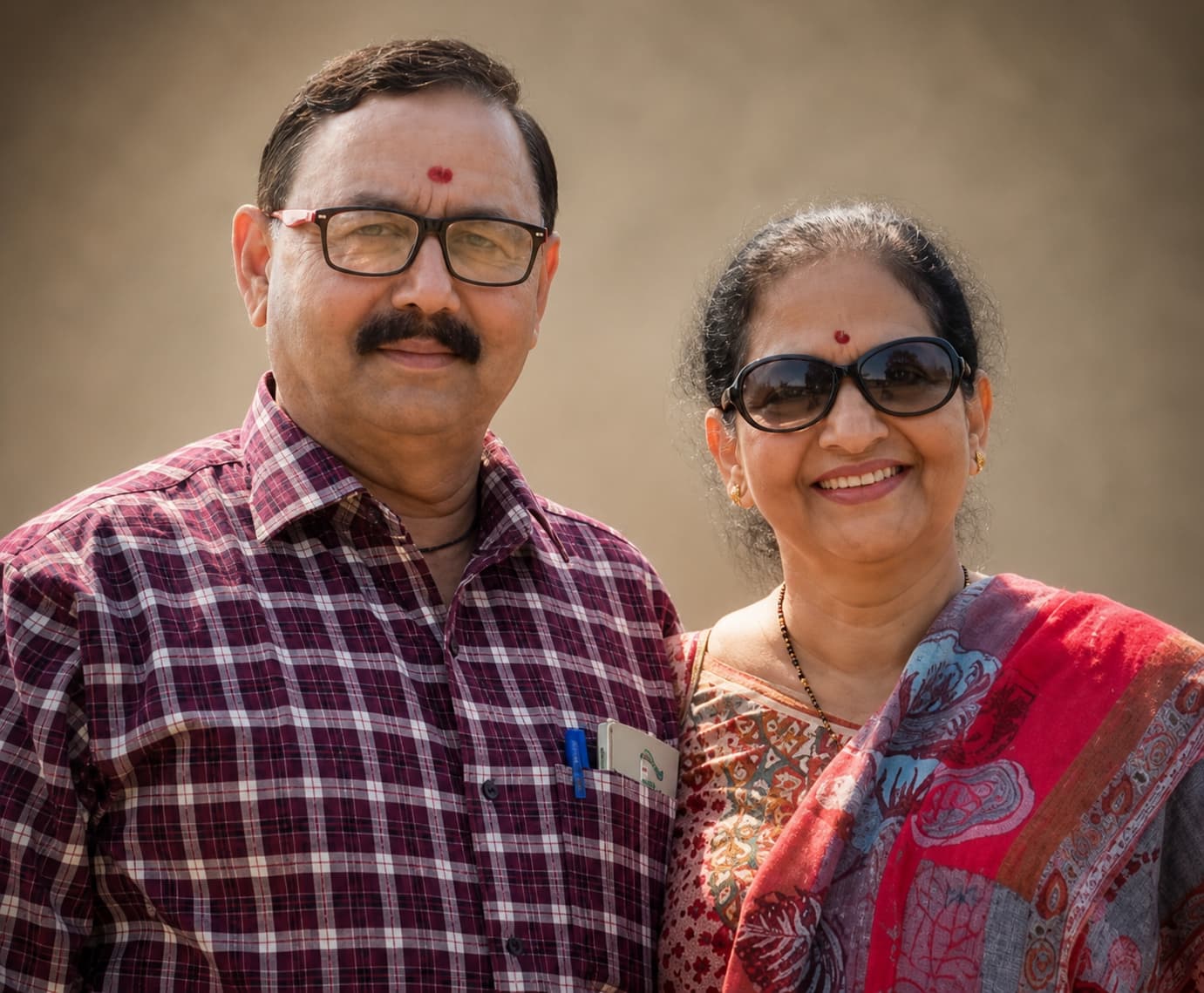
The chocolate was small — a single piece, shared between friends — but in the context of their lives at that moment, it was luxury enough to count as celebration. Madhushree Madhankar and her circle of friends from small Vidarbha towns had arrived at Government Medical College, Nagpur in 1973 speaking more Marathi than English, uncertain of their footing among the convent-educated girls from the city. By the end of first MBBS, the uncertainty had dissolved. The shared chocolate marked the discovery that they were, in every way that mattered, their equals.
The Girl from Akola
Madhushree was born in Akola into a family shaped entirely by education. Her father served as Deputy Education Officer. Her mother retired as Principal of the Government B.Ed. College, Akola. The household was one where learning was not an aspiration but an assumption.
Her schooling moved through several towns — Balwadi and primary school in Buldhana, classes four through seven at Government High School, Katol, her tenth standard at New Era High School, and pre-medical college at Shri Radhakisan Laxminarayan Toshniwal (RLT) College, Akola, in 1970. She was offered a GMC seat in 1972, but was admitted to the 1973 batch because she had not yet reached the minimum age for medical school admission. The year’s wait proved inconsequential — she entered GMC Nagpur with the batch that would become her lifelong cohort.
At GMC, she found her closest companions among women who shared her background: Vijaya Vithalkar, Vijayalaxmi Kane, Anjali Sapkal, Aruna Gattani, and Sandhya Mohgaonkar — girls from small towns, Marathi medium, navigating the same adjustment. “We were girls from small towns, could hardly speak English, and found it difficult to adjust to the convent-educated, English-speaking, elite students from our batch,” she recalled in a telephone conversation decades later. “But after the first MBBS, we found that we were at par with the more privileged girls from our class and acquired self-confidence. And a small shared chocolate was the ultimate symbol of luxurious celebration during our graduation days.”
Paediatrics in Bilaspur
After graduation, Madhushree completed her internship at the Rural Health and Training Centre, Saoner, and at District Hospital, Akola. She then enrolled for the Diploma in Child Health (DCH) at Jawaharlal Nehru Medical College, Raipur, and in 1982 set up her private practice as a Consultant Paediatrician at Deshpande Hospital, Bilaspur — the hospital she has run alongside her husband, Dr. Madan Deshpande, a consultant ophthalmologist, for more than four decades.
The generation of doctors who built careers in Chhattisgarh’s smaller cities — before the state was carved out of Madhya Pradesh in 2000, before corporate hospital chains arrived, before AIIMS Raipur changed the referral landscape — built those careers on continuity and trust. In a city like Bilaspur, a paediatrician of four decades standing is not merely a clinician. She is an institution. Madhushree became that institution.
She served as President of the Indian Academy of Paediatrics, Chhattisgarh branch. In 2005, she received the Academic Excellence Gold Medal from the Chhattisgarh IAP. In June 2006, she ranked first in the FCGP examination conducted by the Indian Medical Association College of General Practitioners and received its Gold Medal. She serves as advanced counsellor, national faculty, and Master Trainer in Chhattisgarh — the accumulated authority of someone who has not only practised a specialty for four decades but taught it to others.
The Teen Clinic
Adolescent paediatrics became her particular focus. Madhushree runs a dedicated teen clinic at Deshpande Hospital — one of the few such specialist services in the region — and has organised workshops and conferences on teenage health, development, and related issues over many years. It is unglamorous, necessary work: the space between childhood and adulthood is where the problems that will define a person’s health often take root, and most healthcare systems address it inadequately. Madhushree chose to address it directly.
Away from the clinic, she reads and listens to music — hobbies cultivated, she says, over five decades, which places their origin somewhere in the GMC years, in a room in Nagpur where a shared piece of chocolate was sufficient occasion for joy.
Her son Mohit — BE and PGDM, now working in Dallas — stood first in his MS in Information Systems at the University of Washington in 2017. Her daughter Manjul, an interior designer, works in California. Both carry the stamp of parents who built their lives in a Chhattisgarh city, far from the metropolitan centres, and made that choice produce something worth inheriting.
The girl who arrived at GMC Nagpur uncertain of her English has spent forty years teaching other people’s children how to stay well, how to grow up, and — in the teen clinic — how to navigate the passage between the two.