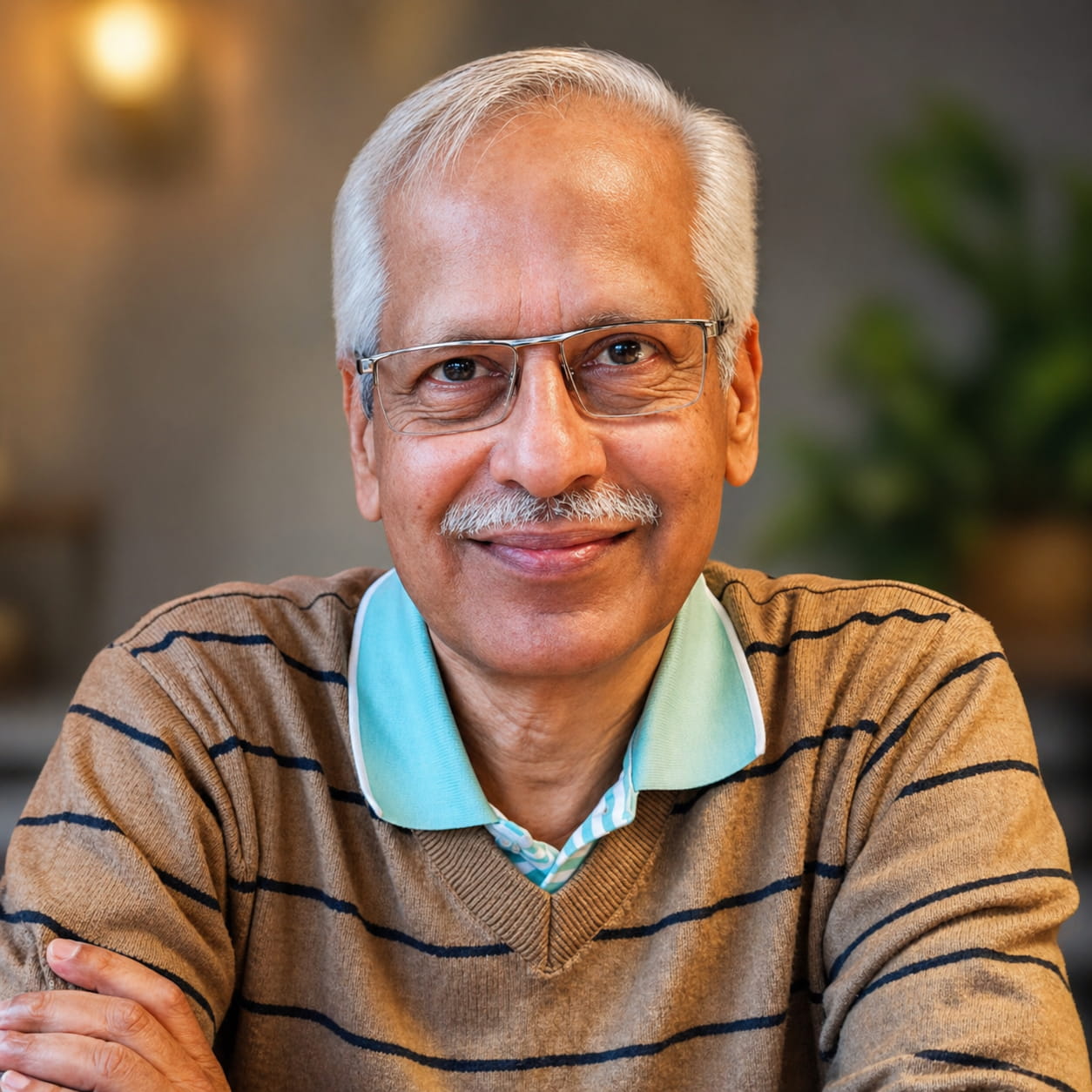
In early May 1982, Wardha lay still under summer heat. A young physician sat in a house in Jajoo Wadi, suspended between two possible lives. One was already arranged: a clinic his father had built near Indira Market, steady, predictable, financially sound. The other was a conversation from the previous evening — brief, almost casual — in which Dr. Ulhas Jajoo had asked whether he might consider joining Mahatma Gandhi Institute of Medical Sciences (MGIMS) at Sevagram.
The salary on offer was Rs 650 a month. He said yes.
It did not feel, at the time, like a decisive moment. Only later, when forty years had accumulated behind it, would it become clear that something irreversible had shifted in that house on that afternoon.
A Name That Stayed Short
He was born Shriprakash Kalantri on 15 August 1957 in Wardha, the youngest of six children in a Marwadi family with no doctors in its past. His father worked in cotton factories managed by the Bajaj group. His mother had studied only to the fourth grade. Somewhere between school and college, his name shortened — to friends, family, students, and patients, he became SP. The abbreviation stayed, gradually ceasing to feel like one.
His schooling moved through Hindi, Marathi, and English in succession. Mathematics did not hold him. When the time came to choose, he dropped it without regret, a decision that quietly ruled out engineering and left medicine as the most coherent path forward. There was no calling, no early conviction. He arrived at medicine because other doors had closed.
At Jankidevi Bajaj Science College, Wardha, he scored 73 percent — enough, narrowly, to gain admission to GMC Nagpur in 1973. He moved on.
Room No. 99
His first year in Nagpur was spent in a room in a cotton factory at Ganesh Peth. In the second year, he shared a flat at 484 Hanumannagar with Suhas Jajoo; meals came from Parasnath Chaturvedi, who cooked simple vegetarian food for a small group that included Ulhas Jajoo, Suresh Chhajed, and Prakash Gupta.
After the first MBBS, his life at GMC settled into Room No. 99 — the room number followed him across Hostels 2, 3, 4, and 5, and eventually into the postgraduate hostel. Friendships formed there: Archana Srivastava, Anjali Sapkal, Ramesh Mundle, Nandkishor Chandak, Harish Baheti.
He was not inclined toward display. He watched how his teachers approached uncertainty — not their confidence but their method. The way they examined a patient, questioned their own assumptions, revised their thinking when evidence required it. During his internship at Bhadrawati, these observations acquired weight. Resources were limited, decisions could not be deferred. Medicine, stripped of its support systems, showed its essential demands.
By the time he began his MD in Medicine in 1980 under Dr. BS Chaubey, his direction had steadied. Internal medicine held his attention without effort. Dr. Chaubey’s decision to include him in his own unit, unusual for the time, drew brief comment within the college and then the routine of work resumed.
Entering Sevagram
On 4 May 1982, he rode a Bajaj Priya scooter through the gates of Sevagram. The transition from Nagpur was immediate. The hospital functioned within modest infrastructure — older buildings, visible wear, no machines to compensate for uncertainty. What existed instead was a direct reliance on clinical judgement.
He joined the Medicine unit under Dr. AP Jain. Mornings began with ECG sessions led by Dr. OP Gupta, Dr. Jain, and Dr. Ulhas Jajoo. Residents presented tracings that were examined line by line, each omission noted, each assumption questioned. The atmosphere was demanding without being theatrical.
He found a rhythm there that suited him.
The alternative — the clinic in Wardha — remained within reach. Choosing Sevagram meant accepting uncertainty, modest pay, and a workload that did not recede. But the choice, once made, did not require repeated justification. Patients returned, students progressed, and the setting rewarded the kind of sustained attention he was, by inclination, prepared to give.
He moved through the academic ranks in the ordinary way: Lecturer in 1983, Reader in 1987, Professor in 1997, Director Professor thereafter. The designations marked time without altering the structure of his days, which remained anchored in wards, classrooms, and the bedside.
Teaching as a Way of Thinking
His approach to teaching developed without declaration. At the bedside, he slowed decisions rather than hastened them. He asked why a diagnosis had been reached, what a test would change, whether doing less might be the more appropriate course. These were not rhetorical questions. They were invitations to think.
Over time, his students absorbed the method. He guided around thirty MD students, regularly placing their names first on publications — a small, deliberate gesture that shifted credit toward those still learning.
In 2001, at a workshop on evidence-based medicine in Toronto, he encountered formal language for ideas he had approached intuitively. Bias, overdiagnosis, unnecessary intervention: concepts he had been acting on acquired structure. When he returned to Sevagram, the influence of pharmaceutical sponsorship in academic events was gradually reduced and then stopped altogether. Medical representatives, once a routine presence, were shown the door. A system of low-cost generic drugs was introduced, changing the economics of treatment in ways patients felt directly.
In 2004, a Fogarty scholarship took him to the University of California, Berkeley, where he completed a Master of Public Health. The experience refined an orientation toward evidence that would continue to shape both teaching and practice.
Building Systems
For many years, hospital records at Sevagram existed as paper — registers, files, handwritten notes that moved slowly and were difficult to retrieve. In 2004, work began on a Hospital Information System. The process was not quick. There were technical setbacks, repeated delays, and the quiet resistance that accompanies any attempt to change established routines. Early mornings were spent travelling to Nagpur to troubleshoot. Systems that seemed stable would fail without warning.
Through these years, Bhavana Kalantri managed the database — ensuring continuity where uncertainty might otherwise have halted progress. The system gradually stabilised. Records became accessible. Information began to move with reliability.
When the COVID-19 pandemic reached Sevagram in March 2020, the nature of his work changed abruptly. As Medical Superintendent, he managed oxygen supplies, bed allocation, and protocols that required constant revision. The hospital admitted close to 6,000 patients across the pandemic. Decisions were made under pressure, often with incomplete information. The underlying approach remained steady: to rely on evidence where it existed and to resist interventions without support.
On 15 February 2023, he stepped down as Medical Superintendent. He returned, fully, to teaching.
The Shape of What Remains
Outside the hospital, his interests moved without display. Reading had been a constant since childhood; writing followed naturally — articles, blogs, and longer reflections in Hindi, Marathi, and English. He documented the lives of his 1973 batchmates, wrote the history of MGIMS, and recorded the contributions of those who shaped the institution. Cycling entered later — long-distance rides through villages around Sevagram, physical and repetitive and quietly demanding.
Across four decades, the outline of his work becomes visible only at distance. He stayed in one place. He chose teaching over private practice. He questioned procedures that did not seem necessary. He helped build systems that continued beyond any individual role.
No single moment defines it. Instead, there is a series of decisions — each modest on its own — that accumulated into a pattern steady and difficult to reduce to a single description.
“Sevagram had its own plans,” he once wrote of the afternoon in Jajoo Wadi. He was right. And it turned out, so did he.