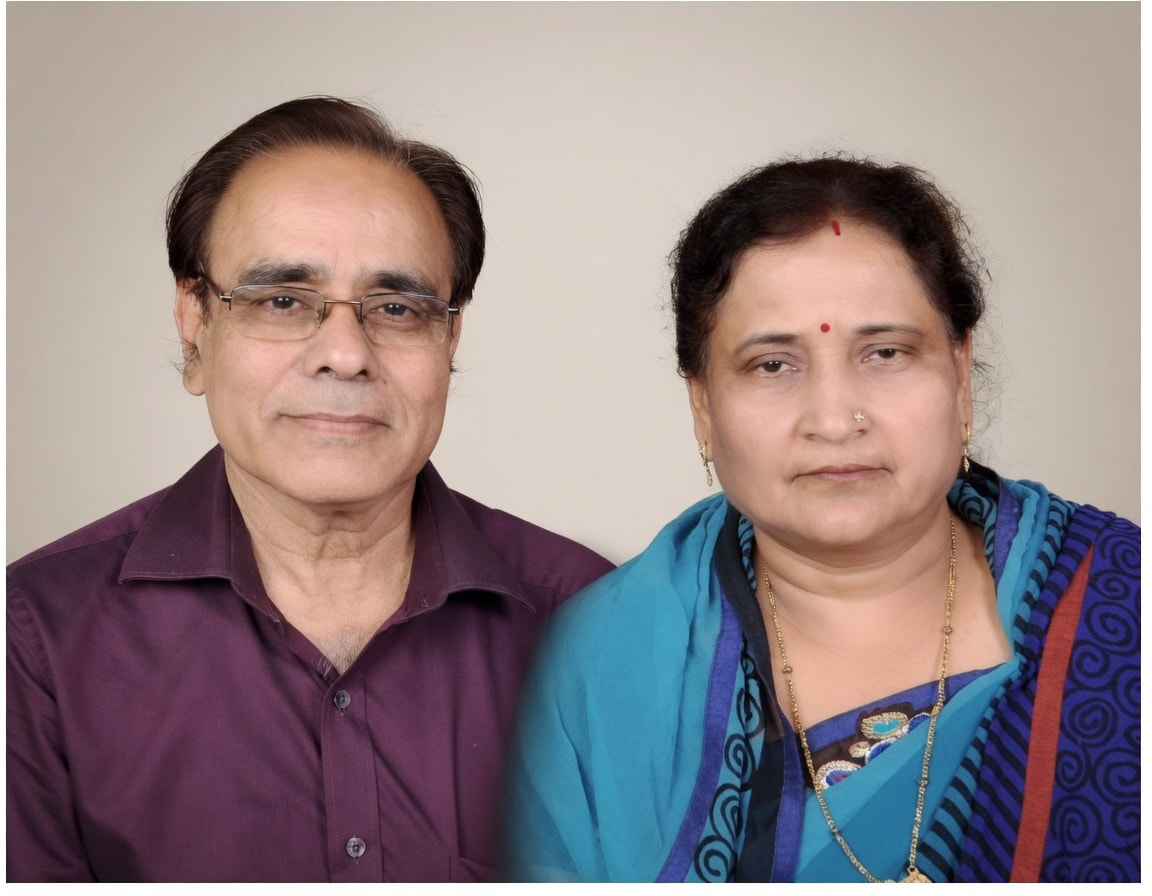
He was among the youngest in his batch to marry. He and Usha began their life together on 4 July 1979, while many of his classmates were still preparing for postgraduate entrance examinations. That same year, at the age of twenty-five, he returned to the small town that had shaped him and opened a laboratory. He named it Adarsh—the ideal. It was less a label than a quiet pledge.
Four decades later, the laboratory is still there. So is the intent.
The Boy from Paratwada
Omprakash Bohra was born in Paratwada, a modest town in the foothills of the Satpura range, about thirty kilometres from Amravati. His father earned a small salary; the family lived close to the edge of uncertainty. Poverty was not an idea—it shaped daily life, narrowed choices, and demanded resilience early. His own account of those years — texted to Dr. Kalantri on 11 February 2021 in a single sitting — reads, he said, almost like a Bollywood script. The poverty was not metaphorical.
When the time for college arrived, circumstance opened a narrow door. Jagdamba College of Science had just begun its first batch in Paratwada. He enrolled, completed his Pre-University and BSc Part I there, and in 1973 entered Government Medical College, Nagpur—the first doctor his family would produce.
At GMC, friendships took root—quiet, dependable, enduring. His internship at Kondhali Primary Health Centre, 30 km west of Nagpur, with its limited resources and constant demands, stripped medicine down to its essentials. There was little room for hesitation. You learned quickly, because someone was always waiting. Nandkishor Chandak, Nandkishor Taori, and Laxmikant Rathi worked alongside him.
A Lecturer Before the Degree
Please make it less flowery and a bit simple
In the late 1970s, the medical landscape in India shifted. The Union Health Minister, Raj Narayan, decided to increase medical school seats across the country. At Government Medical College (GMC) Nagpur, the 1977 batch swelled to 275 students. The college was suddenly short-staffed and had to hire lecturers quickly, even recruiting young graduates who hadn’t finished their postgraduate degrees yet.
Among these new recruits were Omprakash Bohra and Vinayak Sabnis. It was a unique, practical era of medical training where the line between student and teacher blurred.
The Lecturer-Student Life
Omprakash joined the Pathology department in July 1979 and was officially appointed as a lecturer by November. At the same time, he enrolled for his MD under Dr. Kher, focusing his research on salivary gland tumors.
This created a demanding daily routine:
- The Dual Role: He was a staff member on paper but a student in practice. He had to grade the work of juniors while preparing for his own exams.
- Discipline of Mind: Teaching forced a deep level of preparation. To explain complex pathology to a classroom, Omprakash had to master the subject far more thoroughly than if he were just studying for himself.
- Lack of Shortcuts: In 1970s Nagpur, there were no digital aids. Learning meant hours spent with heavy glass slides, microscope mirrors, and the constant scent of formalin in the labs.
Building a Foundation
By the time Omprakash completed his MD in 1983, he had gained a rare kind of experience. Most doctors only begin teaching after they are fully certified; he had already spent four years at the front of the classroom.
When he left GMC that winter, he didn’t just leave with a degree. He left with a rigorous foundation in Pathology built from “learning and teaching in the same breath.” This unusual start—born out of a sudden policy change—shaped the rest of his professional life, giving him a practical edge that defined his career.
Adarsh, and What It Meant
In the winter of 1983, Omprakash returned to his roots in Paratwada to open Adarsh Pathology Laboratory. He was not merely coming home; he was bringing something the town had never seen before: a formally trained, credentialed pathologist running a dedicated diagnostic facility. The name “Adarsh”—meaning “ideal”—was a deliberate choice. It reflected his firm belief that medical standards in a small town should be no different from those in a bustling city. While the practicalities of running such a lab in a district town were demanding, his commitment to that idealism remained steady.
In the home that Omprakash and Usha built, a medical legacy took root quietly and without fanfare. All three of their children chose the path of medicine, a rare distinction shared with only two other members of his 1973 GMC batch. His eldest daughter, Vijaya, specialized in pediatrics and now serves as a neonatologist at the District Hospital in Amravati, married to cardiologist Dr. Shailesh Jayde. The younger daughter, Archana, became an anesthesiologist practicing in Aurangabad and is married to orthopedic surgeon Dr. Mangesh Rajput.
Finally, his son Ashish followed exactly in his father’s footsteps. He trained in pathology and pursued further fellowships in hemato-oncology and onco-pathology, eventually taking up a post at the National Cancer Institute in Nagpur. With three children, three specialties, and a house full of physicians, the foundation Omprakash laid in that first small-town laboratory grew into a significant family contribution to the field of medicine.
What the Laboratory Became
The Adarsh Pathology Laboratory has been running for more than four decades. In those years, Omprakash has watched his discipline transform, seeing the shift from manual counts and hand-stained slides to automated analyzers, digital imaging, and molecular diagnostics. He adapted to each transition, updating his equipment and methods as the science moved forward.
Today, the laboratory offers diagnostics in biochemistry, histopathology, cytology, haematology, and immunology. In a town of Paratwada’s scale, it has served as the primary diagnostic resource for the surrounding region—the place where referring physicians send their difficult cases and where ambiguous results get a second look from someone who has spent decades studying tissue and blood.
The name Omprakash chose in 1983—”Ideal”—is a demanding one. It is much easier to name something ideal than to keep it so. That he has maintained the laboratory for forty years in a small Vidarbha town, without the infrastructure of a city hospital, speaks to a conviction more stubborn than simple ambition. It reflects his original belief that patients in a rural district deserve the same standard of care as patients anywhere else.
His batchmates from the 1973 GMC class still remember him with affection as “the youngest boy in the class to marry.” He was also among the first to return to his roots. Paratwada had sent him to Nagpur, and Nagpur sent him back with a degree and a purpose. The laboratory he named Adarsh, opened when his idealism was at its freshest, remains open today. The ideal, it seems, held.
In His Own Words
मैं आज जीवन के उन प्रसंगों को साझा करना चाहता हूँ, जिन पर कभी खुलकर बात नहीं हुई। 1973 में जब मैंने बी.एससी. पार्ट 1 में 79 प्रतिशत अंक प्राप्त किए, तो घर में खुशी नहीं, बल्कि चिंता छा गई। माँ रो पड़ीं—“बाहर जाकर पढ़ाई कैसे करेगा? घर तो अभी तुम ही संभाल रहे हो।” सच भी यही था। मैं 12 वर्ष की उम्र से काम कर रहा था। पिताजी की मामूली नौकरी बीमारी के कारण छूट चुकी थी और घर में रोज़ी-रोटी का संकट था।
स्कूल के सामने बैठकर चने बेचना, छुट्टी के दस मिनट में साइकिल से कई स्कूलों के बाहर जाना—दिन के तीन रुपये भी तब बड़ी राहत थे। साथ ही, सहपाठियों को ट्यूशन पढ़ाता और रात में सिनेमा के बाहर छोटे-मोटे काम करता। इसी बीच एक शिक्षक ने दया कर मुझे भूविकास बैंक में छोटी-सी नौकरी दिला दी। समय की कमी के कारण पढ़ाई और काम के बीच संतुलन कठिन था, पर माँ हमेशा कहतीं—“मेहनत में कभी शर्म नहीं होती।”
इसी संघर्ष के बीच मैंने अच्छे अंकों से परीक्षा उत्तीर्ण की, पर कमाने की ज़रूरत बनी रही। तभी मित्र सतीश नंदावशी ने मुझे लोन स्कॉलरशिप के लिए प्रेरित किया। आगे की पढ़ाई के लिए यह निर्णय निर्णायक साबित हुआ। नागपुर में मेडिकल प्रवेश मेरे जीवन का अविस्मरणीय क्षण था। ऐसा लगा जैसे किसी नए संसार में कदम रख रहा हूँ। माँ की चिंता स्वाभाविक थी—पढ़ाई का खर्च और घर का गुज़ारा, दोनों अनिश्चित थे—लेकिन सतीश भैया ने मुझे सहारा दिया और सही राह दिखाई।
स्कॉलरशिप मिलने से पढ़ाई का रास्ता खुला, भले ही साधन सीमित थे। इस यात्रा में मित्रों का साथ अमूल्य रहा—सतीश, पूरण, कन्हैया, प्रकाश और राम अग्रवाल। शुरुआती दिनों में मैं हॉस्टल में सहारे से रहा, फिर एक छोटे से कमरे में शरण मिली। रोज़ साइकिल से कॉलेज जाना, शाम को लौटकर दोस्त का इंतज़ार करना, और आधा कप चाय साझा करना—यही दिनचर्या थी। 1974 की बाढ़ में कमरे में भरता पानी और एक ऊँची मेज़ पर बैठकर बिताए वे क्षण आज भी याद हैं।
धीरे-धीरे समय बीतता गया। अनेक कठिनाइयाँ आईं, पर हर मोड़ पर किसी न किसी का हाथ थामे आगे बढ़ता रहा। आज पीछे मुड़कर देखता हूँ तो लगता है—समय सबसे बड़ा शिक्षक है, और मित्र सबसे बड़ी पूँजी।
— डॉ. ओमप्रकाश बोहरा