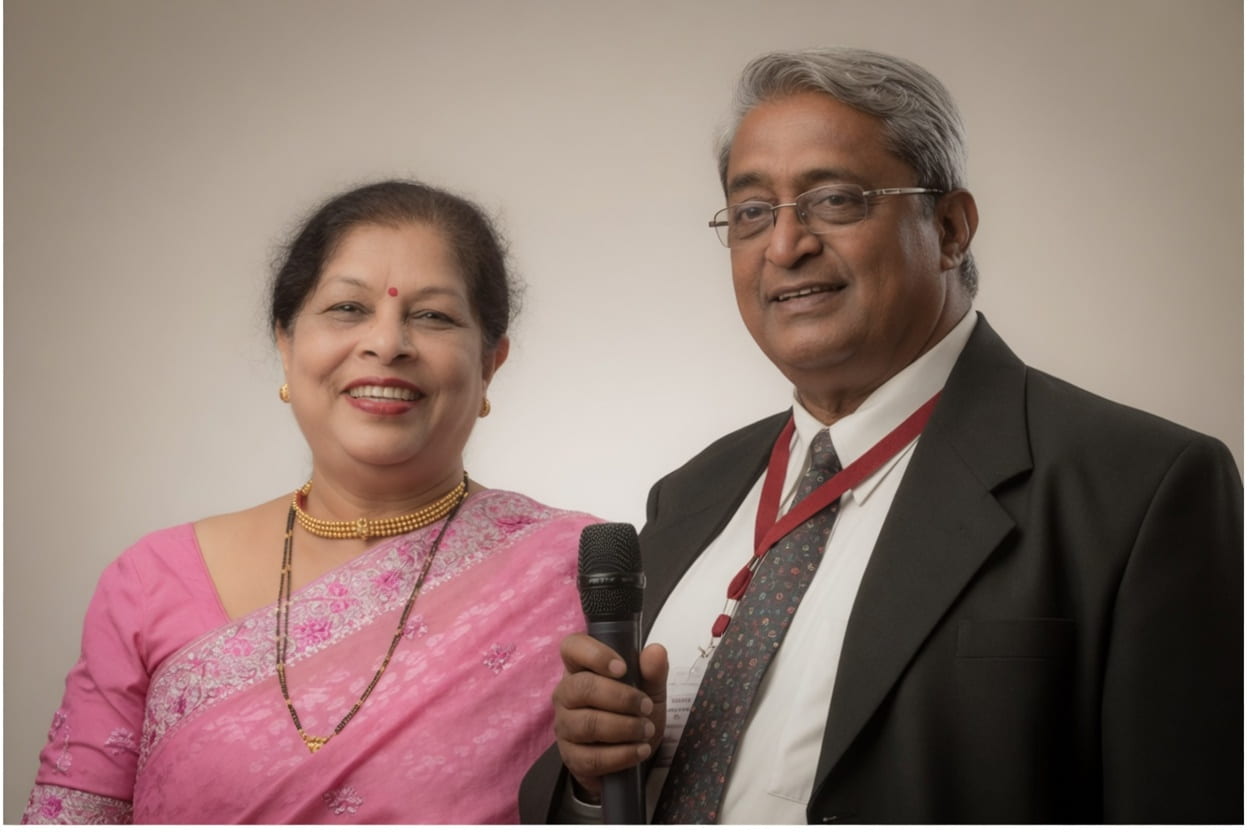
At a clinic in Sadar, Nagpur, patients arrive who were first seen by Ajit Pradhan’s grandfather. Then by his father. Now by Ajit himself. Three generations of the same family at the same address, in the same discipline, for the same neighbourhood. It is a continuity that few practices in India can claim, and Ajit does not claim it loudly. He mentions it the way one mentions a fact of geography — here is where we are, this is how it has always been.
His grandfather graduated from GS Medical College, Mumbai in 1934. His father graduated from the same college. Ajit came to Government Medical College, Nagpur in 1973 and returned to the clinic in Sadar in 1982. The address has not changed.
A Lineage of Practitioners
Ajit was born in Murtijapur, at his grandfather’s home — a detail that places him, even at birth, inside a family shaped by medicine and movement. He grew up in Nagpur, attended Mount Carmel School and then New English High School, Congress Nagar, and completed his education at Hislop College, Nagpur, where Alka Parekh was a classmate. He entered GMC Nagpur in 1973.
He was an active sportsman at GMC, representing the college in Badminton and Swimming. After graduation, he interned in Kuhi — 40 kilometres southeast of Nagpur — with Mohan Gupte, Pradip Sambarey, and Dilip Magarkar. Then Mumbai: house jobs in Infectious Diseases and Medicine at MGM Hospital and Kasturba Hospital, Arthur Road. He returned to Nagpur in 1982 and stepped into the clinic his father had run for decades.
He also opened a second consultation room at Panchpaoli.
Forty-Three Years in Sadar
Ajit does not use the word practice the way doctors who have built hospitals or run departments use it. His practice is something quieter: a clinic, a consultation table, a stethoscope, and four decades of accumulated knowledge about the families of Sadar. He sees patients whose grandparents his grandfather treated. He knows their histories without opening a file.
“I have thoroughly enjoyed my years in practice,” he said. “I’ve been serving patients and families who were once cared for by my grandfather and father, along with their relatives, friends, and acquaintances, who come from various places.”
His approach is traditional in the best sense of that word: deep familiarity with the patient, a close doctor–patient relationship as integral to treatment rather than incidental to it, and a confidence in clinical skills that does not depend on technology. He has operated without the instruments and investigations that a hospital environment provides. He has made diagnoses from the consultation table that machines might not have caught faster.
There is nothing to prove in this. The clinic in Sadar has been proving it, quietly, since 1934.
His wife Seema manages the hospital. Their daughter Anuprita, a dentist, practices in Toronto with her husband, Dr. Mehta. Their son Omkar — an engineer and MBA — works with the Broadcast Audience Research Council in Mumbai. Neither chose medicine. That, too, is a kind of continuity: knowing that the family name in medicine will rest, for the first time in three generations, on a single pair of hands.