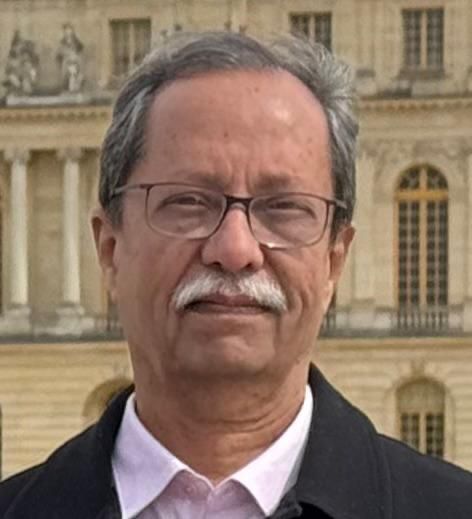
When Harsha Sheorey’s scooter met a truck during the final MBBS examinations in the late 1970s and he spent six months convalescing — depressed, his study momentum gone — it was not a teacher who showed up at his door. It was a classmate. Ramesh Mundle, in the thick of his own internship, made regular visits to Harsha’s house, sat with him, and taught him. When the results came, Harsha passed. Decades later, he still says he owes Ramesh the most.
The story is small. It is also, as those who know Ramesh well will confirm, entirely typical.
The Schoolmaster’s Son
Born in Amravati to Mandakini and Prabhakar, Ramesh was destined for the classroom. As the son of a headmaster who led Lal Bahadur High School in Bhandara, he represents the third generation of educators in his family. With such a deep pedagogical lineage, the art of teaching was woven into his DNA long before he ever stood in front of a class.
His schooling moved through Buldhana and Amravati, and he went to Vidarbha Mahavidyalaya for his premedical year before entering Government Medical College, Nagpur in 1973. The batch of 1973 was a particular gathering — students from small towns and villages across Vidarbha, many of them the first doctors their families had produced. Ramesh was among them, unremarkable in arrival, steady in everything that followed.
His rural internship took him to PHC Mohadi in Bhandara district, 80 km northeast of Nagpur, alongside Rajeev Laul, Jayant Pande, Maitreyan Vasudevan, and Vikas Chitnavis. The urban internship was at GMC Nagpur. Then came the MD.
His thesis examined vasodilator therapy — oral prazosin — in congestive heart failure, supervised by Dr. HC Atal. He earned his MD (Medicine) in 1981, a year before many of his peers had established their private practices. He was not in a hurry. He would not be rushed.
The Long Commitment to One Place
After MD, Ramesh stayed at GMC Nagpur — first as senior resident in the Medicine ICU, then as lecturer from 1983 to 1989. A move to Dr. Vaishampayan Memorial Government Medical College, Solapur followed, as associate professor, and then in 1992 he joined NKP Salve Institute of Medical Sciences and Research, Nagpur. By 1999 he was a professor of Medicine there. He has not left.
This is not inertia. It is a deliberate preference for depth over breadth, for knowing a place and a student body over the accumulation of prestigious postings. In the era of superspecialisation — when general physicians found themselves marginalised by cardiologists, nephrologists, and gastroenterologists with their subspecialty thrones — Ramesh remained an internist. Patients who had been through the specialist circuit and returned, unsatisfied, found in him the physician who sat with complexity rather than routing it to a colleague.
At his clinic in Niti Gaurav Complex, Ramdaspeth, Nagpur — where he has consulted since 2001 — the queue is not short. It has not been short for a very long time.
Davidsons and Harrison at the Bedside
What his students remember most is not his knowledge, though that is formidable. They remember the questions. At the bedside, Ramesh slows decisions. He asks why a diagnosis was reached, what a test will change, whether the clinical finding was actually examined or merely assumed. The questions are not theatre. They are the method.
His engagement with textbooks — Davidson’s, Harrison’s — is the engagement of someone who reads for pleasure and argument, not examination. He comes to the ward having already thought about the case overnight. His prescriptions, written in an exquisite cursive with ink-filled pens, are themselves curiosities — colleagues have been known to remark on the calligraphy before reading the drug.
Shuchita, and the Lancet
In 1986, Ramesh married Shuchita, a GMC Nagpur alumna from the 1980 batch who chose the demanding world of Obstetrics and Gynaecology. Shuchita did not merely practice her craft; she built a formidable academic legacy, navigating the corridors of GMC Nagpur and Ambajogai before rising to lead the department at AIIMS Nagpur.
The household at 108, Samaj Bhushan Society, Wardha Road, was was less a residence and more a shared workshop of the mind. In 2017, Shuchita published a trial in The Lancet; two years later, she published another. In the world of research, these are not mere credits—they are rare achievements that change how medicine is practiced. In those years, the house was alive with the energy of two equal minds. Medicine was their common language, spoken and debated with a shared, quiet intensity.
The family legacy of service and learning has since moved into new territories, as the next generation charts its own course. Their elder son, Aditya, is a data scientist based in Austin, Texas; in 2023, he married Jaime Wilkins, a filmmaker and graduate student in the social sciences. Their younger son, Abhiram, chose to build upon the family’s scientific tradition through the rigors of medicine. His journey began at the Indira Gandhi Government Medical College in Nagpur (2011–15), followed by a residency in General Surgery at NKPSIMS & Lata Mangeshkar Hospital (2017–20). He recently achieved the pinnacle of his surgical training at the same institution, earning his M.Ch. in Plastic and Reconstructive Surgery.
The story came full circle when Abhiram married Shivani Deshmukh, daughter of Dr. Avinash Deshmukh. For the GMC 1973 community, this was more than a wedding—it was a symbolic strengthening of the “Maitry” bond. Following the union of the Wagh and Gohokar families, this became the second cross-generational alliance within the batch, transforming a fifty-year friendship into a shared family legacy. In this union, the ties formed in the wards and classrooms of the 1970s found a new way to endure.
The Physician-Teacher
In November 2023, Ramesh and his colleagues organised MAPCON in Nagpur — a three-day internal medicine conference that drew nearly 1,200 delegates and was, by general agreement, a success. He served as chairman of the Vidarbha Association of Physicians of India in 2011, and chairman of the Academy of Medical Sciences in 2007. These administrative roles sit alongside the clinical and the pedagogic without displacing either.
The Clinical Intuition of Ramesh Mundle
Ramesh Mundle belongs to a vanishing tribe of physicians—men trained in an era before the cold glow of a screen stood between the doctor and the sufferer. In the cavernous wards of GMC Nagpur—wards 23, 25, and 13—Ramesh’s education was forged not in the lab, but at the bedside. To watch him work was to witness a dialogue with the body: the attentive silence while listening for the faint whistle of a murmur or the dry crackle of a lung; the deliberate, rhythmic palpation of a liver; the gentle stroke of a sole to test a plantar reflex. Even before he had crossed the threshold of twenty-five, while still navigating his own residency, he had become the batch’s unofficial tutor. His classmates, among them Harsha Shorey and Vilas Tambe, remember a young man who stripped medicine of its jargon. He did not merely teach facts; he taught a way of thinking—how to organize a chaotic set of symptoms into a clean line of differential diagnoses, and how to read the jagged ink of an ECG as if it were a clear sentence in a book.
This impulse to teach remained the bedrock of his career, from the corridors of Solapur to NKP Salve in Nagpur. Ramesh lacks the thunderous persona of his own mentor, the legendary Dr. B.S. Chaubey, but he possesses a quieter, perhaps more profound, strength. In a poignant reversal of roles during the evening of Dr. Chaubey’s life, Ramesh became the caretaker of the man who had once been his towering superior. He treated a mellowed, aging Chaubey not as a clinical case, but as a sacred trust. Throughout those final hospital days, Ramesh was there—tapping pleural effusions with a steady hand, ensuring comfort, and providing a bridge of dignity between a great teacher’s life and his end. It was a masterclass in the “art of letting go,” delivered by a student who never stopped honoring his roots.
Today, Ramesh remains the ultimate point of reference for a vast, sprawling network of relatives, acquaintances, and even the distant drivers of friends. In an age of flamboyant medical consumerism, he is a study in restraint. His silhouette is as lean and sharp today as it was fifty years ago, as if he has refused to let time add any unnecessary weight to his frame. His mind, however, is a vast and meticulously indexed archive. He is the batch’s historian, holding the names, dates, and episodes of 1973 in a grip that never falters. He does not seek the limelight; he makes his pen and his prescriptions do the talking. When a worried message arrives on WhatsApp with a blurry scan attached, Ramesh responds with a soft, gentle clarity that immediately settles the recipient’s pulse. He is the most trusted of anchors—a man who heals not with noise, but with presence.
He once said of the profession: “Medicine, for me, has always been a calling as well as a privilege.” And elsewhere: “A good physician treats the disease; the great physician treats the patient who has the disease.” These are not aphorisms collected from motivational calendars; they are the distillation of a career lived strictly by them.
A headmaster’s son, Ramesh remains a teacher. Though retired from NKPSIMS, he returned at the management’s request to teach medicine—a call he could not refuse.
While the world has shifted, his methods remain unyielding. The students have changed; they no longer flock to clinical demonstrations. The slow, deliberate art of bedside medicine—patient observation, nuanced history, and tactile diagnosis—holds little allure for a generation gripped by the compulsion to crack the NEET. The clinic has been eclipsed by the entrance exam.
Yet, Ramesh is undeterred. He makes his twice a week pilgrimage to NKP Salve, content to instruct the few who still value the old ways. He then drives to his own clinic, satisfied. The crowds have thinned, but his commitment has not moved an inch.