Dhulip Singh Tajne entered the world with a bit of local history behind him. Born on 12 May 1955 in Nimboli, Dhamangaon, he is the scion of a family that carried considerable weight in Amravati. His father, Advocate P.P. Tajne, was a criminal lawyer of some renown—a man whose life was spent navigating the high dramas of the courtroom.
Growing up in Kishore Nagar among three brothers and four sisters, Dhulip’s early landscape was one of sprawling family ties and the disciplined atmosphere of Holy Cross Convent and Dnyanmata High School. By the time he reached Vidarbha Mahavidyalaya for his pre-med, the path was clear. The son of the lawyer would not be arguing briefs; he would be writing prescriptions.
The Wardha-Nagpur Circuit
In 1973, Dhulip joined Government Medical College, Nagpur. It was a time of transformation, moving from the protected cocoon of Amravati to the bustling wards of GMC. He navigated the MBBS curriculum with the steady, quiet competence that would become his trademark, graduating in 1979.
The internship phase offered a final taste of the Vidarbha heartland. He teamed up with Waqar Mohiuddin Taji and Shailendra Kale—a trio of young doctors—to tackle the rural internship at Karanja Ghadge in Wardha district. It was the quintessential rural experience: thirty kilometres west of Nagpur, where the medicine was raw and the resources were thin. He balanced this with an urban internship at Irwin Hospital back in his home turf of Amravati, perhaps a final goodbye to the district before the magnetic pull of the capital took hold.
The Mumbai Migration
In 1980, Dhulip made the move that defines so many Indian professional lives: he headed for Mumbai. He didn’t arrive with a flourish; he arrived to work. He spent his early Mumbai years as a Resident Medical Officer (RMO) at Asha Parekh Hospital in Santa Cruz and Bhartiya Arogya Nidhi Hospital in Juhu. These were the “grinding years,” where a young doctor learns the pulse of the city through its emergencies and night shifts.
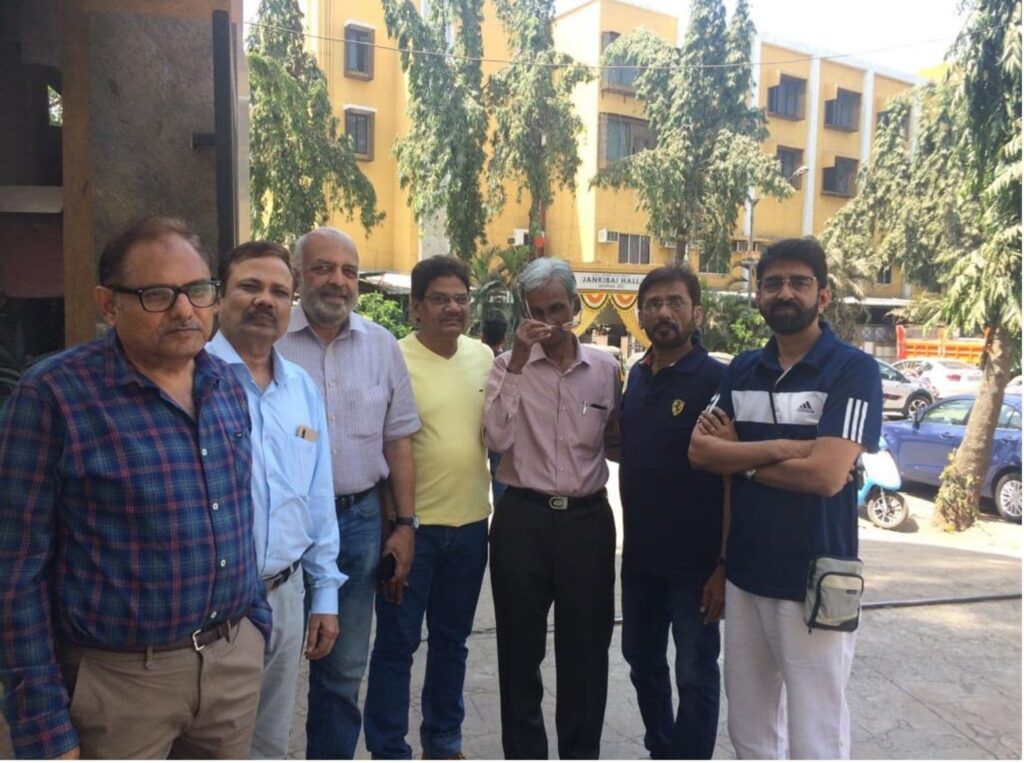
Eventually, the nomadic life of an RMO gave way to the stability of a General Practitioner. He chose Chembur as his anchor—specifically the Old Barracks area—where he established both his practice and his home. In a city that often feels impersonal, the neighborhood GP remains the last vestige of the “family friend” doctor, a role Dhulip has inhabited with grace for decades.
Domestic Rhythms in Chembur
Today, life at “T-42/6” is a picture of suburban contentment. Dhulip shares his life with his wife, Saraswati, a schoolteacher who has spent her career shaping minds while he tended to bodies. Their son, Sohal, born in 1990, represents the new Mumbai—a graduate of the University of Mumbai and PVG College of Science and Technology, now working as a Quality Assurance Analyst at Capgemini.
Dhulip’s journey from the son of a famous criminal lawyer in Amravati to a respected healer in Mumbai’s Chembur Camp is a classic narrative of the GMC73 batch. It is a story of migration, adaptation, and the quiet satisfaction of a job well done. He may have left the courtrooms of his father behind, but in the crowded barracks of Chembur, Dr. Dhulip Tajne has built a legacy that is entirely his own.