In the early 1970s, long before the digital age reduced music to a stream of invisible data, the quality of a man was often measured by the weight of his music system. In the rooms of GMC Nagpur, Chandramohan Singh Hajari—known simply as Hajari—was a man of high fidelity. He owned systems from HMV, Sonodyne, and Bosch, equipment that represented a specific kind of modern, technological aspiration. But Hajari’s true passion was for a different kind of high-fidelity data: the “Science of Signs.” He realized early in his residency that while machines could play music, only a human could interpret the silent, subtle signals of a sick child.
The Engineer’s Luck
Hajari was born in Nanded, the son of a high-ranking state government official. His father, Manmohan Singh, was a registrar of co-operative societies whose work took the family across the map of Maharashtra—from the primary schools of Patur to the high schools of Akola. Like many of the class of 1973, Hajari’s entry into medicine was an act of maternal will. He had secured 100% marks in mathematics and was fascinated by the logic of buildings; he longed to be an engineer. But his mother was a formidable force of professional nature; she managed to turn four out of her five children into doctors.
He arrived at GMC Nagpur in 1973, a year that would define the rest of his life. He lived in a bungalow in Dhantoli with a Ranji trophy player before moving into a room at the Kamla Choudhary nursing home. This distance from the central hostel did not diminish his presence; his music systems and his enthusiasm made him a central figure in the batch’s social fabric. After graduation, he interned at the Rural Health Center in Saoner, a site of communal immersion where the theoretical world of the classroom met the practical grit of the village.
Hajari obtained his MD in Pediatrics in 1981, writing a thesis on the changing trends in sickle cell anemia and thalassemia. It was a period of professional crossroads. In the early 1980s, the Indian medical system was beginning its long, slow tilt toward specialization. Hajari was offered a path into DM Cardiology—a “heroic” specialty that promised higher prestige and higher fees. He refused.
I loved the “Science of Signs.” Pediatricians need to wear many hats. You need to be empathetic, perceptive, and endlessly patient. I thought that I fitted the bill. During my residency, I had already discovered that Pediatrics was my calling.
The Sentinel of Andheri
Hajari’s career reflects the historical sweep of the generational shift in Indian medicine—from the secure, public service of the Employee’s State Insurance Scheme (ESIS) to the risky, high-pressure world of private practice. He served as a Class I Pediatrician in the government system until 2013, but his primary legacy was built in his 30-bed private facilities in Andheri.
In the 1990s, he built a Neonatal Intensive Care Unit (NICU) that became a landmark of care in Mumbai. But the NICU is a jealous mistress. For two decades, Hajari lived a life of “nonstop” work, often coming home after three or four days in the unit. The central tension of his life was the conflict between the “Science of Signs” and the demands of the soul. In 2004, his wife, Nita—a pathologist—died a sudden cardiac death. The loss forced a radical realignment. Realizing that the profession was “getting the better” of him, he closed the NICU to spend more time with his daughters.
This decision was a quiet rebuke to the corporate trend of “leveraging” every available hour for profit. Hajari understood that a doctor’s first duty is to his own family’s health. He pivoted his focus to mentoring, teaching nearly a hundred students from the USA, Canada, and Brazil who traveled to Mumbai to learn the infectious disease skills that only a clinician in India can provide.
The Midnight Custodian of the Batch
The GMC Nagpur 1973 WhatsApp group came into being in 2016, but it acquired shape, rhythm, and continuity only after Hajari took active charge two years later as its chief coordinator. Since then, he has quietly held together nearly 130 batchmates scattered across cities, countries, professions, illnesses, retirements, and memories. Every night, often close to midnight, Hajari posts birthday greetings unfailingly—a ritual he has maintained tirelessly for the last eight years without missing a single classmate’s birthday. The greeting is usually followed by a cascade of responses from across the world, briefly animating the group into a shared virtual common room.
Like most WhatsApp groups of aging classmates, many members remain silent observers, while the more active participants often circulate forwarded videos, jokes, cartoons, and recycled messages that have already travelled widely through the digital world. Yet beneath this seemingly ordinary chatter lies something deeper. For a generation now past seventy, the group has become a modest but steady source of companionship, passive entertainment, shared concern, and unexpected nostalgia. Every now and then, an old photograph, a memory from the 1970s, news of an illness, a bereavement, or an achievement surfaces—momentarily collapsing the distance of five decades and bringing the old GMC corridors alive again.
Private practice is extremely hard now. The parents have a lot of expectations—one needs to be punctual, committed, alert, and ever-responsive. Should an adverse event occur, one needs to be prepared for ruthless attacks from the media and local politicians who fail to understand that doctors are also human beings.
Hajari completes the circle that began with his Sonodyne music systems. He is still a man of high fidelity—faithful to his friends, faithful to the memory of his wife, and faithful to the children he heals. He is the engineer who didn’t build bridges of steel, but instead built a bridge of empathy that spans the distance from a Nanded childhood to a global medical community. He remains the boy who got 100% in Math, now applying that same precision to the complex, human equation of healing.
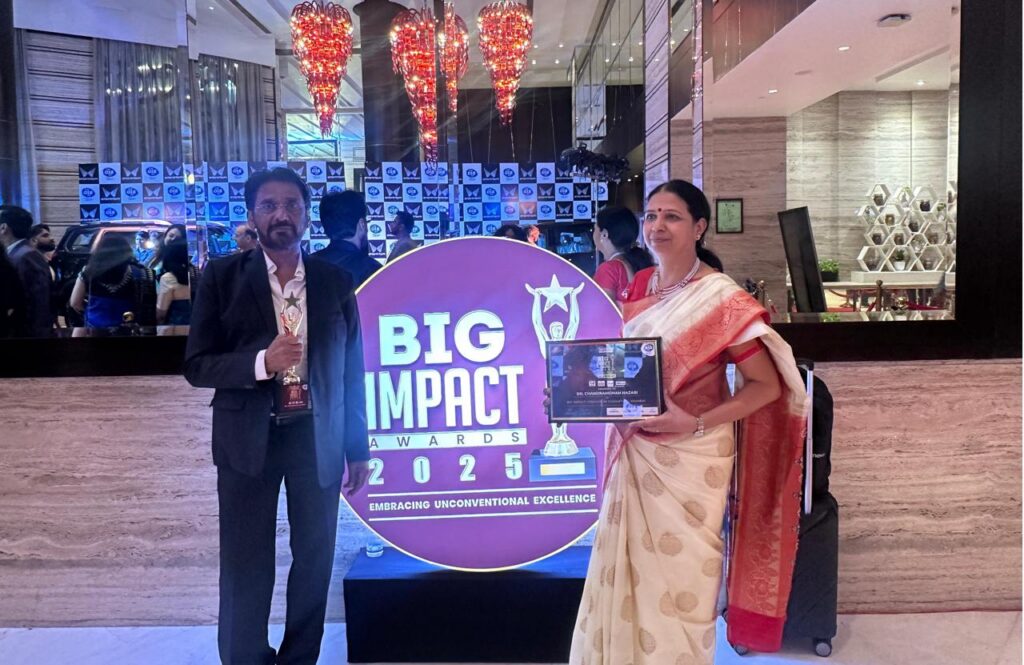
Over the last three decades, I have derived as much satisfaction from mentoring younger colleagues as from practicing medicine itself. That journey received an unexpected recognition earlier this year, when I was presented the Big Impact Lifetime Achievement Award 2025 by 92.7 BIG FM at the Taj Santacruz, Mumbai, on 25 February 2025.
The award recognised what they described as “unconventional excellence,” and I happened to be the only pediatrician from Mumbai among the eight doctors honoured nationally. The event was a grand one, attended by personalities such as Bobby Deol, Dia Mirza, and Amruta Fadnavis. Yet, for me, the deeper meaning of the award lay elsewhere—not in the stage or ceremony, but in the relationships and trust built over a lifetime in medicine.
Since the 1980s, I have had the privilege of helping more than twenty-five young consultants establish themselves in practice. I always tried to support them without burdening them with expectations, obligations, or financial pressures.
Watching these young doctors gradually find confidence, independence, and their own place in the profession has been among the most fulfilling experiences of my career. For a pediatrician, perhaps there is no greater satisfaction than knowing that the next generation is ready—and “fit to fly.”