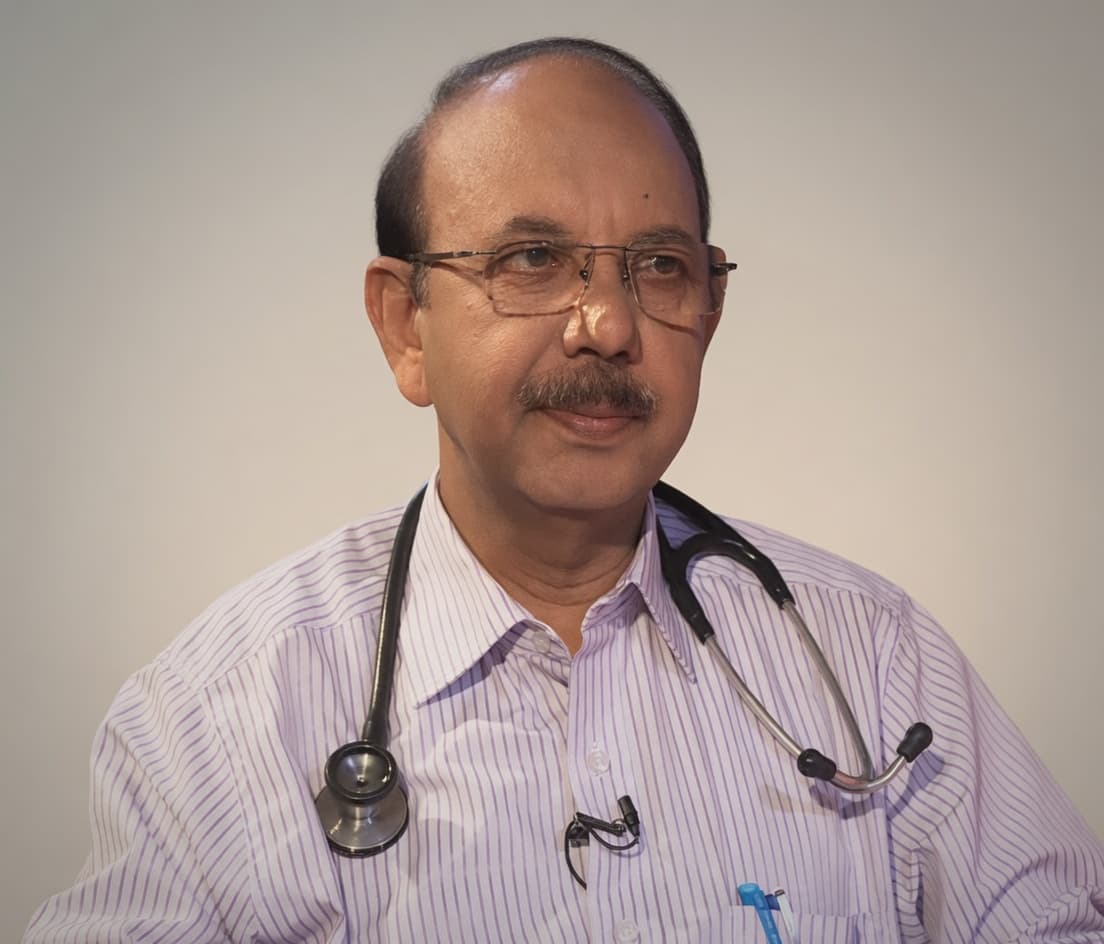
On 17 September 2017, a journalist from Nedrick News sat across from the Additional Director General of Health Services and asked him to defend the often-maligned machinery of India’s public teaching hospitals. Adesh Gadpayle did not hesitate. He spoke of Dr. Ram Manohar Lohia (RML) Hospital’s emergency control rooms, its overflowing dengue wards, and its grievance cells. He championed a “face-to-face and paper-to-paper” approach—a rare philosophy in an increasingly digital world.
By then, Adesh was the personal physician to a former President and a former Prime Minister, having climbed every rung of the Central Health Services (CHS) over thirty-five years. The distance from his first posting in Silvassa in 1983 to the top grade of the service in 2016 was more than a career trajectory; it was a testament to what was possible for a boy from a tiny village in Bhandara who arrived in Nagpur at sixteen with nothing but a merit rank and a desperate hope.
A Name to Cheat Death
Before he was the Additional Director General, he was “Adku.” Born on 15 March 1955 in Khandala—a village of fewer than a thousand people—his arrival followed a string of tragedies. His mother, Sarjabai, had lost four children before him. In the mid-1950s, in rural Bhandara, infant mortality was a ghost that haunted every doorstep. A village elder, steeped in folk wisdom, suggested that the only way this male child would survive was to give him a name so “unpleasant” that death would lose interest.
But “Adku” was born with a brilliance that no superstition could hide. At the Zilla Parishad Primary School, his headmaster, Shri Parvate Guruji, recognized a rare talent. He personally took the boy to the fourth-standard board exams at the taluka place, where Adku stood first in the entire Sakoli block. Neighbors who once pitied the poor farmer Kisanji now flocked to his house to congratulate him. Education, however, was an expensive dream. When it came time for higher studies in Nagpur, his father—facing the crushing weight of poverty and the lack of local facilities—decided the journey had to end. The farm needed hands, and the family coffers were empty.
The Two-Acre Sacrifice and the Nagpur “Exile”
The intervention that saved Adesh’s career came from his teachers at SES High School Sakoli. They traveled to Khandala and found the young merit-lister in the fields, hands on a plough, tilling the family farm. They pleaded with Kisanji, accusing him of destroying a future that belonged to the nation.
Moved by their conviction, Kisanji made a radical choice: he sold two acres of land for 800 rupees to fund his son’s move to Nagpur. In 1971, the two traveled to the city—the bus fare was exactly five rupees. Adesh found a spot at the Sant Chokhamela Hostel near Deekshabhoomi, sharing a long-abandoned, dusty room with two other poor but ambitious students, Ganesh Ramteke and Kailash Ramteke. The room was so filthy that the warden, Shri Atey Sir, looked on with visible helplessness until the boys spent days scrubbing it into a habitable space. It was from this humble, shared sanctuary that he entered the Institute of Science and, eventually, the 1973 “Maitry” batch of Government Medical College (GMC) Nagpur.
The GMC Years: A Quiet Ambition
At GMC Nagpur, Adesh was defined by a quiet, rhythmic application to his studies. While the city offered distractions, Adesh, Ganesh, and Kailash remained a tight-knit trio, anchored by their shared background of rural struggle. He was not a student who sought the spotlight of college politics or cultural festivals; instead, he was found in the wards, meticulously noting clinical signs.
He completed his MD in Medicine under the guidance of Dr. Ramesh Salkar, focusing his thesis on the clinical profile of rheumatic heart disease in pregnancy—a condition that disproportionately affected the rural poor he knew so well. By 1982, he had cleared the UPSC examination, a grueling hurdle that opened the doors to the Central Health Services.
From Silvassa to the Capital
His entry into the Central Health Services in 1983 took him to Silvassa in the Union Territory of Dadra and Nagar Haveli. It was a “sea change” long before the term became fashionable. At twenty-six, he was the Medical Specialist Grade II, responsible for a population that had little access to advanced care. He was six hundred kilometers from his roots, navigating a system that was slow, hierarchical, and intensely demanding.
In Silvassa, he learned the true meaning of public health administration—working with limited resources to provide care for tribal communities. This period of “exile” from the familiar streets of Nagpur tempered his resolve. He moved methodically through the grades: a transfer back to Nagpur under the CGHS in 1989 allowed him a brief period of proximity to home, but the pull of the capital was inevitable. In 1994, he arrived at New Delhi’s Ram Manohar Lohia (RML) Hospital, an institution that stands at the very heart of the Indian medical and political establishment.
The Architecture of Public Trust
At RML, Adesh’s career reached its zenith. Over two decades, he ascended to become a Professor, Head of Medicine, and eventually the Director and Medical Superintendent of PGIMER. His role was a delicate balancing act: managing one of the busiest emergency departments in the country while catering to the specific needs of the nation’s political elite.
As the personal physician to President Pratibha Tai Patil and Prime Minister Chandra Shekhar, he provided clinical stability to the nation’s leaders. Yet, he never lost his village-born empathy. He was known for walking the dengue wards during outbreaks, ensuring that the “grievance cell” wasn’t just a bureaucratic checkbox but a place where a poor patient from Bihar or Uttar Pradesh could actually be heard. He championed the “paper-to-paper” approach—ensuring that in the rush for modernization, the human element of medicine and the physical record of care were never lost.
A Legacy of Continuous Service
Adesh’s expertise was backed by a relentless pursuit of knowledge. He accumulated a suite of qualifications—including an MA in Public Administration, a Diploma in Health Management, and an MBA in Healthcare—to better navigate the complex machinery of state medicine. He understood that to save a public hospital, one had to understand the law and the ledger as well as the stethoscope.
Even after “retiring” from the government in March 2020, Adesh refused to slow down. He spent six years shaping the medical school at Sharda University in Greater Noida, mentoring a new generation of doctors who would never know the struggle of a five-rupee bus fare. Today, as of early 2026, he continues to lead as the Director of Medicine and Medical Superintendent at Mahanandan Superspeciality Hospital in Greater Noida.
The Son of Khandala
The boy who was named “Adku” to survive now oversees the health of thousands in the National Capital Region. His personal life remains his anchor. Married to Asha since 1986, he has watched his daughters find their own success: Kritika, a PhD in Environmental Science working with the CII, and Ruchika, an engineer and MBA leading teams at Reliance/Jio.
Dr. Adesh Gadpayle’s life is a reminder that in the 1973 batch of GMC Nagpur, merit wasn’t just a rank—it was a way out. From the ploughing fields of Bhandara to the Additional Director General’s office in New Delhi, he has navigated the transformation of Indian medicine with the same steady hand that once held the reins of his father’s oxen. He remains a man of the system who never forgot the village that almost didn’t let him leave