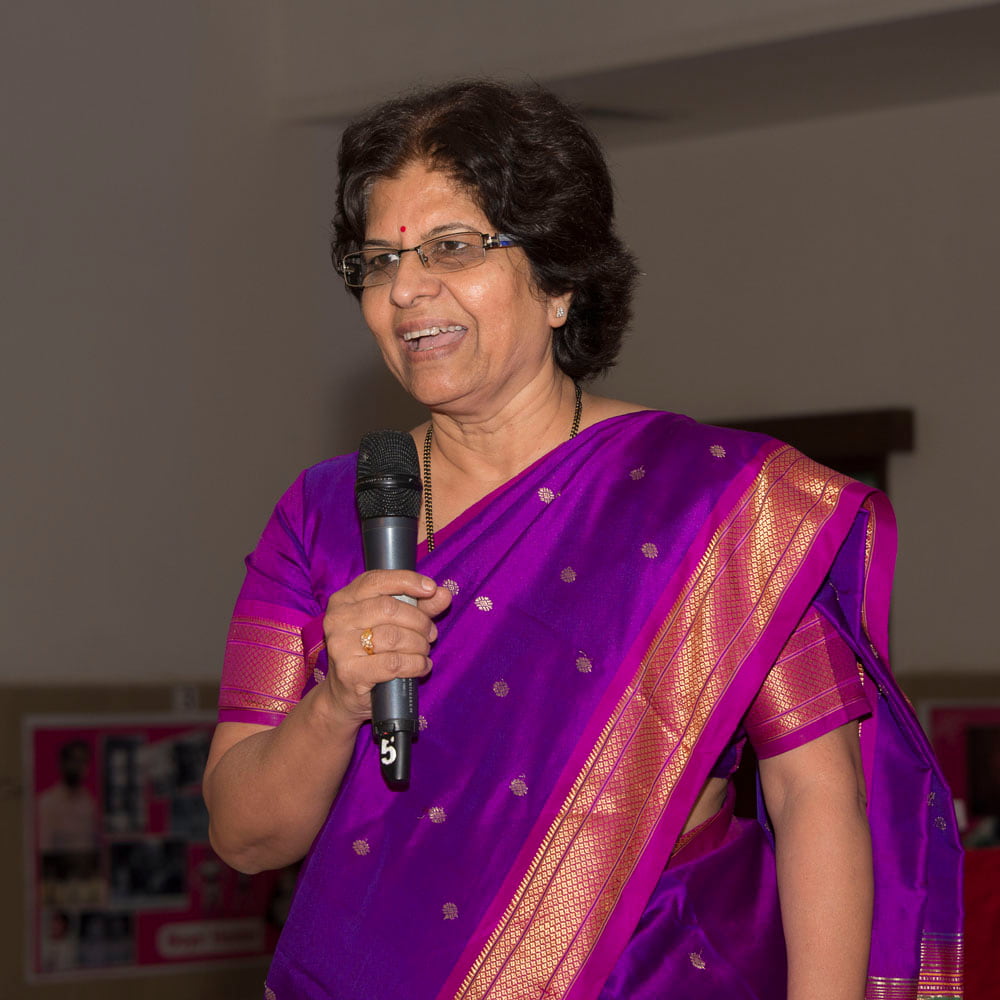
In 1985, an MS (General Surgery) seat unexpectedly became available at Government Medical College, Nagpur. Alka Naik did not hesitate.
She was twenty-nine. She had a husband, a three-year-old son and a settled practice in Bhusawal as an anaesthesiologist. Most doctors in her position would have stayed where life was comfortable.
Alka packed her bags and returned to medical college.
She had spent five years putting other surgeons’ patients to sleep. Now she wanted to hold the scalpel herself.
Growing up in a family that valued learning
Alka Moreshwar Desai grew up in Nagpur in a family where education was expected rather than admired.
Her father served as a Divisional Engineer in the Telegraph Department. Her mother taught English at the Physical Education Training School. Medicine also ran through the wider family. Her grandfather had been a respected physician of the old school. One aunt became an MRCOG-qualified obstetrician and gynaecologist in England. Her elder brother Srinivas later settled in the United Kingdom and remained a constant source of encouragement throughout her career.
She attended Mount Carmel School until Class VII before moving to Somalwar High School. For her pre-medical studies she joined Shri Mathuradas Mohota College of Science, which produced an extraordinary number of students who entered the 1973 GMC batch. Among them were Harshvardhan Sheorey, Vilas Tambe, Siddhartha Kumar Biswas, Arvind Dani, Rajshree Chaturvedi, Hari Paranjape, Uday Kanhere, C. L. Sonkusare, Sujata Sawangikar, Madhukar Parchand, Surendra Bhandarkar—and Alka herself.
At Government Medical College she was as visible on the badminton court as in the classroom, representing the college in the All-India Inter-Medical tournaments for three consecutive years.
After graduation she completed her internship at the Rural Health Centre, Saoner, where she belonged to the memorable “Famous Five”—Vijaya Vithalkar, Rajshree Chaturvedi, Sujata Sawangikar, Alison Girling and Ratna Shekhawat.
She then entered postgraduate training in Anaesthesiology, earning her Diploma in Anaesthesia in 1980.
Marriage, Bhusawal and a change of direction
Alka married Dr Pradeep Naik on 5 July 1979.
Pradeep had returned to his hometown of Bhusawal to establish an Obstetrics and Gynaecology practice. Neither inherited a hospital nor stepped into an established medical practice. They started with little more than professional training, youthful optimism and long working hours.
For the next five years Alka worked as an anaesthesiologist, including an appointment with the Central Railway Hospital. She became the doctor every surgeon wanted beside the operating table—calm, dependable and technically skilled.
Yet something remained unfinished.
She later summed it up in one unforgettable sentence.
“I always wanted to be a surgeon and grew tired of being behind the wickets.”
The metaphor is perfect. The anaesthesiologist protects life while the surgeon performs the visible act. Alka wanted to move from supporting the operation to leading it.
When an MS (General Surgery) seat became available at GMC Nagpur in 1985, she returned as a postgraduate student under Professor K. D. Golhar. Her dissertation dealt with acute abdomen in children, demanding both sound surgical judgement and an understanding of paediatric physiology.
She completed her MS in 1986.
Becoming the first woman general surgeon in Khandesh
Returning to Bhusawal with an MS degree was only the beginning.
In the mid-1980s, very few patients in small-town Maharashtra expected a woman to perform major surgery. Confidence had to be earned one operation at a time.
Alka did exactly that.
Over the years she became recognised as the first woman qualified general surgeon in the Khandesh region.
Her husband later wrote that she had quietly postponed her own ambitions for years before finally pursuing surgery, and once she became a surgeon she transformed not only her own career but also the future of their hospital.
Building a hospital together
The Naiks gradually built a twenty-bed hospital that combined general surgery with obstetrics and gynaecology, allowing patients from Bhusawal and neighbouring villages to receive comprehensive care close to home.
In 1998 they established the region’s first infertility centre and performed its first successful IVF treatment the same year.
For many couples in Khandesh this meant that parenthood no longer required repeated journeys to Pune or Mumbai.
Not every venture succeeded. Together with eight colleagues they attempted to establish an intensive care unit, but the project eventually closed. Small-town medicine constantly tests the boundary between clinical need and economic reality. Alka accepted both success and disappointment with equal composure.
Throughout these years she continued working wherever patients needed her—as an anaesthesiologist, general surgeon, clinical director, intensive care physician and partner in expanding the hospital’s services. She stood beside Pradeep as they introduced laparoscopy, ultrasonography, microsurgery and assisted reproductive technology to their town. Training took them to Belgium and Singapore, while support from her brother Srinivas in the United Kingdom helped them during crucial phases of their professional growth.
Home
Their son Anand, born in 1982, became a mechanical engineer and settled in the United States.
Their daughter Harshada, born in 1987, earned a Master’s degree in Medical and Psychiatric Social Work and now lives in Toronto with her husband Ambarish and their children, Aari and Riyan.
Pradeep often says that while both parents spent countless nights answering emergency calls, Alka made sure the children never lacked direction, discipline or encouragement.
Forty-seven years together
On their forty-seventh wedding anniversary in July 2026, Pradeep reflected on nearly five decades of shared work and shared purpose.
He remembered the young woman he first met on the terrace of her family home—a convent-educated badminton player whose fluent English impressed his entirely Marathi-speaking family. He remembered her willingness to leave behind a successful anaesthesia career, return to training and become the first woman surgeon in Khandesh. More than anything, he remembered her unwavering partnership.
“Every important decision we took,” he wrote, “she stood beside me.”
Their marriage was never separated from their profession. They built the hospital together, learnt new techniques together, travelled abroad to acquire new skills together and cared for generations of patients together. Their life unfolded through midnight emergencies, difficult operations, financial risks, new beginnings and quiet perseverance.
What she built
When Alka entered Government Medical College in 1973, surgery was still widely regarded as a man’s domain. Women were expected to choose what were considered the “softer” specialties—paediatrics, obstetrics and gynaecology, pathology or anaesthesiology. General surgery, like orthopaedics, belonged to the male bastion. Few women crossed that invisible line.
Alka was not alone in doing so. Our own classmate Shobha Dami chose orthopaedics at a time when her decision was met with raised eyebrows and quiet scepticism. Patients wondered whether a woman could handle broken bones. Colleagues questioned whether she could cope with the physical demands of the specialty. Like Alka, Shobha did not answer those doubts with arguments. She answered them with years of competent work.
Neither woman set out to make a statement. They simply chose the specialty they loved, persevered when others expected them to retreat, and quietly widened the path for the women who followed.
Today, the hospital that Alka and Pradeep built continues to serve Bhusawal. The infertility centre still offers hope to couples who once had nowhere nearby to turn.
Alka no longer stands behind the wickets. She walks into the operating theatre as the surgeon.
These days, however, the operating theatre shares her time with airports and grandchildren. Between India, Canada and the United States, she divides her year among patients, family and three generations. The scalpel is still part of her life, but so are Aari and Riyan’s laughter, visits to Anand in America, and the quieter pleasures that follow four decades in medicine.