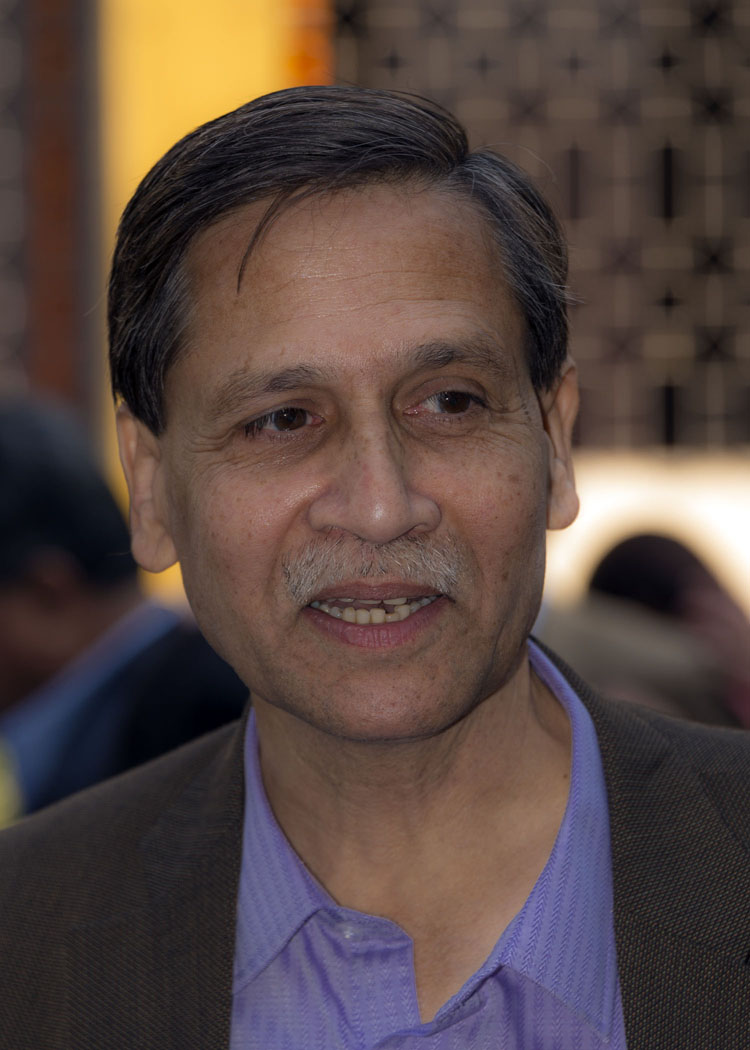
The thesis Rajendra Phadke wrote for his MD in Radiology was on the two-bath development of X-ray film. It was 1982. The technology that would eventually make that thesis a historical curiosity — digital imaging, PACS systems, interventional radiology guided by real-time fluoroscopy — was still years away. Rajendra saw it coming, moved toward it, and spent the next four decades at its leading edge.
He has published 132 research papers. They have been cited 1,424 times.
A Childhood of Transfers
Rajendra was born in Pune into a family shaped by the rhythms of government service. His father worked in the Public Works Department and moved, as the rules required, every two years. Solapur, Aurangabad, Wardha, Bhandara, Nagpur — Rajendra attended schools in each. By the time he arrived at the Institute of Science, Nagpur for his premedical year, he had learned to settle quickly into new places and to leave without much ceremony.
During his first year at GMC Nagpur he shared accommodation with Abhimanyu Niswade at Dharaskar building, Ramdaspeth. He played cricket — bowling medium fast, opening the batting — and interned with Sanjay Gadre and Sanjeev Chandorkar at Deolapar. After graduation he did house jobs in Surgery and Radiology at GMC, and the radiology posting held him. He obtained his Diploma in Radiology in 1981, his MD in 1982. His guide, Dr. V.P. Bhutada, supervised the film development thesis. Nobody was embarrassed by the subject. Radiology in India then meant exactly that — dark rooms, chemical baths, and the discipline of reading shadows on film.
The Long Innings at Lucknow
In 1987, Rajendra completed a post-MD certificate in interventional radiology — a specialty that barely existed in India at the time. Two years later, he joined Sanjay Gandhi Postgraduate Institute of Medical Sciences in Lucknow, one of the country’s most respected postgraduate hospitals. He rose to Professor and Head of Radiodiagnosis in 2002, a position he held until his retirement in 2018.
In 1996 he took a fellowship in neuro-intervention at Perth, Australia. In 2006 he spent a year in Preston, Manchester as a Consultant Neuro-interventional Radiologist. He obtained a further fellowship in interventional radiology through the British Council and Commonwealth Universities — all of it in the service of a specialty that requires not just reading images but acting on them: placing stents, embolising aneurysms, threading catheters through vessels no wider than a knitting needle.
Neuro-intervention is a discipline that combines the fine-motor demands of microsurgery with the interpretive burden of radiology. Very few Indian radiologists have pursued it at the level Rajendra did. That he did so from a government institution, without the financial incentives available in the private sector, says something about what drew him there.
He has invited to teach and lecture at conferences across India, at centres in Australia, Singapore, and the United Kingdom, and has served as reviewer for international radiology journals. His son Satyajit — a materials scientist at an energy consultancy in Pune, trained at IIT Roorkee and the University of Florida — represents the generation that followed a different path, equally demanding.
After the Institute
Rajendra retired from SGPGI in 2018. He joined Apollo Hospital in Lucknow as an interventional radiologist — not as a retreat into comfort, but because the work still held him. His wife Shubha, also a GMC Nagpur graduate (1977 batch), is Professor and Head of Medical Genetics at SGPGI. Her research has brought the institution international recognition; in August 2017, she published a landmark multicentre randomised controlled trial in The Lancet on labour induction methods, followed by a second Lancet publication in August 2019 on the management of severe hypertension in pregnancy. The couple have spent their professional lives in the same institution, each building something of lasting value.
“I am fortunate to be able to work in the field of invasive radiology,” Rajendra said when asked to reflect on the career. “There is also a lot of autonomy in academic radiology, and I can control my time more flexibly around family commitments and hobbies. There are many opportunities to travel abroad combining academics with visiting places of tourist interest.”
He has taken those opportunities. The atlas of places he has visited — professionally, not merely as a tourist — reads like a map of where modern neuro-intervention was being made.
The Image That Persists
The X-ray film thesis is now a museum piece. The field moved on, and Rajendra moved with it — from dark rooms to catheter laboratories, from passive reading to active intervention, from Nagpur to Lucknow to Perth to Preston and back. The 132 papers and 1,424 citations are one measure. Another is the trainees who passed through his department at SGPGI, who now head their own units in hospitals across North India.
Radiology, he once observed, gives a clinician something unusual: autonomy over time, combined with the satisfaction of a procedure completed. The two-bath developer, the digital reconstruction, the wire navigating a cerebral aneurysm — all are variations on the same act. You look carefully at something invisible to others, and then you do something about it.