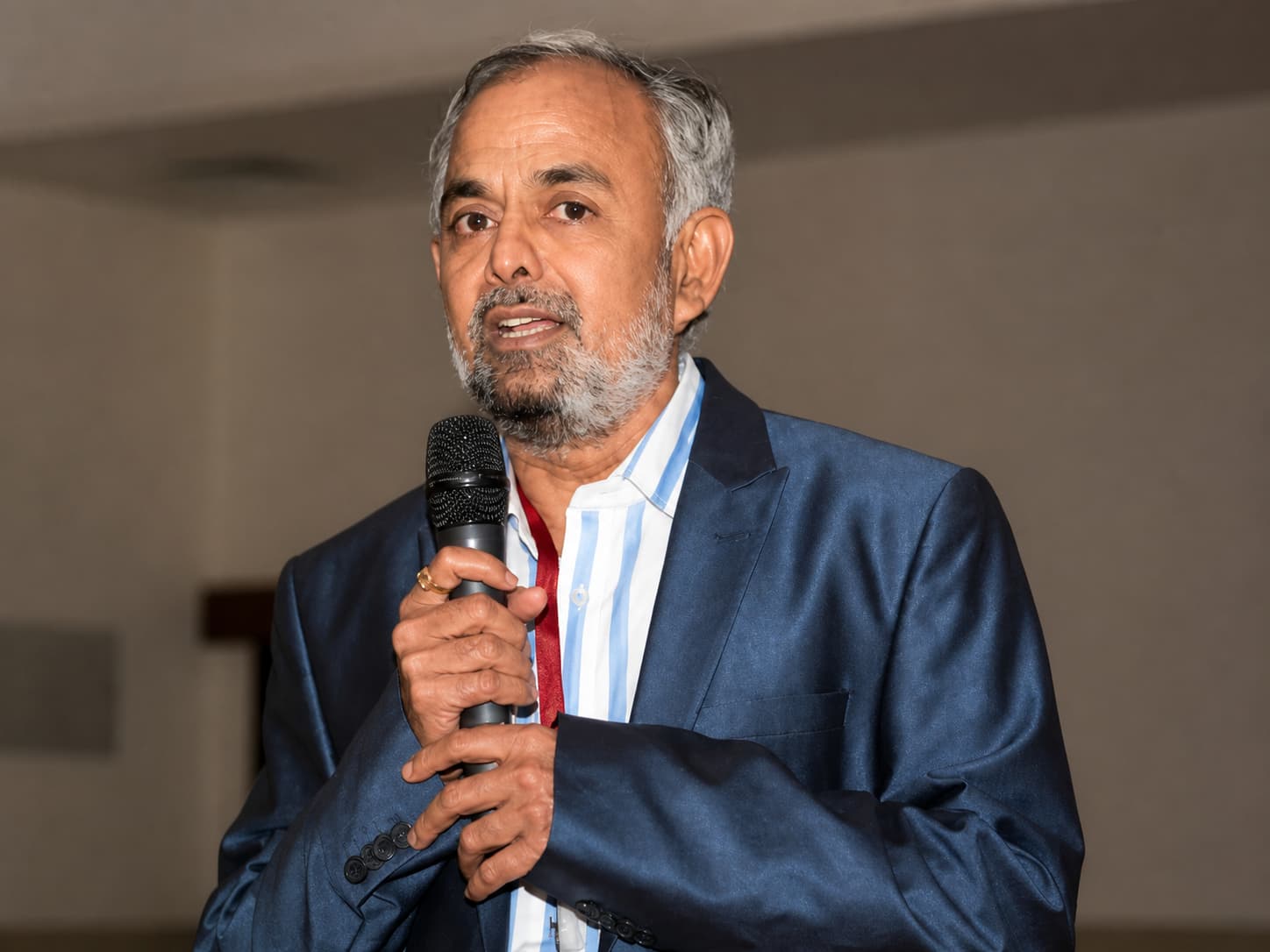
The Mother
Before he became a professor of community medicine, before the decades of government postings across half of Maharashtra, before the long arc from Yavatmal to Nagpur to Guntur and back again, Nandkishor Kasturwar was the eighth of nine children in a farming family in Zhari Jamni, a village in the Wani subdivision of Yavatmal district. His father, Bhumanna, owned land but could not work it well. The weight of the household fell on his mother, Chandrabhagabai — illiterate, indefatigable, and unwilling to make allowances for difficulty.
“My mother ensured that we did not face any financial hardship,” Kasturwar said. “She dealt with all the chores at home, managed the farm, earned a living for the family — with a remarkable poise.” It is the kind of sentence that a man delivers simply, because the truth in it is so large it needs no decoration.
He carries that inheritance — stoic, undemonstrative, steady — through everything that followed.
The Long Road to Nagpur
Kasturwar’s schooling traced the geography of his family’s circumstances. Three local primary schools in Zhari Jamni, then a move to Ballarshah, where an elder brother had settled, and two schools there: Janata High School for the fifth and sixth standards, Thapar High School for the seventh through eleventh. For his premedical education, he went to Anand Niketan College, Warora — a mofussil college that, in 1973, managed to place nine students into the medical colleges of Nagpur. Five of them — Kasturwar, Suresh Batra, Rajendra Sarda, Anand Patil, and Nabatosh Biswas — found seats at Government Medical College, Nagpur.
At GMC, Kasturwar spent his first MBBS year at Shriram Dharmshala, sharing a room with Narayan Dongre, Nabatosh Biswas, and Ramvallabh Rathi. After passing the first MBBS examination, he moved into the boys’ hostel. He was among the few hostellers who owned a scooter — a Chetak, in the company of Vilas Tambe, Pramod Bangde, and O.D. Singhania.
The Chetak very nearly ended his career before it began. During his internship at the primary health centre at Balharshah, a vehicle struck him while he was riding pillion, and he broke his leg. Dr. Sudhir Babhulkar admitted him to his nursing home for a month and charged him nothing. Recovery took eight months. The accident changed his plans: though his marks in Surgery, Obstetrics and Gynaecology, and Paediatrics were strong enough for postgraduation in clinical subjects, he chose instead to sit for Preventive and Social Medicine. The disability had redirected him. It was, in the manner of the best redirections, permanent.
A Career in Public Health
Kasturwar obtained his MD in Community Medicine from GMC Nagpur in 1983. Supervised by Dr. Ingole, his thesis examined whether measles vaccination in rural preschool children improved their nutritional status — a question whose answer mattered for policy, not just for papers. He served briefly as a lecturer at GMC Nagpur, then began a peripatetic career through Maharashtra’s public health infrastructure: Urban Health Centre, Mumbai (1983); Nanded (1990); Yavatmal (1992–95); Nagpur and Saoner (from 1995). At Saoner, he inherited a rural health centre that had deteriorated — insufficient drugs, inadequate staffing, equipment in name only. He fixed it.
“Although the brick-and-mortar facility was set up decades ago,” he said, “it was insufficiently equipped with drugs and medical supplies and faced a shortage of trained doctors, nurses and paramedical staff. I tried to fix all these problems.” He did not elaborate on how. He rarely did.
He moved subsequently to Dhule, then GMC Yavatmal, before taking voluntary retirement in 2003. A brief private practice in his native village followed — with an X-ray facility — and then an impulse that speaks to the man’s particular restlessness: he moved to medical schools in Guntur and Karimnagar in Andhra Pradesh, and Bhavnagar in Gujarat, where he spent six years teaching community medicine before returning to Nagpur to join NKP Salve Institute of Medical Sciences from 2010 to 2017.
The trajectory is not one that a career counsellor would have designed. But it covered more of India than most physicians see, and it kept Kasturwar close to the populations he had entered community medicine to serve — the poor, the rural, the underserved.
“Every day I would see close to 100 patients,” he recalled of his village practice, “but then decided to sign off. I found it difficult to live all alone in a small village and began to feel lonely.” He tells this without self-pity. A man who grew up the eighth of nine siblings in a house his mother held together by will alone knows something about managing solitude that arrives uninvited.
The House Built in 1981
In 2017, Kasturwar retired formally. He returned to the house he had built in Nagpur in 1981 — a house he had left for postings and peripatetic appointments for most of the decades since. His wife, Rekha, holds an MA in Economics. Their son Nikhil is an advocate practising in the District and High Court of Nagpur; he is married to Vaishali, and they have two daughters, Rishika and Advika.
The career that the broken leg in Balharshah set in motion — forty years across Maharashtra, Andhra Pradesh, and Gujarat, through government hospitals, rural health centres, medical colleges, and tribal hamlets — has reached its end in the same city where it began. What remains is the house, the grandchildren, and the particular equanimity of a man who learned early that the world does not reorganise itself around anyone’s plans, and that this is not a reason to stop working.
Chandrabhagabai, his mother, would not have been surprised.