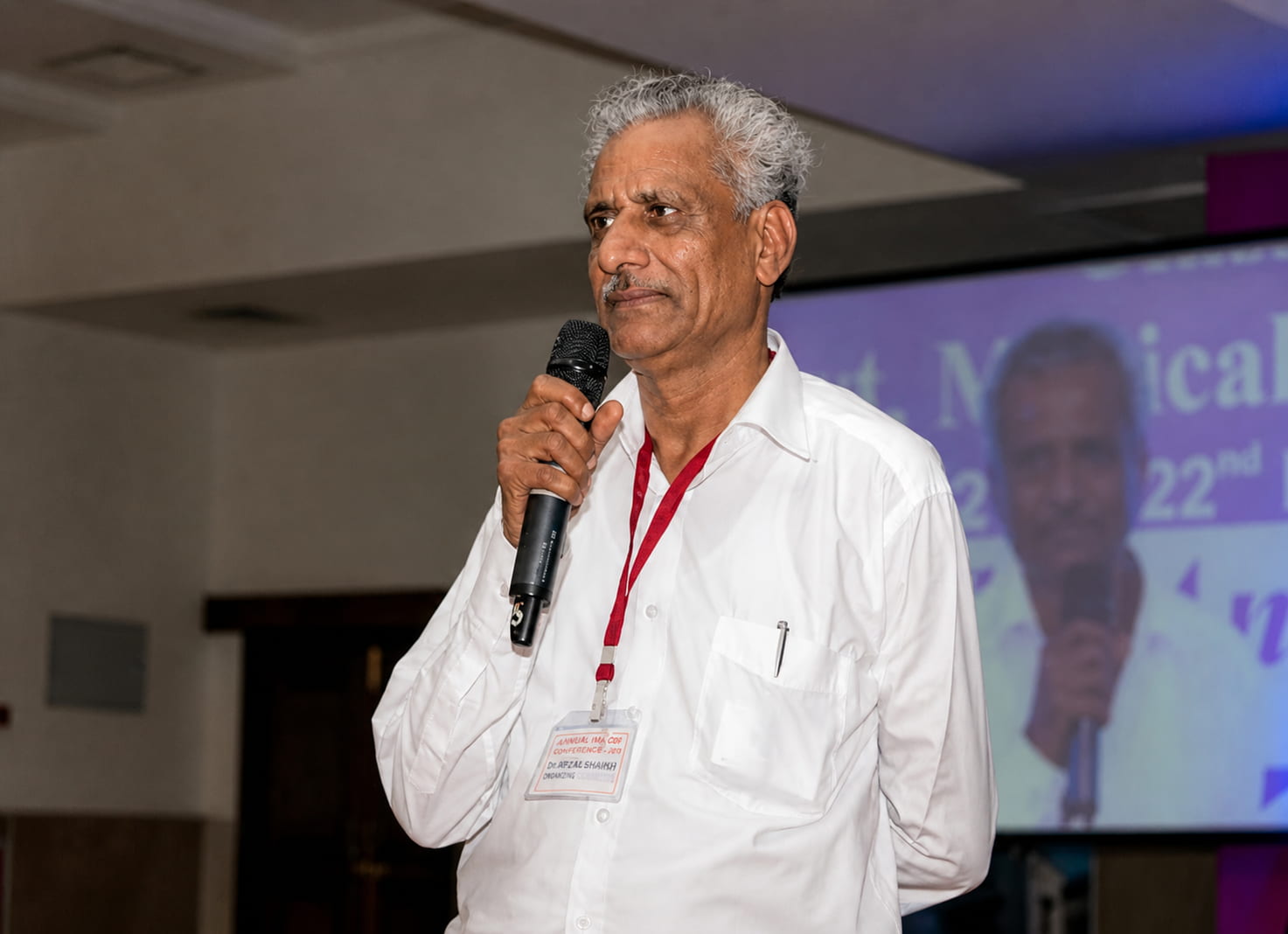
At night in the boys’ hostel at Government Medical College (GMC), Nagpur, the corridors would go quiet after dinner. Then, from somewhere in Hostel 2 or 3 or 4, a sound would rise — unhurried, clear, unmistakably a flute. The residents knew without asking. Raju Sarda had picked up his bansuri again. He played Pyar Hua Ikraar Hua and Chahunga Main Tujhe Saanjh Savere with a softness that stopped conversations mid-sentence. He was not, he would be the first to say, a professional. He was simply a man for whom bamboo and breath were sufficient to say what words could not.
Fifty years on, the flute has been put aside. But the quality it expressed — a preference for the inner life over the performed one — has not.
The Boy from Warora
Rajendra was born in Bhusawal, where his maternal grandfather lived, though his roots were in Warora, a town in Chandrapur district. He attended Netaji High School, Warora, and did his pre-medical education at Anand Niketan College, Warora — a mofussil institution that nonetheless sent five students to GMC Nagpur in 1973: Rajendra alongside Suresh Batra, Nandkishor Kasturwar, Anand Patil, and Nabatosh Biswas. The year of his admission, his parents migrated to Nagpur, the city that would become his permanent home.
His interest in the human mind had begun before medicine. He had read Acharya Rajneesh from his school days — drawn not to the guru’s controversies but to the underlying questions: why people behave as they do, what drives fear and longing, how consciousness shapes suffering. These were not questions that Medicine in its clinical sense could easily answer. But Psychiatry, he understood even then, came closest.
After graduating from GMC Nagpur, Rajendra completed his internship at a primary health centre in Parseoni alongside Deepak Bahekar, Satyanarayan Rathi, and Prakash Katariya, and his urban posting at Civil Hospital, Chandrapur. When the time came for postgraduation, he applied only to MD (Psychiatry) at GS Medical College and KEM Hospital, Mumbai — no second choice, no fallback. He got in.
The Mind That Enamoured Him
At KEM Hospital, Mumbai, under Dr. NP Shah, Rajendra wrote his MD thesis on psychiatric morbidity among burn survivors — patients who had lived through an acute catastrophe and were now navigating its aftermath in the mind. It was exacting, affecting work. He completed his MD in 1981. Avinash Joshi and Laxmikant Rathi followed him a year later.
In 1982, Rajendra returned to Nagpur and established a practice at Gandhibaug. For close to two decades, he also worked as a visiting psychiatrist at hospitals across the city, once a week at each, helping institutions — and the communities around them — understand what psychiatry actually was and what it could do. In a city where mental illness was then spoken of in whispers, if at all, this was work that required patience of a particular kind.
The India that Rajendra Sarda entered as a young psychiatrist in 1982 offered the specialty almost no social support. The stigma was dense, the referrals few, and the public understanding of mental illness almost entirely folkloric. General physicians did not know when to refer. Families concealed illness for years before seeking help. Psychiatrists worked largely alone, without the collegial infrastructure that surrounds surgery or internal medicine. That Rajendra built a practice that endures four decades later — quiet, consistent, unhurried — says something about both his temperament and his faith in the work itself.
A Different Kind of Inheritance
His sons chose commerce and law rather than medicine — branches that, as Rajendra observed with characteristic dryness, seem to offer more recognition than the medical profession affords these days. Nakul is a financial adviser in Nagpur; Rahul is a lawyer at Bombay High Court, having qualified both as a CA and in law. His daughter-in-law Neha holds an MD in Pathology. The household is not without medicine — it has simply moved into the next generation at a remove.
His wife, Dr. Lata Taori, completed her MD in Pathology at GMC Nagpur (1977 batch) and has practiced as a pathologist throughout their shared life. Two doctors, two disciplines: one peering at tissue under the microscope, the other listening to minds unburden themselves across a consulting table. It is a conjunction that might have struck Rajendra’s Rajneesh-reading adolescent self as apt.
The bansuri is silent now. But there are still, one imagines, evenings in the Sarda household that carry the quality he once coaxed from bamboo: unhurried, interior, sufficient to themselves.